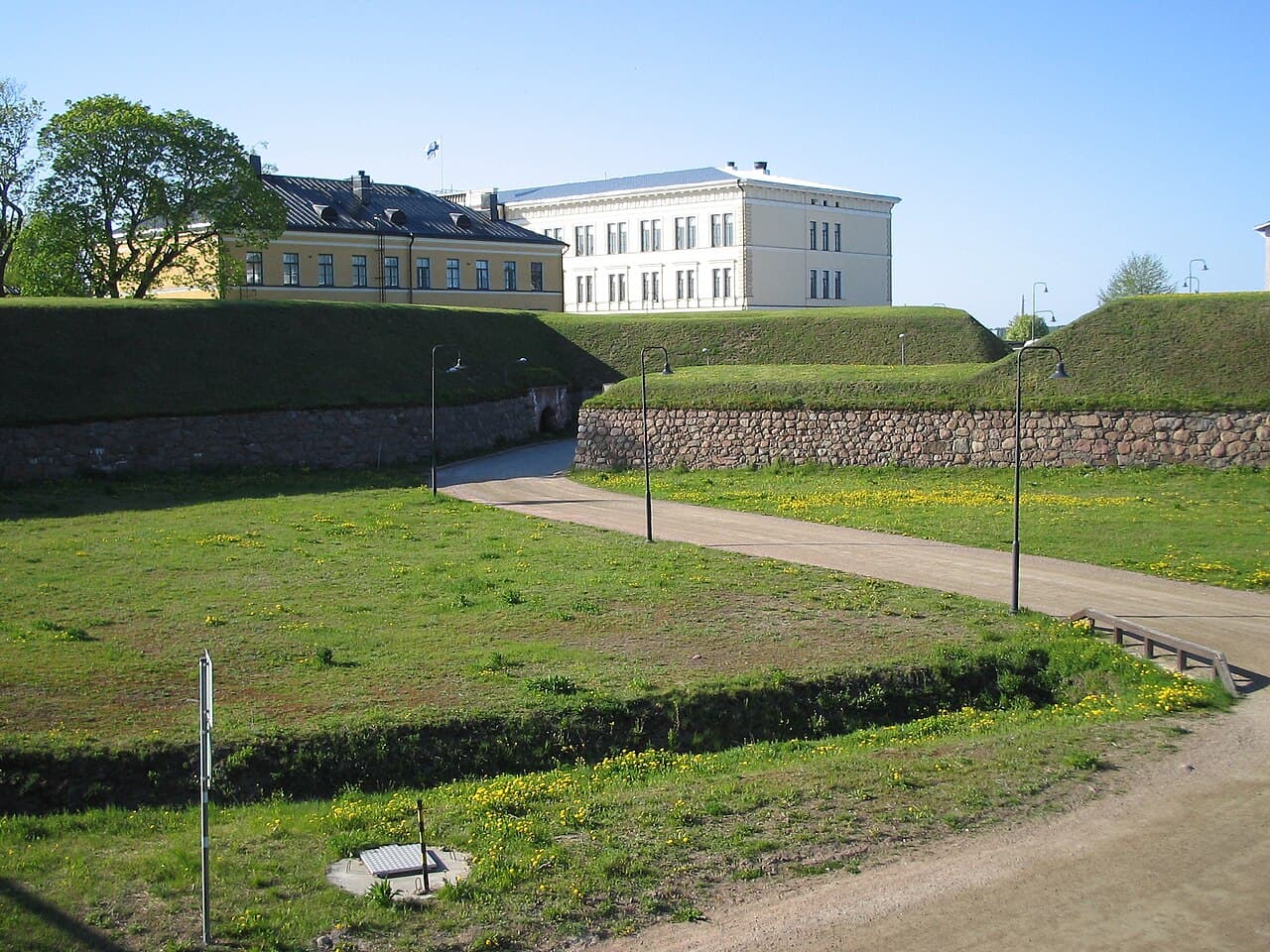
Hamina Fortress
Hamina fortress is a unique example of a bastioned fortress in Finland, notable for its rare circular layout inspired by Renaissance ideals of urban fortification. Constructed primarily in the 18th century following the Great Northern War, the fortress was built on the site of the former Vehkalahti town ruins. This strategic location near the Gulf of Finland made it a key military installation for controlling the coastal road and defending the region.
Origins and strategic significance
The fortress was initiated in the 1720s under the direction of Swedish general Axel von Löwen after the Treaty of Nystadt (1721) shifted the border between Sweden and Russia to the Kymeenlaakso area. The design reflects the Renaissance concept of an ideal fortified city, similar to the star-shaped city of Palmanova in Italy, but Hamina stands out as a rare circular fortification rather than a polygonal star shape. Its six bastions provided overlapping fields of fire, enhancing its defensive capabilities against artillery and infantry assaults.
Architectural design and features
Hamina fortress is classified as a bastioned fortress, a style that emerged in the post-Renaissance period to counter advances in siege artillery. Its circular plan is exceptionally rare among bastioned fortresses, which typically have polygonal or star-shaped layouts. The fortress comprises six bastions connected by thick curtain walls, surrounded by a defensive ditch. The bastions are angled to allow defenders to cover the walls with flanking fire, a hallmark of bastion fort design.
The fortress also includes several internal structures such as barracks, magazines, and command buildings arranged within the enclosed area. The layout integrates both military functionality and urban planning principles, reflecting the Renaissance ideal of harmony between form and function.
Historical developments and military role
During its construction, the fortress was incomplete when the Russo-Swedish War of 1741–1743 began. Russian forces captured the fortress, and the subsequent peace treaty placed it under Russian control. The fortress became part of the South-Eastern Finland fortification system, designed to protect the approaches to St. Petersburg from western threats.
Under Russian command, notably led by General Aleksander Suvorov, construction and improvements continued. In the early 19th century, the fortress underwent significant reconstruction under Dutch general Jan Pieter van Suchtelen to modernize its defenses. However, after Russia's conquest of Finland in the Finnish War (1808–1809), Hamina fortress lost its frontline military importance and was eventually abandoned as a fortress in the 1830s.
Later military use and decline
Despite losing military status, the fortress was reinforced again during the Crimean War (1853–1856) to defend against potential attacks from the British and French fleets. After this period, the fortress gradually fell into disuse. In the mid-20th century, restoration efforts began in 1957 to preserve the remaining structures.
Current status and cultural significance
Today, much of Hamina fortress remains well preserved, serving as a cultural venue for various events and festivals. Parts of the fortress are still in military use, notably housing the Finnish Reserve Officer School. The fortress is integrated into the urban fabric of Hamina city, making it a prominent historical landmark and tourist attraction.
The fortress's rare circular design and its embodiment of Renaissance military architecture principles make it an important site for understanding the evolution of fortification in Northern Europe. Its layers of history—from Swedish construction to Russian adaptation and modern restoration—reflect the complex geopolitical history of the region.
Architectural and urban planning legacy
Hamina fortress exemplifies the transition from medieval fortifications to modern bastioned designs, combining military engineering with urban planning ideals. Its circular layout was intended to optimize defense while also representing a harmonious and orderly city plan, a concept rooted in Renaissance humanism. This makes Hamina an exceptional case study in the history of military architecture.
The fortress's bastions, curtain walls, and ditches remain largely intact, allowing visitors to appreciate the sophisticated design and defensive strategies employed. The integration of military and civic functions within the fortress walls illustrates the dual role such structures played in early modern Europe.
Visiting Hamina fortress
Visitors to Hamina can explore the fortress's bastions, ramparts, and internal buildings. The site hosts cultural events, concerts, and reenactments that bring its history to life. The presence of the Reserve Officer School adds a living military dimension to the fortress, linking past and present.
Its location on the coast of the Gulf of Finland offers scenic views and a tangible connection to the strategic maritime routes that influenced its construction and use.
Frequently asked questions (FAQ)
- When was Hamina fortress built?
- Hamina fortress was constructed between 1720 and 1803, beginning under Swedish rule and completed under Russian control.
- What is unique about Hamina fortress's design?
- Hamina fortress is a rare circular bastioned fortress, reflecting Renaissance ideals of fortification and resembling the ideal city concept.
- Can I visit Hamina fortress today?
- Yes, Hamina fortress is well preserved and open to visitors. It hosts cultural events and includes parts still used by the Finnish Reserve Officer School.
- Why was Hamina fortress important historically?
- The fortress guarded the coastal road and served as a key defensive position between Sweden and Russia, especially after the Treaty of Nystadt.
- Is there military use of the fortress today?
- Yes, parts of Hamina fortress are still used by the Finnish Reserve Officer School, maintaining a military presence on site.
Photo gallery

Information
Sources & official resources
Verify the information above using these authoritative references.
Loading map...
Visitor reviews
No reviews yet. Been here? Write the first review and help other travelers!
Write the first reviewVisited this castle? Share your experience
Your review helps other travelers and adds first-hand knowledge to our encyclopedia.



