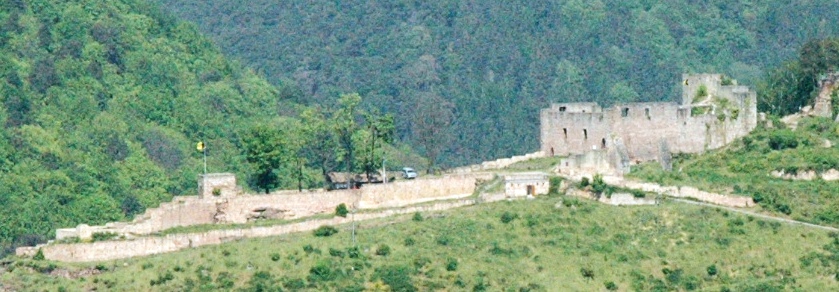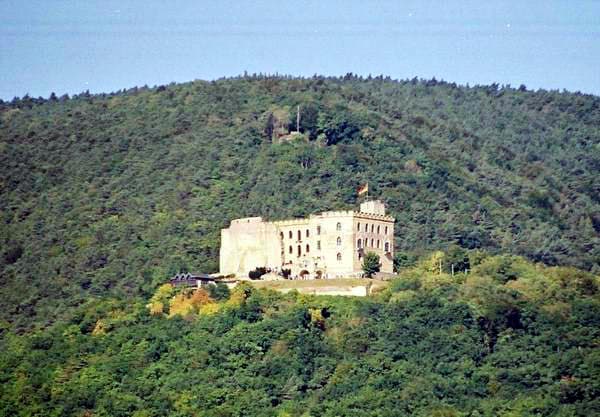
Hambach Castle
Hambach Castle, located in Neustadt an der Weinstraße, Germany, stands as a powerful symbol of the German democracy movement due to its association with the historic Hambacher Fest of 1832. This hill castle is perched atop the Schlossberg hill, offering commanding views over the Palatinate Forest and the German Wine Route. Its strategic location and rich history span from late Roman times through the High Medieval period and into the modern era, reflecting a complex architectural evolution that blends Romanesque, Renaissance, and neo-Gothic styles.
Archaeological evidence confirms that the site of Hambach Castle was used as early as the late Roman period. During the Carolingian and Ottonian dynasties, an early refuge castle was constructed here, with remnants still visible beneath and in front of the outer ring wall. The first documented ownership transfer occurred between 1090 and 1104 when Bishop Johann I of Speyer acquired the estate, including Hambach Castle, for the Bishopric of Speyer. The castle remained under ecclesiastical control until the late 18th century, serving as a residence and administrative center for the bishops of Speyer.
Medieval origins and episcopal significance
The castle's medieval construction was notably expanded during the 13th century, a period marked by significant building projects that shaped much of its surviving structure. In 1388, Bishop Nikolaus I was consecrated in the castle chapel, underscoring the site's religious importance. Further construction occurred in the late 14th and 15th centuries under bishops Nikolaus I and Matthias I, who also established the castle as the repository for the Episcopalian document archive by the end of the 14th century.
Throughout the Middle Ages, Hambach Castle functioned as both a defensive fortress and an administrative hub. It guarded vital trade routes and served as a toll collection point, reflecting its strategic significance. The castle's governance included notable figures such as Trushard von Kästenburg, who served as treasurer and held imperial offices in Italy during the late 12th century. The castle's importance declined after the early 15th century, particularly following the construction of the new estate at Hanhofen.
Destruction and decline in the early modern period
Hambach Castle endured significant turmoil during the 16th century. In 1525, during the German Peasants' War, it was occupied and looted by rebellious forces. Later, in 1552, the castle was conquered and burned by troops under Margrave Albrecht Alcibiades of Brandenburg, a mercenary leader known for his destructive campaigns. The devastation left the castle in ruins, and although Bishop Marquard of Speyer (in office 1560–1581) initiated a provisional restoration, the castle was repurposed as the seat of a forester rather than fully rebuilt.
The castle escaped damage during the Thirty Years' War but was again destroyed in 1688 during the War of the Palatine Succession by French forces. Partial restoration efforts took place between 1701 and 1703, but the castle largely remained a ruin. The French government declared the castle property in 1797, and following the Congress of Vienna in 1816, it became part of the Kingdom of Bavaria.
Symbol of democracy: the hambacher fest and 19th-century restoration
Hambach Castle gained enduring fame as the focal point of the Hambacher Fest in 1832, a six-day gathering of approximately 25,000 to 30,000 people advocating for German national unity, civil liberties, and democracy. The event was a direct response to the repressive measures imposed by the Bavarian administration, which had rescinded rights granted during the French Revolutionary period. This festival cemented the castle's legacy as a symbol of democratic aspirations in Germany and Europe.
In 1844, the ruined castle was granted to Crown Prince Maximilian II of Bavaria, who was affectionately nicknamed "Maxburg" in connection with the site. Architect August von Voit led a neo-Gothic restoration inspired by Hohenschwangau Castle, blending medieval elements with 19th-century romantic historicism. The reconstruction included the addition of pointed-arch windows, battlements with decorative merlons, and sandstone rustication on façades. However, the project was interrupted by the revolutions of 1848 and 1849, leaving parts of the castle incomplete for over a century.
20th-century preservation and modern adaptations
In 1969, ownership transferred to the district of Bad Dürkheim, and in 2002, the Stiftung Hambacher Schloss foundation assumed guardianship, supported by regional and federal authorities. Extensive restoration took place from 1980 to 1982 to commemorate the 150th anniversary of the Hambacher Fest, involving significant investment to restore structural integrity and install permanent exhibitions.
Further renovations between 2006 and 2008 enhanced accessibility, including the installation of an elevator to accommodate visitors with disabilities. Controversial features such as a wooden ceiling were removed to better preserve the historic fabric. From 2009 to 2011, Swiss architect Max Dudler designed a modern restaurant within the castle grounds. This facility, seating over 100 guests, integrates contemporary materials like cherry wood, sandstone, glass, and steel, harmonizing with the historic environment. Dudler's work earned the 2012 DAM Architecture Prize.
Architectural features and site description
Hambach Castle's architecture reflects its layered history. The main building is L-shaped and rises over 12 meters high. Its principal façade features three vertical rows of pointed-arch windows, including two semicircular openings set into niches supported by corbels—stone projections that likely supported a now-lost balcony. The façade is clad in sandstone rustication, a Renaissance masonry technique that gives a textured, block-like appearance. The battlements alternate between plain and cross-shaped merlons, combining defensive and decorative elements.
A prominent rises above the northern façade, flying the German national flag. Remnants of the original Romanesque curtain wall survive around the bastion, constructed using the opus incertum technique, which employs irregular stones arranged without precise uniformity for strength.
The castle chapel, dedicated to Archangel Michael, remains a significant historic feature. Rebuilt and reconsecrated in 1723 after earlier destruction, it suffered desecration during the French Revolution but continues to be an integral part of the castle complex.
Modern interventions include a discreet visitor entrance and the award-winning restaurant, which respect the castle’s historic character while providing contemporary amenities. Accessibility improvements ensure that Hambach Castle remains welcoming to a broad audience.
Cultural significance and current use
Today, Hambach Castle functions as both a museum and a conference center. It attracts approximately 200,000 visitors annually, hosting official events and dignitary visits, including a notable speech by U.S. President Ronald Reagan in 1985. The castle's designation with the European Heritage Label in 2015 recognizes its enduring role as a symbol of European unity and democratic ideals.
Hambach Castle's rich history, architectural evolution, and symbolic importance make it a unique cultural landmark in Germany. Its preservation and adaptive reuse demonstrate a successful balance between honoring the past and serving contemporary educational and cultural needs.
Frequently asked questions (FAQ)
- When was Hambach Castle originally built?
- Hambach Castle was originally constructed in the 11th century during the High Medieval period, with earlier archaeological evidence indicating late Roman use of the site.
- What is the historical significance of the Hambacher Fest?
- The Hambacher Fest of 1832 was a pivotal event advocating German national unity, democracy, and civil liberties, making Hambach Castle a lasting symbol of the German democracy movement.
- Can visitors access all parts of Hambach Castle?
- Most of Hambach Castle is accessible to visitors, including the museum and conference areas. Accessibility improvements such as an elevator have been installed to accommodate visitors with disabilities.
- What architectural styles are represented in Hambach Castle?
- Hambach Castle features a blend of Romanesque foundations, Renaissance masonry techniques, and 19th-century neo-Gothic restoration elements, reflecting its long and varied history.
- Are there guided tours available at Hambach Castle?
- Yes, guided tours are available that provide detailed insights into the castle's history, architecture, and its role in the democracy movement.
- What are the visiting hours and ticket prices for Hambach Castle?
- Hambach Castle is open daily from 10:00 to 18:00. Ticket prices are €5 for adults and €3 for children.
- Is there a restaurant on-site at Hambach Castle?
- Yes, a modern restaurant designed by architect Max Dudler is located within the castle grounds, offering seating for over 100 guests and blending contemporary design with historic surroundings.
Photo gallery

Information
Opening hours
10:00-18:00, daily
Ticket prices
€5 adult, €3 child
Current owner
Stiftung Hambacher Schloss
Website
Visit websiteSources & official resources
Verify the information above using these authoritative references.
Loading map...
Visitor reviews
No reviews yet. Been here? Write the first review and help other travelers!
Write the first reviewVisited this castle? Share your experience
Your review helps other travelers and adds first-hand knowledge to our encyclopedia.