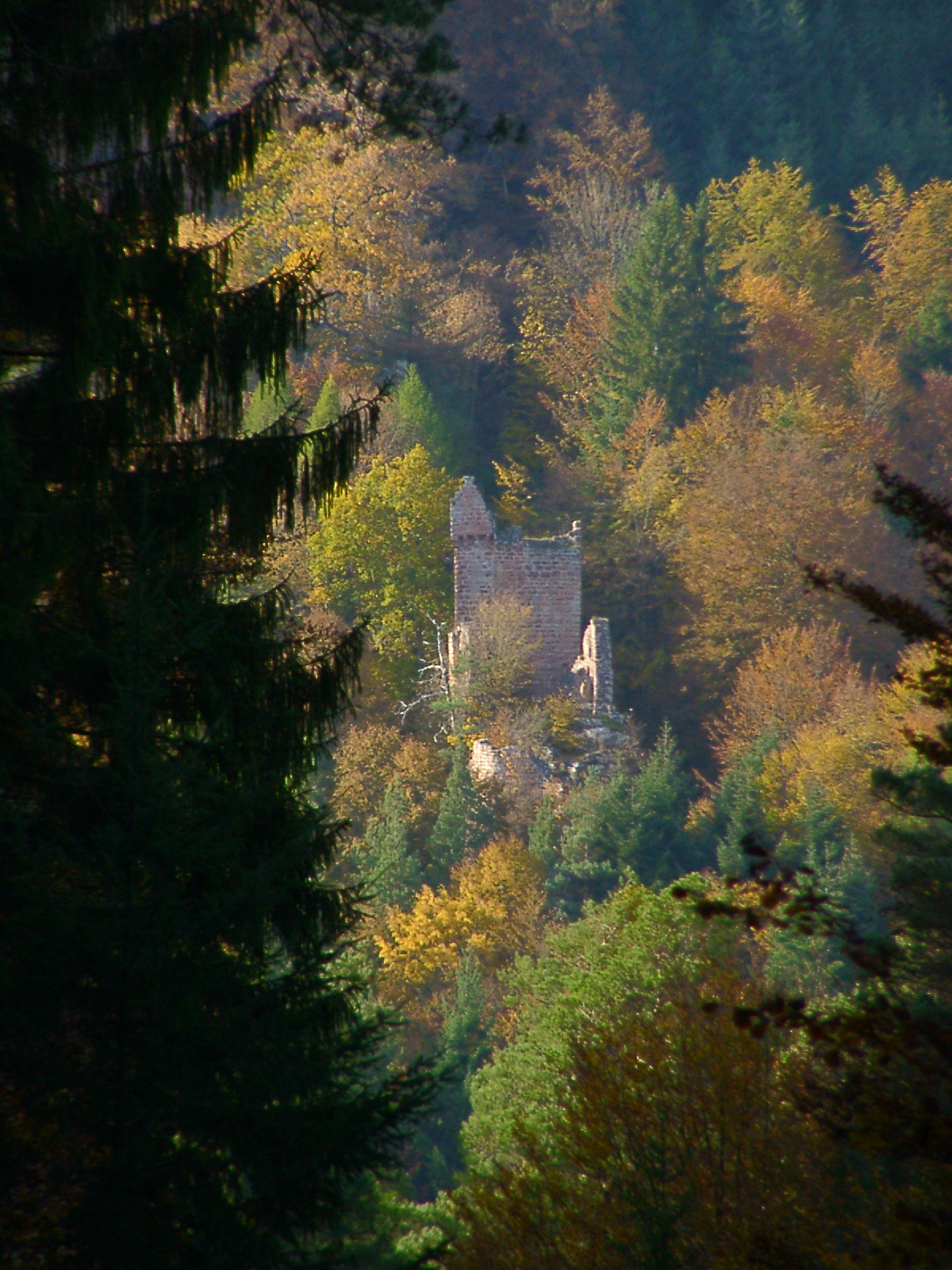
Erfenstein Castle
Erfenstein Castle is a notable example of a medieval spur castle situated in the German state of Rhineland-Palatinate, prominently located within the scenic Palatine Forest above the Elmstein Valley. This castle, dating back to the 13th century, was constructed during the high medieval period and is historically linked with the nearby Spangenberg Castle through the intriguing legend of the Leather Bridge.
The origins of Erfenstein Castle remain somewhat uncertain, but it is widely accepted that the House of Leiningen, a significant noble family in the region, were its founders. The castle was likely established as a strategic stronghold to protect the extensive forest lands owned by the Leiningen counts. The first documented mention of the castle appears in 1272, referencing a ministerialis named Bock of Erfenstein, a member of the lesser nobility who resided at the castle with his family. This early record highlights the castle's role as a noble residence and administrative center within the Leiningen territories.
Historical ownership and significance
Throughout its history, Erfenstein Castle experienced a complex succession of ownership, primarily within branches of the Leiningen family. The castle's ownership oscillated between the Leiningen-Hardenburg and Leiningen-Rixingen lines as a result of inheritance and familial division. The Rixingen branch held the castle along with the village of Esthal until 1345, after which the castle became a Ganerbenburg, or a jointly inherited castle, shared among multiple co-heirs.
This joint ownership led to numerous disputes among the co-owners, eventually resulting in the castle passing to the counts of Sponheim in 1415. Upon the extinction of the Sponheim family line, ownership reverted to the Leiningen-Hardenburgs. The castle's history is intertwined with regional power struggles, especially between the lords of Erfenstein and Spangenberg, who were often rivals due to their competing allegiances and territorial claims.
The legend of the leather bridge and castle rivalry
The famous Leather Bridge legend connects Erfenstein Castle with nearby Spangenberg Castle. Historically, these castles were owned by different lords—the Spangenberg by the prince-bishops of Speyer and Erfenstein by the Leiningen family. This ownership division fostered competition and conflict between the two castles, reflecting broader feudal rivalries in the region.
In 1470, during the Weißenburg Feud, a conflict between Elector Frederick I of the Palatinate and his cousin Duke Louis I of Palatinate-Zweibrücken, both castles were destroyed. Erfenstein was attacked and ruined first, followed by the destruction of Spangenberg Castle. Since then, Erfenstein has remained in a state of ruin, a testament to the turbulent medieval history of the Palatinate region.
Architectural features and layout
The two sites: Old Erfenstein and New Erfenstein
Erfenstein Castle is unique in that it comprises two distinct sites: Old Erfenstein (Alt-Erfenstein) and New Erfenstein (Neu-Erfenstein). The older site, located above the newer one, has largely succumbed to time, with only remnants such as an outer neck ditch filled with earth and the remains of a square bergfried visible. This bergfried stands on an eight-meter-high sandstone rock and features rusticated ashlars, indicating its original robust construction.
The newer site, situated below, is dominated by a well-preserved bergfried with a high entrance on its eastern side, a common defensive feature designed to protect against invaders. Adjacent to the tower are fragments of a curtain wall, with right-angled sockets that once supported wooden beams, suggesting the presence of multiple internal floors within the tower.
Defensive structures and lower wards
Separating Old and New Erfenstein is a wide inner neck ditch, a defensive trench that would have hindered attackers moving between the two sites. At the base of the sandstone rock supporting New Erfenstein, there was a lower ward (Unterburg), remnants of which still survive. This lower ward likely contained auxiliary buildings and served as an additional line of defense.
Compared to Spangenberg Castle, Erfenstein's ruins are in poorer condition, with significant deterioration caused by natural elements and human activity. Vegetation growth and visitors climbing on the ruins have accelerated the decay, particularly affecting the tower stump of the upper ward. Conservation efforts have been proposed to stabilize the site and protect its historical fabric.
Erfenstein Castle in the context of the Palatine Forest
Situated in the Palatine Forest, Erfenstein Castle was strategically placed to oversee and protect the surrounding woodland and valleys. The castle's location on a spur provided natural defensive advantages, leveraging the steep terrain to deter attackers. This setting also allowed control over trade routes and forest resources, which were valuable assets during the medieval period.
The castle's proximity to Spangenberg and other fortifications created a network of strongholds that shaped the political and military landscape of the region. Despite its ruinous state, Erfenstein remains an important cultural landmark within the Palatine Forest, attracting historians, archaeologists, and visitors interested in medieval architecture and history.
Preservation and visitor information
Today, Erfenstein Castle stands as a ruin that offers insight into medieval fortification techniques and noble life. While much of the castle has been lost, the surviving structures provide valuable information about high medieval castle design and construction. Visitors to the site can explore the remains of the bergfried, curtain walls, and ditches, although caution is advised due to the fragile condition of the ruins.
Efforts to secure and preserve the castle are ongoing, with proposals to stabilize the upper ward and protect the neck ditches from further erosion. The site is accessible from the nearby town of Lambrecht and is a popular destination for hiking and historical tours within the Palatine Forest.
Information
Loading map...
Visitor reviews
No reviews yet. Been here? Write the first review and help other travelers!
Write the first reviewVisited this castle? Share your experience
Your review helps other travelers and adds first-hand knowledge to our encyclopedia.