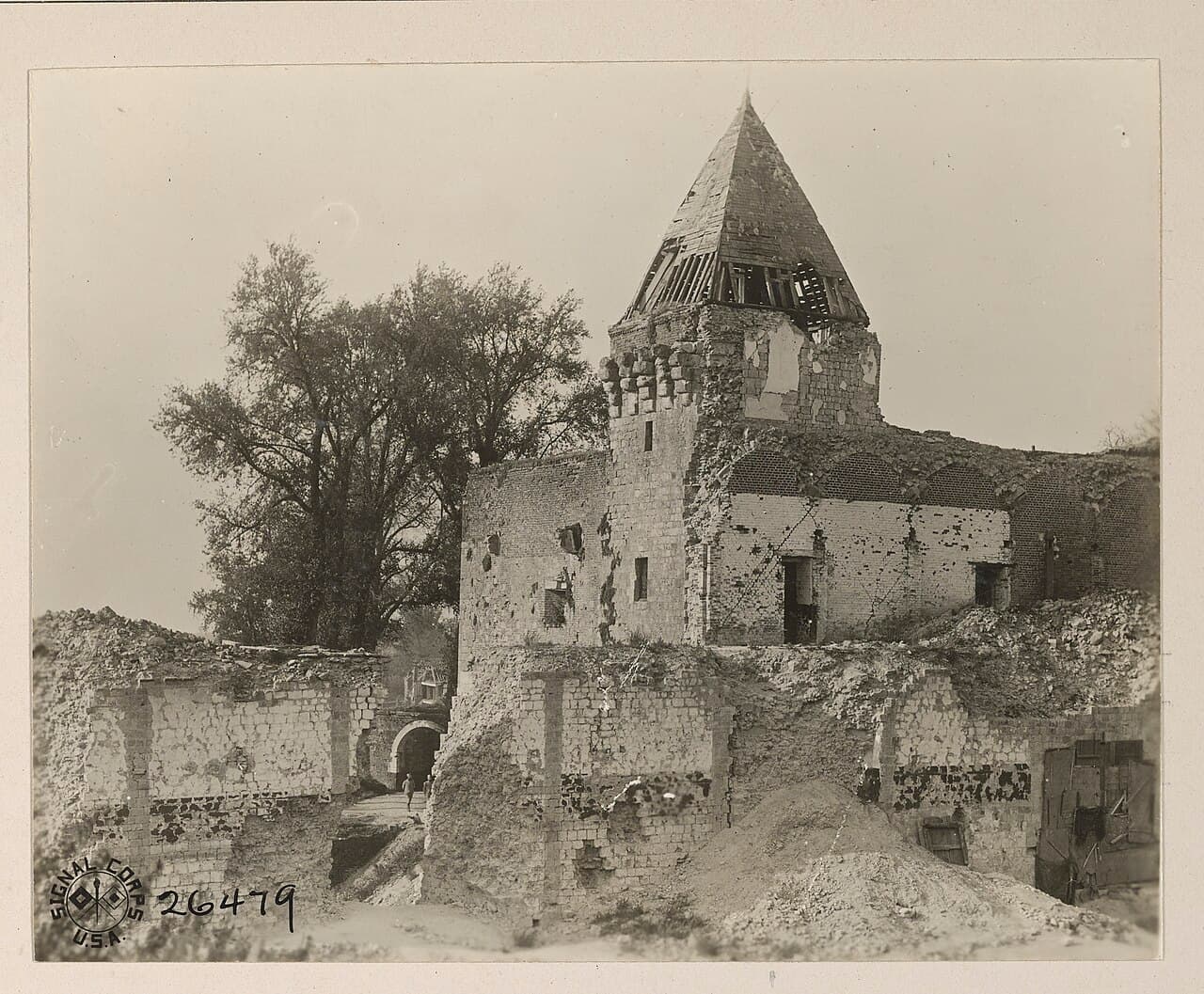
Ham Castle
Ham Castle, locally known as Château de Ham, is a prominent medieval fortress located in the town of Ham, in the Somme department of Hauts-de-France, France. This hill castle has a rich history dating back to at least the mid-11th century, making it a significant example of French medieval military architecture and noble residence.
The origins of Ham Castle are somewhat obscure, but the first documented mention occurs in 1052 when it was recorded as a property of the Counts of Vermandois. The castle's initial construction likely predates this mention by a short period, placing its foundation in the early medieval era. However, the structure as it is known today largely stems from extensive reconstructions and expansions carried out in the high medieval period, particularly during the 13th and 15th centuries.
In the early 13th century, Odon IV, Baron of Ham, undertook significant rebuilding efforts to modernize the castle's defenses. This reconstruction followed the architectural principles of the Philippian style, named after Philip II of France (Philippe Auguste), characterized by robust polygonal layouts and powerful cylindrical towers designed to improve defensive capabilities against siege warfare. These enhancements established much of the castle’s enduring layout, including its rectangular ground plan fortified by round towers at each corner and square towers along the curtain walls.
Architectural features and defensive design
The castle's structure was formidable, with curtain walls approximately 16 meters high, built on sturdy sandstone foundations and topped with limestone rubble. These walls were equipped with machicolations and battlements, allowing defenders to repel attackers effectively. The round towers at the corners provided wide fields of fire, while the square towers served strategic roles, including guarding the main entrance on the northeast side.
One of the most remarkable architectural features was the massive keep, known as the "tour du connétable", constructed in 1441 by Louis of Luxembourg, Count of Saint-Pol. This keep was an imposing cylindrical tower standing 33 meters tall and 33 meters in diameter, with walls up to 11 meters thick. Its design included isolated access points separated by an internal moat, and a curtain wall connection without a direct entrance, making it highly resistant to assault.
The castle was originally surrounded by a wet moat fed by the nearby Beine river, enhancing its defensive perimeter. This moat was later drained following the construction of the Canal de la Somme in the late 18th century, which altered the landscape around the fortress.
Historical ownership and transformations
After the extinction of the male line of the Barons of Ham, the castle passed through several prominent noble families. Around 1380, it was acquired by Enguerrand VII, Lord of Coucy, a powerful lord of northern France. In 1400, ownership transferred to Louis I, Duke of Orléans, who initiated further reconstructions. Following Louis's assassination in 1418, John II of Luxembourg, Count of Ligny, completed these works.
The castle eventually passed to the House of Bourbon-Vendôme by marriage by the end of the 15th century, linking it to the ancestors of King Henry IV of France. Under Henry IV’s reign, the château became royal property. In the late 17th century, the fortress was modernized by the famous military engineer Vauban, who adapted its defenses to meet the evolving demands of artillery warfare.
Military significance and sieges
Ham Castle played a notable role in regional conflicts and was besieged multiple times. One significant siege occurred in 1557 when the castle was attacked by forces of Philip II of Spain. During the Franco-Prussian War in 1870, the French Second Army of the North surrounded the castle, compelling the surrender of the Prussian garrison stationed there.
The castle as a state prison
In the 18th and 19th centuries, the castle transitioned from a military fortress to a state prison, primarily housing high-profile prisoners. Among its most famous inmates was Charles-Louis Napoléon Bonaparte, the future Napoleon III, who was imprisoned there from 1840 until his daring escape in 1846. Disguised as a mason and using the pseudonym "Badinguet," his escape became legendary and contributed to his political rise.
Destruction and preservation
The castle suffered catastrophic damage during World War I when German forces, employing scorched earth tactics under General Ludendorff, dynamited much of the fortress in March 1917. This destruction was similar to that inflicted on other regional castles such as Coucy Castle.
Despite the extensive damage, several parts of the castle remain, including portions of the curtain walls, the square tower guarding the former entrance, and the ruins of the monumental keep. The site today functions as a public park, freely accessible to visitors interested in exploring its ruins and learning about its storied past.
Notable features and cultural legacy
A living symbol of the castle’s history is the "arbre de la liberté", a linden tree planted in 1793 that remarkably survived the devastation of World War I. This tree was visited by Emperor Napoleon III in 1853, linking it to the castle's era as a political prison and a place of historical significance.
The castle's blend of Philippian military architecture, massive defensive structures, and its role in French history make it a fascinating subject for historians, architects, and visitors alike. Its ruins offer insight into medieval fortification techniques and the evolution of military architecture in northern France.
Today, Ham Castle stands as a testament to the region’s turbulent history, from feudal conflicts through to modern warfare, and remains an important cultural landmark within Hauts-de-France.
Frequently asked questions (FAQ)
- How do I get to Ham Castle?
- Ham Castle is located in the picturesque town of Ham, France. You can easily reach it by car or public transport, with nearby train stations connecting to major cities. Parking is available for visitors who choose to drive.
- What is the historical significance of Ham Castle?
- Ham Castle dates back to the 13th century and has played an important role in French history, serving as a defensive stronghold during various conflicts. Its architecture reflects the medieval design trends of the era, making it a fascinating site for history enthusiasts. The castle has witnessed numerous historical events that shaped the region.
- When was Ham Castle built?
- Ham Castle was constructed in the early 1200s, during a time when fortifications were essential for protecting territories. Over the centuries, it has undergone various renovations and restorations, adding to its historical value. Its enduring presence offers a glimpse into medieval life and architecture.
- Can I visit Ham Castle year-round?
- Yes, Ham Castle is open to the public year-round, though specific opening hours may vary by season. It is advisable to check the official website or contact the visitor center for the most current information. During peak tourist seasons, guided tours may be available for a more in-depth experience.
- Why is Ham Castle a popular tourist attraction?
- Ham Castle attracts visitors due to its rich history, stunning architecture, and beautiful surrounding landscapes. It offers a unique opportunity to explore medieval life and enjoy panoramic views of the region. Additionally, the castle often hosts events and exhibitions that engage visitors of all ages.
- Is it possible to access all areas of Ham Castle?
- While many parts of Ham Castle are accessible to visitors, certain areas may have restrictions due to preservation efforts. The main attractions, such as the great hall and battlements, are open for exploration. Visitors with mobility concerns should inquire in advance about accessibility options.
- What are the ticket prices for Ham Castle?
- Ticket prices for Ham Castle vary depending on age and whether you are part of a guided tour. Generally, adults pay a standard entry fee, while discounts are available for children, seniors, and groups. It's best to purchase tickets online in advance during peak season to ensure availability.
- What is the best time to visit Ham Castle?
- The best time to visit Ham Castle is during the spring and early fall when the weather is mild and the gardens are in full bloom. Summer can be quite busy, but it also offers vibrant events and activities. Visiting during weekdays may provide a more tranquil experience.
- Are there any nearby attractions to explore?
- Yes, there are several nearby attractions to enhance your visit to Ham Castle. The charming town of Ham offers quaint shops and local eateries, while the surrounding countryside features beautiful hiking trails and picnic spots. Other historical sites in the area also provide a rich cultural experience.
Photo gallery

Photo by Unknown authorUnknown author or not provided•Public domain
Information
Address
Rue André Audinot, Ham, France
Loading map...
Visitor reviews
No reviews yet. Been here? Write the first review and help other travelers!
Write the first reviewVisited this castle? Share your experience
Your review helps other travelers and adds first-hand knowledge to our encyclopedia.



