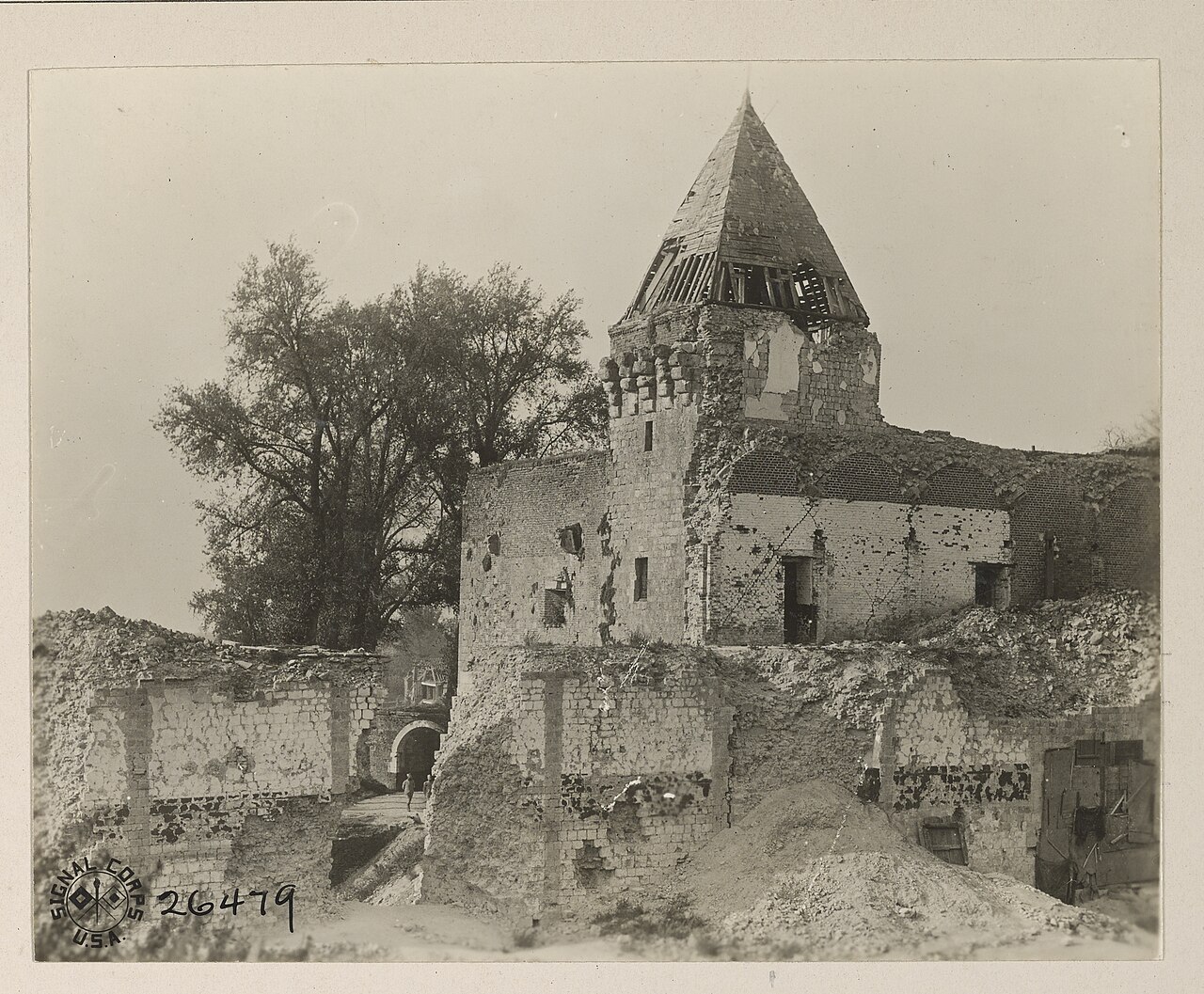
Fort Caraby
Fort Caraby, also known locally as Fort Carabit, is a 19th-century military fortification located near the town of Péronne in the Somme department of northern France. Constructed in the years immediately preceding the Franco-Prussian War of 1870, the fort was designed to strengthen the defensive network around Péronne, a strategic town on the right bank of the river Somme.
The fort was engineered by the father-and-son duo Jean-Pierre and Fidel-Achille Caraby, military engineers from Péronne. Their work focused on protecting the southwest approach to the town, a critical direction for potential invasions. Additionally, Fort Caraby played an important role in controlling the water levels of the nearby lakes, which were part of the defensive landscape. A small island in the river, now largely inaccessible, was integrated into the fort's defensive perimeter, enhancing its strategic position.
Design and construction details
Fort Caraby was constructed as part of a broader wave of fortifications built in the late 19th century to modernize French defenses after the vulnerabilities exposed during earlier conflicts. It was built on relatively low-lying terrain next to the river, which influenced its classification as a lowland castle type fortification. The design incorporated contemporary military engineering principles of the time, focusing on artillery placements and water defenses.
The fort's layout included defensive walls, artillery platforms, and water-regulating structures. However, the rapid advancement of artillery technology in the late 19th century, particularly the development of more powerful and longer-range guns, quickly rendered the fort's defenses obsolete. This technological leap meant that fixed fortifications like Fort Caraby could be easily targeted and destroyed before they could effectively respond.
Historical context and military significance
Built just before the outbreak of the Franco-Prussian War, Fort Caraby was part of France's urgent efforts to strengthen its border defenses. Despite these efforts, the war revealed the limitations of such fortifications against modern artillery and tactics. Following the war, the fort remained in military use for a few decades but was increasingly seen as outdated.
By 1906, less than 40 years after its construction, Fort Caraby was dismantled. The dismantling reflected the broader shift in military strategy away from static fortifications toward more mobile and flexible defense systems. The fort's dismantling also meant that many of its original features were lost or fell into ruin.
Current condition and accessibility
Today, Fort Caraby exists as a partially preserved site within a municipal park. Its remains are freely accessible to the public, although the fort is heavily overgrown with vegetation. This overgrowth obscures much of the fort's original layout, making it difficult to discern the full extent of its design without expert guidance.
The site is notable for its quiet, somewhat hidden atmosphere, offering visitors a glimpse into 19th-century military architecture amid natural surroundings. The fort's proximity to the historic Péronne Castle adds to the area's appeal for those interested in military history and castle architecture.
Architectural and cultural significance
Although Fort Caraby was short-lived as an active military installation, it represents an important phase in the evolution of fortification design during the late 19th century. Its construction by the Caraby engineers reflects the localized expertise applied to national defense challenges. The fort's integration with the river and lakes demonstrates the strategic use of natural waterways in military architecture.
As a historic site, Fort Caraby offers insight into the rapid changes in military technology and strategy that occurred during the transition from traditional fortresses to modern warfare. It stands as a reminder of the challenges faced by military planners in adapting to new artillery capabilities and the eventual obsolescence of fixed fortifications.
Frequently asked questions (FAQ)
- How do I visit Fort Caraby and what can I expect?
- Fort Caraby is located next to Boulevard du Fort Carabit in Péronne and is freely accessible as part of a municipal park. Visitors should be prepared for an overgrown site where the fort's layout is not clearly visible, offering a quiet and natural setting for exploration.
- What is the historical significance of Fort Caraby?
- Fort Caraby was built just before the Franco-Prussian War of 1870 to protect the southwest approach to Péronne and regulate nearby water bodies. It reflects 19th-century military engineering but was dismantled in 1906 due to advances in artillery that made it obsolete.
- Is Fort Caraby well preserved?
- The fort is partially preserved with remains that are overgrown and difficult to discern. While many original features have been lost, the site remains an important historical landmark within a municipal park.
- Can I visit other historical sites near Fort Caraby?
- Yes, the historic Péronne Castle is located nearby and is worth visiting for those interested in medieval and military history in the region.
Information
Architect
Jean-Pierre and Fidel-Achille Caraby
Current owner
Municipality
Address
Boulevard du Fort Carabit, Péronne, France
Loading map...
Visitor reviews
No reviews yet. Been here? Write the first review and help other travelers!
Write the first reviewVisited this castle? Share your experience
Your review helps other travelers and adds first-hand knowledge to our encyclopedia.