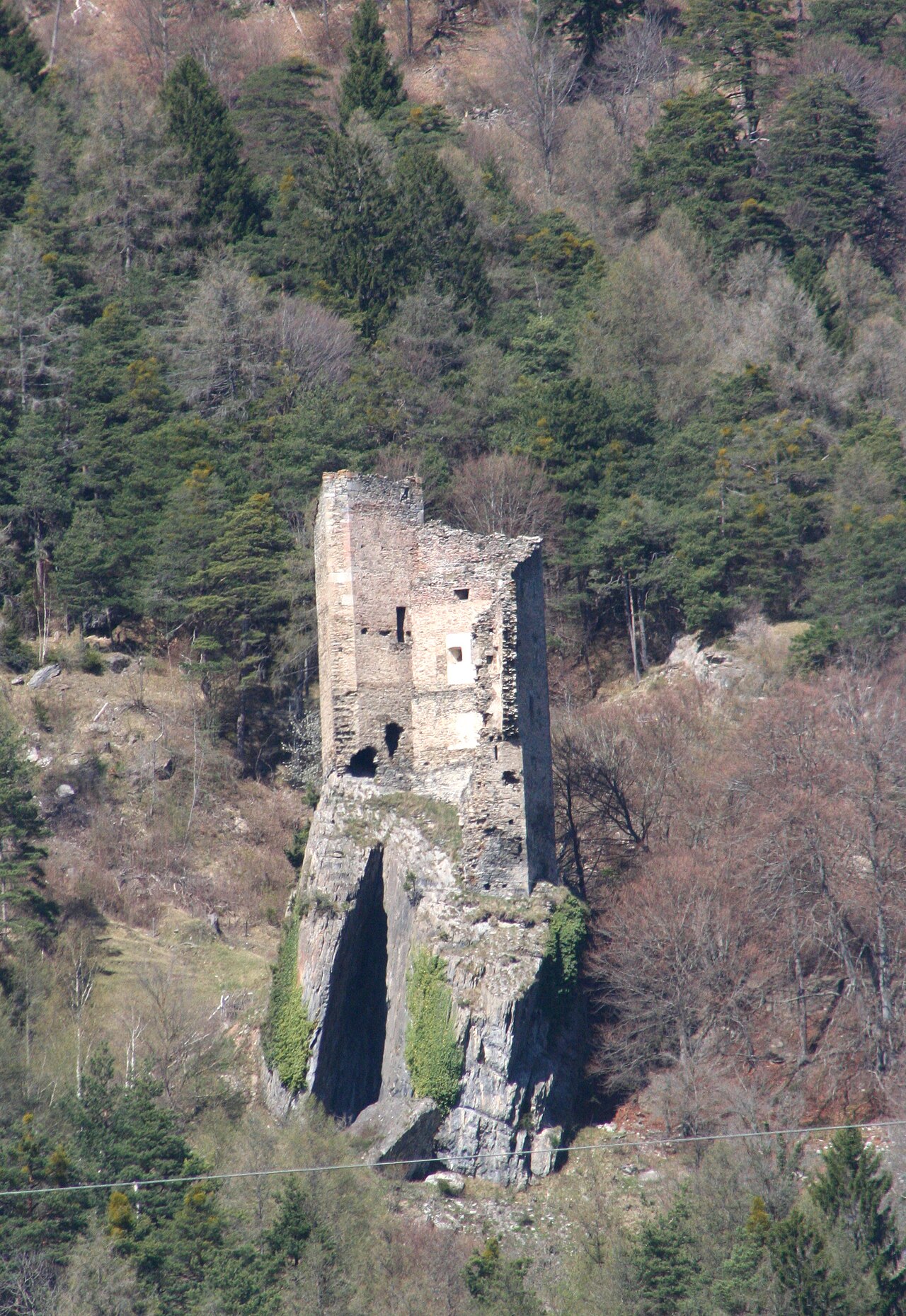
Burg Ober-Ruchenberg
Burg Ober-Ruchenberg is a notable hill castle ruin located in the municipality of Trimmis, Switzerland, perched at an elevation of approximately 1058 meters above sea level. This castle, with origins tracing back to the Middle Ages, holds significant historical importance due to its association with the noble von Ruchenberg family, who were prominent in the region from the early 13th century until the late 14th century.
Historical background and noble lineage
The earliest known documentation of Burg Ober-Ruchenberg dates to 1328, notably in relation to the death of a priest near the castle grounds. During this period, the castle was under the lordship of the von Ruchenberg family, including knights such as Albero and Detrich de Ruhin-berg. The family's history is marked by both prominence and tragedy, including a notorious event involving Johann von Ruchenberg, who killed his sister Katharina, an act that resulted in the loss of some family estates. Despite such setbacks, the von Ruchenbergs maintained control over bishopric fiefs until around 1395. By the end of the 14th century, the von Ruchenberg lineage appears to have vanished, and the castle ceased to be held by its original noble owners.
Following this, ownership of the castle shifted among various local figures and families. In 1339, Walter der Meier von Altstätten and Conrad von Unterwegen offered protection to merchants traveling near the castle, highlighting the strategic importance of the location. By 1409, the castle was owned by Dietegen von Marmels, and in 1444, it was managed by a bailiff from the Sigberg family. The property later passed to Josua von Beroldingen in 1522, although by this time, the castle was likely abandoned. Historical records from 1548 describe the site as a ruin, a status confirmed by archaeological excavations revealing layers of destruction within the structure.
Architectural features and layout
Burg Ober-Ruchenberg is situated atop a wooded hill accessible by a steep path from the south. The castle's layout centers on a plateau featuring the remains of dry stone walls that likely belonged to auxiliary buildings supporting the main complex. The primary castle structure extends approximately 20 meters in length and originally comprised a bergfried (main tower) and a palas (residential hall).
The bergfried
The bergfried stands about 15 meters tall on a slightly irregular rectangular base measuring roughly 9.5 by 10.5 meters, with walls between 1.5 and 2.3 meters thick. Archaeological evidence indicates the tower had four interior floors, accessible via an elevated entrance on the west side, where fragments of the original door frame remain visible. The tower's interior features include small windows, a latrine oriel for waste disposal, storage niches, and smoke vents on the second and third floors. Beam holes and traces of staircases carved into the stone walls suggest wooden floors and internal access routes. Although the exact form of the roof is unknown, it may have featured battlements and a pointed, tent-like design, typical of medieval defensive towers.
The palas and surrounding structures
Adjacent to the bergfried on its western side lies the palas, a three-story residential hall. Structural collapse has obscured the precise connections between the tower and the palas, with significant portions of the southern walls having slipped down the hillside. Early 20th-century records noted a fireplace in the central portion of the palas' west wall, but this feature has since fallen. Large window openings suggest the hall was approximately eight meters wide and likely used during warmer seasons, while narrower arrow slits near the base provided defensive capabilities.
About 30 meters west of the palas is an artificially leveled terrace, part of the castle grounds, though it shows no evidence of masonry construction. This terrace may have served as an open courtyard or space for auxiliary activities related to the castle's operation.
Archaeological findings and destruction
Excavations conducted in 1960 inside the bergfried uncovered a distinctive layer of burned material directly covering the natural rock foundation, overlain by approximately half a meter of collapsed wall rubble. This fire layer indicates a significant destructive event, likely a violent siege or accidental fire, which contributed to the castle's abandonment. The presence of multiple construction phases is evident, with later additions leaving minimal traces today.
Strategic importance and location
Perched on a wooded hill, Burg Ober-Ruchenberg commanded a strategic vantage point over the surrounding landscape, including important trade routes. The castle's position allowed its owners to control and protect merchants traveling through the region, as evidenced by historical records of local figures offering protection to traders near the castle in the 14th century. The steep southern approach and elevated plateau provided natural defensive advantages, complemented by the castle's stone fortifications and towers.
Cultural significance and preservation
Today, Burg Ober-Ruchenberg stands as a well-preserved ruin that offers valuable insights into medieval castle architecture and noble life in the Swiss region during the Middle Ages. The surviving structures, including the bergfried and palas, showcase typical defensive and residential features of hill castles from this era. The castle's history, marked by noble lineage, conflict, and eventual decline, reflects broader regional dynamics of feudal lordship and territorial control.
Visitors to the site can explore the remains via a steep path leading to the hilltop plateau, where the castle ruins are set amidst a wooded environment. The site remains an important heritage landmark, contributing to the understanding of medieval fortifications in Switzerland.
Frequently asked questions (FAQ)
- How do I get to Burg Ober-Ruchenberg?
- Burg Ober-Ruchenberg is located on a wooded hill in Trimmis, Switzerland, accessible by a steep path from the south. Visitors should be prepared for a moderate hike to reach the castle ruins.
- What is the historical significance of Burg Ober-Ruchenberg?
- The castle was a medieval hill fortress associated with the noble von Ruchenberg family, who controlled the region from the 13th to the 14th century. It played a role in protecting trade routes and local lordship during the Middle Ages.
- What remains can be seen at the castle today?
- Visitors can see the ruins of the bergfried (main tower) and the palas (residential hall), including stone walls with pietra rasa plaster, arrow slits, window openings, and evidence of a latrine oriel inside the tower.
- Is Burg Ober-Ruchenberg suitable for families and children?
- Due to the steep path and rugged terrain, caution is advised when visiting with children. The site is best suited for visitors comfortable with moderate hiking and exploring ruins.
- When is the best time to visit Burg Ober-Ruchenberg?
- The best time to visit is during late spring to early autumn when the weather is favorable for hiking and outdoor exploration. Winter months may pose challenges due to snow and slippery conditions.
Information
Loading map...
Visitor reviews
No reviews yet. Been here? Write the first review and help other travelers!
Write the first reviewVisited this castle? Share your experience
Your review helps other travelers and adds first-hand knowledge to our encyclopedia.