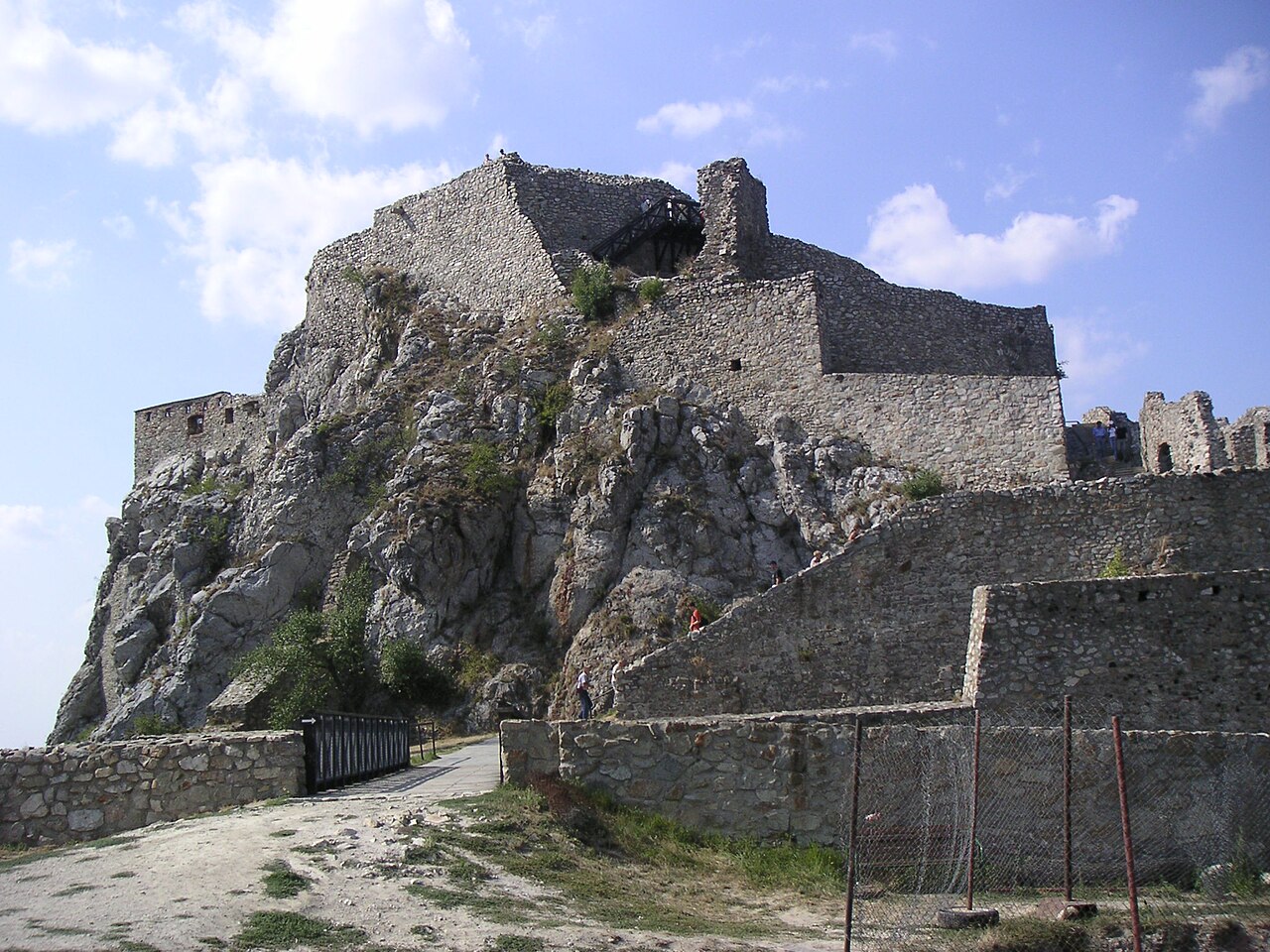
Hainburg Castle
Hainburg Castle, also known as Heimenburg or Heimoburg, is a significant medieval fortress located on a mountain overlooking the town of Hainburg an der Donau in the province of Lower Austria. This castle stands as a testament to the region's turbulent history and strategic importance along the Danube River. Originally constructed in the mid-11th century, it has undergone numerous expansions, sieges, and reconstructions, reflecting the evolving military architecture and political landscape of Central Europe.
The origins of Hainburg Castle date back to around 1050, when Henry III, Holy Roman Emperor, ordered the construction of a new fortification at the site, likely restoring an earlier defensive structure. The castle's location was chosen strategically to protect and control traffic along the vital Danube trade route, underscoring its military and economic significance. Early construction efforts were met with resistance, as Hungarian troops attempted to prevent the castle's completion, highlighting the contested nature of the border region.
Medieval expansions and the babenberg era
In 1192, Leopold V, Duke of Austria, initiated a major expansion of the castle, enhancing its defensive capabilities and residential facilities. After Leopold's death in 1194, his successors continued the work, financed in part by the ransom paid for the release of Richard the Lionheart. Throughout the 13th century, Hainburg Castle served as a residence for the influential Babenberg family, who were the ruling dynasty in Austria before the rise of the Habsburgs.
The castle's chapel was the site of an important royal marriage in 1252, when Ottokar II of Bohemia wed Margaret of Austria, symbolizing political alliances of the period. The castle later came under the control of the Habsburg family in 1278, marking a new chapter in its history and the broader power shifts within the Holy Roman Empire.
Sieges and military significance in the late medieval period
Between 1477 and 1482, the castle endured multiple sieges by the forces of Matthias Corvinus, the Hungarian king known for his formidable Black Army. Despite several unsuccessful attempts, Matthias finally captured the castle after a prolonged five-month siege in September 1482. His occupation lasted until his death in 1490, when Maximilian I, Holy Roman Emperor, reclaimed the fortress for the Habsburgs.
In the early 16th century, the castle was granted to the Von Zelking family in 1514. Recognizing the growing threat of Ottoman incursions, the Von Zelking family fortified the castle further and adapted its defenses to accommodate firearms, reflecting advances in military technology. Despite these efforts, the castle fell to Sultan Suleiman the Magnificent during his 1529 campaign en route to the Siege of Vienna.
Decline and destruction in the early modern period
Following its military peak, Hainburg Castle entered a period of decline. By 1547, the Von Zelking family leased the castle, which marked the end of its use as a noble residence. Subsequent rebuilding efforts focused on strengthening the fortress, but a catastrophic lightning strike in 1569 caused an explosion in the powder depot, severely damaging the structure.
By 1672, the castle's palas (main residential building) was in ruins, although its defensive walls remained formidable. However, in 1683, during the Ottoman advance toward Vienna, the castle was captured and destroyed by the forces of Grand Vizier Kara Mustafa Pasha. This event marked the end of the castle's military relevance.
Post-medieval abandonment and modern preservation
After the destruction in the late 17th century, Hainburg Castle was gradually abandoned throughout the 18th century and left to deteriorate. It was no longer maintained as a military stronghold or noble residence. In the 20th century, efforts were made to consolidate the ruins and preserve what remained of the historic structure.
Today, Hainburg Castle is a freely accessible ruin that offers visitors panoramic views over the medieval town of Hainburg an der Donau and the surrounding countryside. The site is appreciated for its historical significance and scenic vantage points. Nearby, visitors can also explore the ruins of Röthelstein Castle, adding to the region's rich medieval heritage.
Architectural features and layout
The castle's original design reflects typical high medieval fortification principles with a focus on strategic location and robust defensive structures. Its position atop a mountain provided natural protection and commanding views of the Danube valley. Over the centuries, the castle complex was expanded to include multiple defensive walls, towers, a palas, a chapel, and fortified gates.
Adaptations in the 16th century to accommodate firearms included reinforced bastions and artillery platforms, demonstrating the evolution of military architecture in response to changing warfare technologies. Despite damage from sieges and explosions, elements of the castle's walls and towers remain visible, offering insights into medieval construction techniques.
Historical context and cultural importance
Hainburg Castle played a pivotal role in controlling the Danube trade route and defending the eastern borders of the Holy Roman Empire. Its history encapsulates the shifting power dynamics between Austrian, Hungarian, and Ottoman forces. The castle's association with prominent historical figures such as Henry III, Leopold V, Matthias Corvinus, and Suleiman the Magnificent underscores its importance as a military and political landmark.
As a ruin, the castle today serves as a cultural monument and tourist attraction, preserving the legacy of medieval fortifications in Austria. Its accessibility and scenic location make it a favored destination for history enthusiasts and visitors seeking to experience the region's medieval past firsthand.
Frequently asked questions (FAQ)
- How do I get to Hainburg Castle?
- Hainburg Castle is located next to Schlossbergstrasse in Hainburg an der Donau, Lower Austria. It is accessible by car or local public transport, with walking paths leading up to the castle ruins from the town center.
- What is the historical significance of Hainburg Castle?
- Hainburg Castle was a strategic fortress controlling the Danube trade route and played a key role in medieval Austrian, Hungarian, and Ottoman conflicts. It was associated with notable figures such as Henry III and Matthias Corvinus.
- Can I visit Hainburg Castle year-round?
- Yes, the castle ruins are open to the public year-round and can be visited freely. However, visitors should check local conditions and weather before planning their trip, as the site is an outdoor ruin.
- Is Hainburg Castle suitable for families?
- Yes, the castle ruins are family-friendly, offering safe walking paths and scenic views. Children can enjoy exploring the historic site while learning about medieval history.
- Are there guided tours available at Hainburg Castle?
- Guided tours may be available through local tourist offices or historical societies in Hainburg an der Donau. Visitors are encouraged to inquire locally for scheduled tours and educational programs.
Information
Address
Next to Schlossbergstrasse, Hainburg an der Donau, Austria
Loading map...
Visitor reviews
No reviews yet. Been here? Write the first review and help other travelers!
Write the first reviewVisited this castle? Share your experience
Your review helps other travelers and adds first-hand knowledge to our encyclopedia.