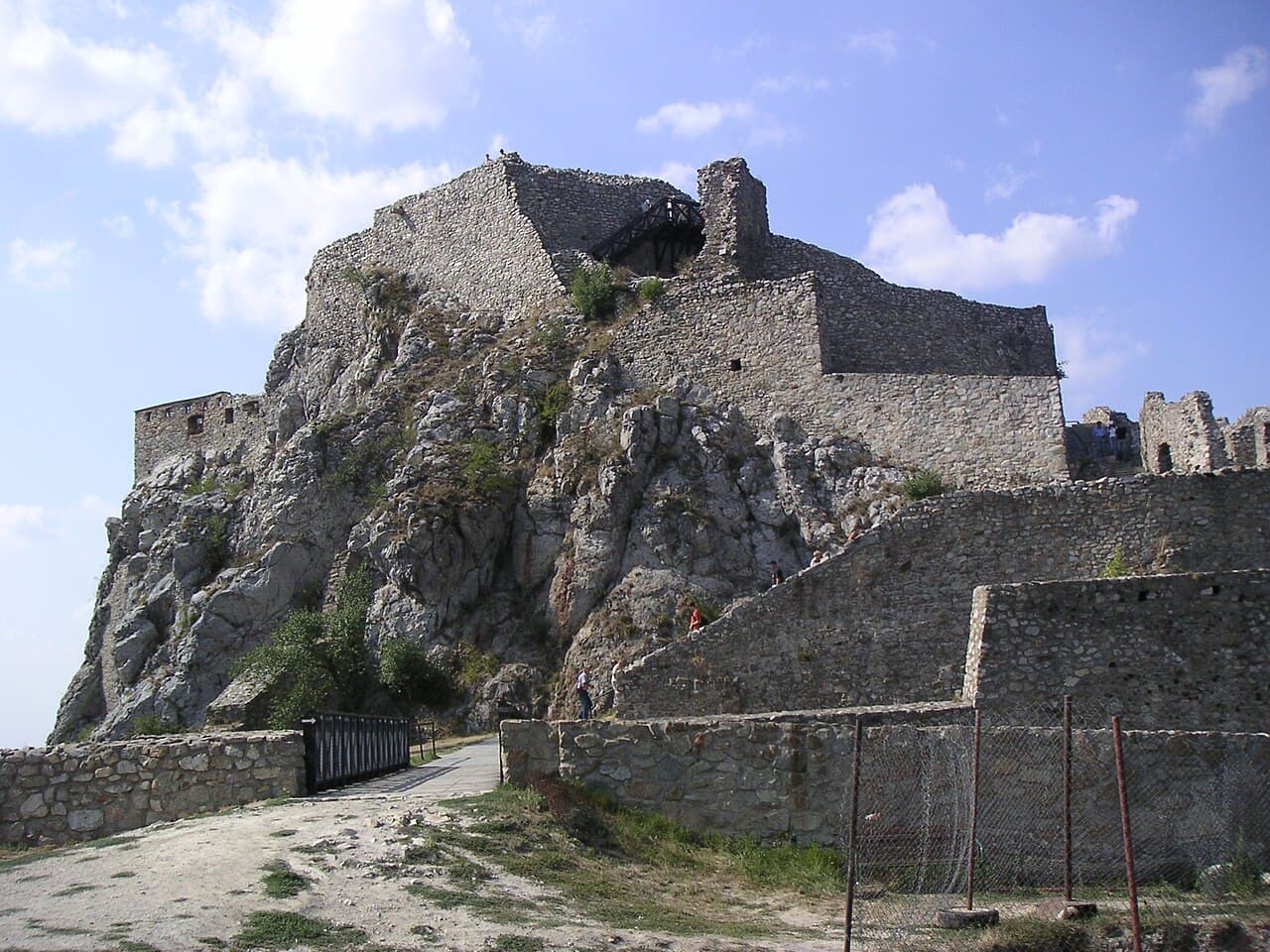
Dziewin
Dziewin Castle stands as one of the most significant and oldest fortifications in Slovakia, perched on a high limestone cliff at the confluence of the Morava and Danube rivers. Its strategic location allowed control over vital trade routes, including the Danube and a branch of the Amber Road, making it a key defensive and political site throughout history. The castle's origins trace back to prehistoric times, with human settlement dating to the Neolithic period around 5000 BCE. Over millennia, the site evolved through Bronze and Iron Age fortifications, Celtic occupation, Roman military presence, and ultimately became a major stronghold during the Great Moravian Empire in the 9th century.
Prehistoric and ancient origins
The hill where Dziewin Castle now stands was inhabited from the Neolithic era, with archaeological evidence showing continuous settlement through the Bronze and Iron Ages. The Celts, associated with the La Tène culture, fortified the site in the early Iron Age, transforming it into a defensive hillfort. During the Roman period, roughly from the 1st to the 4th centuries CE, the location hosted a Roman fort as part of the Limes Romanus frontier defense system. Excavations have uncovered Roman stone buildings, including a four-room structure with a semicircular apse, likely related to military activities during the Marcomannic Wars. The Roman presence ended around 400 CE as imperial borders contracted.
Great moravian fortress and early medieval development
By the 9th century, the site had become a fortified center of the Great Moravian Empire. Historical records from 864 CE mention a heavily fortified settlement called "Dowina," believed to be Dziewin Castle. The fortress was one of three principal centers of Great Moravia, serving as a political and military hub. The natural defenses of steep slopes on two sides were augmented by deep moats and earthen ramparts on the east and north. Archaeological excavations have revealed the foundations of a 9th-century stone church and an 11th-century round rotunda, indicating the site's religious and cultural importance during this period.
Medieval castle construction and expansion
In the 13th century, a royal stone castle was constructed atop the cliff to protect the kingdom's border and river crossings. The initial fortress comprised a hexagonal tower surrounded by defensive walls on the northeast side, accessible via a bridge over a rock-cut moat. The castle was relatively small but strategically vital. In the 15th century, the castle underwent significant expansion, including an additional ring of walls and the creation of a large lower castle area called the "middle castle," which featured a Gothic palace built by the Goryanski family. This phase also saw the construction of a deep well carved into the rock and various utility buildings.
Renaissance enhancements under the batory family
Ownership passed to the Báthory family in 1526, who further developed the castle complex. They built a Renaissance-style palace in the middle castle area and added artillery bastions to the upper castle. A standalone watchtower known as the "Maiden Tower" was constructed on a solitary rock to oversee the Danube road called "Mniszka." The lower castle, serving economic functions, was fortified with walls and bastions, including three gates reinforced with semi-circular towers. These improvements reflected evolving military technology and the need for stronger defenses during the turbulent 16th century.
Decline and destruction in the early modern period
In 1635, the castle came under the ownership of the Pálffy family, who preferred residing in more comfortable estates and invested little in the fortress's upkeep. The castle's military importance waned as the region stabilized after the Ottoman threat diminished. However, in 1683, an artillery bastion was constructed between the upper castle and the western gate in response to renewed Turkish incursions. The fortress's final destruction occurred in 1809 during the Napoleonic Wars when retreating French troops blew up the walls, leaving the castle in ruins.
Modern preservation and cultural significance
The Slovak state purchased the ruins from the Pálffy family in 1932, recognizing the site's exceptional historical value. In 1961, Dziewin Castle was designated a National Cultural Monument of Slovakia. Ongoing archaeological research has uncovered rich layers of history, including Roman, Great Moravian, medieval, and Renaissance periods. Partial reconstructions have made the ruins accessible to visitors, who can explore the remains of all three gates, defensive walls, two palaces, a deep well, and the iconic Maiden Tower. The castle's image even appears on Slovak currency, underscoring its symbolic importance.
Archaeological discoveries and museum exhibits
Excavations have revealed foundations of Roman buildings, a Great Moravian church with a unique trefoil apse and fresco fragments, and a Romanesque circular chapel from the 11th to 13th centuries. The castle grounds feature terraces, staircases, and courtyards, with ongoing restoration efforts preserving these historical elements. A museum housed in the Renaissance palace basement offers seasonal exhibitions on the castle's history. Visitors enjoy panoramic views of the Danube and Morava rivers, appreciating Dziewin Castle's long-standing strategic and cultural role.
Architectural features and defensive structures
Dziewin Castle exemplifies a bastioned fortress with multiple layers of fortifications adapted to its rocky hilltop setting. The hexagonal tower, polygonal bastions, curtain walls, and deep moats demonstrate medieval military architecture evolving into Renaissance artillery defenses. The Maiden Tower, perched on a separate rock, served as a watchtower and signal point. The castle's three gates, reinforced with semi-circular towers and drawbridges, controlled access to the complex. The deep well carved into the rock ensured a reliable water supply during sieges.
Defense adaptations over time
The castle's fortifications reflect changing military needs from the early medieval period through the Renaissance. Initial earthworks and moats gave way to stone walls and towers designed to withstand siege engines and cannon fire. The addition of artillery bastions in the 17th century illustrates adaptation to gunpowder warfare. Despite these enhancements, the fortress was never captured in battle, underscoring its formidable defenses.
Dziewin castle in slovak national identity
Since the 19th century, Dziewin Castle has been a powerful symbol of Slovak heritage and Great Moravian history. It inspired Romantic poets and national revivalists such as Ľudovít Štúr. The castle's image has appeared on Slovak currency and remains a popular tourist destination. Its location on the border with Austria and proximity to Bratislava make it a significant cultural landmark bridging past and present.
Frequently asked questions (FAQ)
- What is the best time to visit Dziewin Castle?
- The best time to visit Dziewin Castle is during spring to early autumn when the weather is mild and the archaeological site is fully accessible. Seasonal exhibitions in the museum are typically open from late spring through early autumn.
- How do I get to Dziewin Castle from Bratislava?
- Dziewin Castle is located about 12 kilometers northwest of Bratislava and can be reached by car or public transport. Regular buses and local trains serve the area, followed by a short walk uphill to the castle ruins.
- Is Dziewin Castle wheelchair accessible?
- Due to its rocky terrain and ruinous condition, Dziewin Castle has limited wheelchair accessibility. Visitors with mobility issues should contact the site management in advance to inquire about available accommodations.
- Can I explore all parts of Dziewin Castle?
- While much of Dziewin Castle's ruins are open to visitors, some areas, especially the upper castle with the hexagonal tower, may be closed for safety and ongoing restoration. Guided tours can provide access to certain restricted sections when available.
- What are the main historical periods represented at Dziewin Castle?
- Dziewin Castle features archaeological remains from the Neolithic, Celtic, Roman, Great Moravian, medieval, and Renaissance periods, reflecting its long and varied history.
- Are there guided tours available at Dziewin Castle?
- Guided tours are occasionally offered by the local museum or cultural organizations, especially during the tourist season. Visitors should check in advance for schedules and availability.

Information
Sources & official resources
Verify the information above using these authoritative references.
Loading map...
Visitor reviews
No reviews yet. Been here? Write the first review and help other travelers!
Write the first reviewVisited this castle? Share your experience
Your review helps other travelers and adds first-hand knowledge to our encyclopedia.



