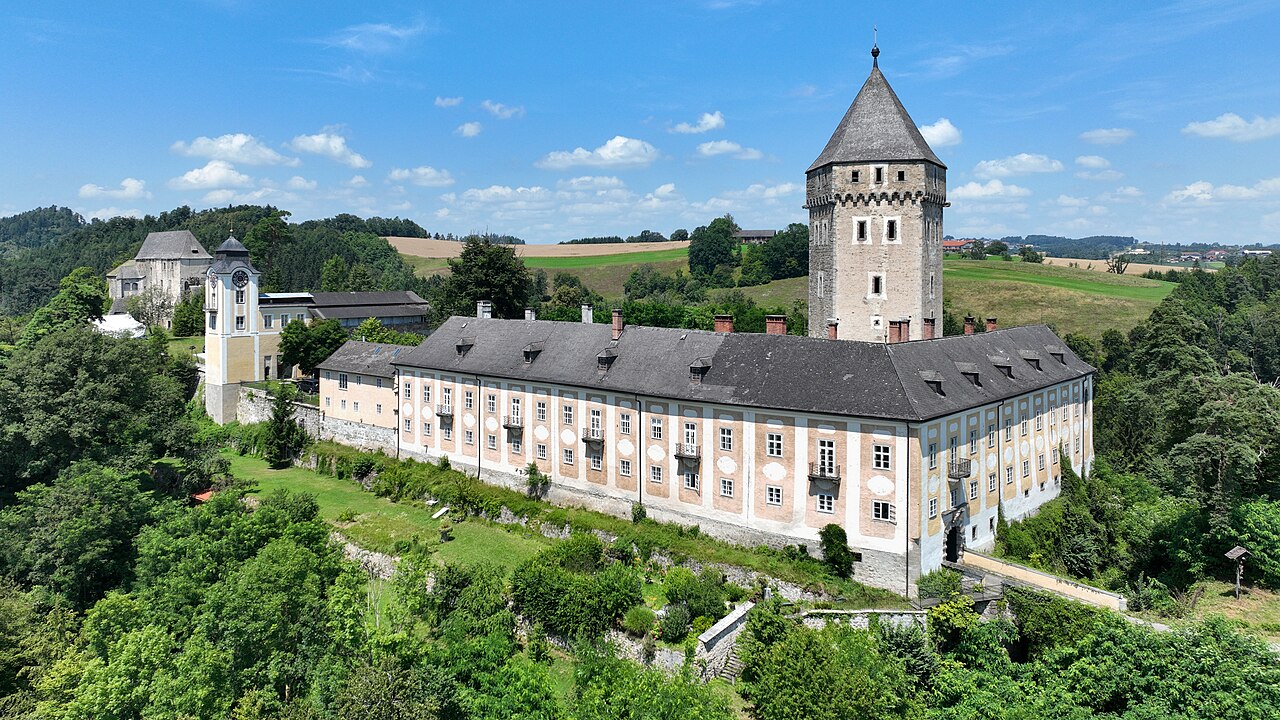
Haichenbach Castle
Haichenbach Castle is a remarkable example of a High Medieval hill castle strategically perched at approximately 450 meters above sea level on a narrow ridge overlooking the Danube's famous Schlögener Schlinge bend. First documented in 1160, the castle offers a vivid window into the medieval period's feudal dynamics, military architecture, and regional power struggles in what is now Austria.
Early history and noble lineage
The earliest known mention of the castle, originally called Eichenbach, dates back to 1160. It was the seat of a ministerial noble family who took their name from the castle itself, a common practice in medieval Europe that underscored the close tie between landholding and identity. Otto and Wernher de Eichenbach were among the first recorded members of this family. By the early 13th century, the family had firmly established their presence, with Otto II von Haichenbach recognized by 1220.
The castle's early centuries were marked by feudal allegiances and territorial exchanges. In 1258, ownership transferred to the influential Rosenberg family, a significant noble house in the region. This transition illustrates the fluidity of medieval property rights and the importance of castles as both military and administrative centers.
Ownership transitions and ecclesiastical control
During the early 14th century, the castle and its estates gradually came under the control of the Bishopric of Passau. This shift was finalized by 1337 under Bishop Albert of Passau, who integrated the castle into the bishopric's extensive territorial holdings. The castle was managed by appointed caretakers or vogts, reflecting its role as an administrative hub rather than a permanent noble residence.
The castle's economic and strategic significance is further highlighted by its pawning to the Schaunberger family in 1381, a powerful noble lineage known for their territorial ambitions. Throughout the 15th century, the castle was granted as a fief to various noble families, including Heinrich Nothaft and the Oberheimer family. The Oberheimers' tenure was notable for controversy, as they were accused of imposing excessive tolls on Danube boatmen, leading to the revocation of their rights by Bishop Wiguleus in 1516. This incident underscores the castle's critical role in controlling river trade and local commerce.
Decline and abandonment
By 1529, administrative focus shifted to Marsbach Castle north of the Danube, resulting in Haichenbach Castle's abandonment. Over time, the original name "Eichenbach" faded from common use, replaced locally by "Kerschbaumerschlössl," derived from a nearby farmstead. The castle fell into ruin, a fate common to many medieval fortresses that lost their strategic or administrative importance.
Architectural features and layout
Haichenbach Castle occupies a compact plateau on a ridge that runs north to south, covering approximately 1,450 square meters. Its location provided commanding views of the Danube, essential for monitoring river traffic and defending the region.
The castle's layout is typical of hill castles from the medieval period, featuring a large outer bailey with servant houses situated behind the main northern gate. This gate has been restored and fitted with a protective roof, preserving its structural integrity. The outer bailey served as a functional space supporting the castle's daily operations and defense.
Rising above the outer bailey is the inner bailey, dominated by a tall residential tower at the northern edge. This tower served a dual purpose as both the lord's residence and a defensive stronghold. Originally, it was equipped with ten embrasures, narrow vertical openings designed for archers to defend the castle while remaining protected. The tower overlooked the lower western gate, an important defensive feature.
Surrounding the inner bailey, remnants of a ring wall remain visible, illustrating the castle's fortified perimeter. Visitors today can explore the residential tower and enjoy panoramic views of the Danube valley, emphasizing the castle's strategic positioning.
Modern restoration and public access
After centuries of neglect, restoration efforts began in 1984 under the direction of the Working Committee for Homeland Care Hofkirchen. These initiatives have stabilized the ruins, making them safe for visitors and preserving key architectural elements. The castle is now a cultural heritage site that offers insight into medieval life and military architecture.
Ownership of the site currently rests with Georg Stradiot, who oversees its maintenance and public accessibility. Visitors to Haichenbach Castle can explore the ruins, learn about its rich history, and appreciate the breathtaking views of the Danube River and surrounding landscape.
Historical significance and cultural heritage
Haichenbach Castle stands as a testament to the complex feudal relationships and territorial governance of medieval Austria. Its strategic location on the Danube allowed it to control vital trade routes and exert influence over river traffic, a critical economic factor during the Middle Ages.
The castle's history reflects broader regional shifts, including the rise of ecclesiastical power through the Bishopric of Passau and the fluctuating fortunes of noble families. The controversies surrounding tolls and ownership disputes highlight the castle's role in local politics and commerce.
Today, the site not only preserves architectural remnants but also serves as a symbol of regional identity and historical continuity. Its restoration and public accessibility contribute to cultural tourism and education, linking past and present in the scenic Mühlviertel region.
Frequently asked questions (FAQ)
- How do I get to Haichenbach Castle?
- Haichenbach Castle is located in Hofkirchen im Mühlkreis, Upper Austria. Visitors can reach the site by car or local transport, followed by a short hike up the hill to the ruins.
- What are the opening hours for visiting Haichenbach Castle?
- The castle ruins are generally accessible to the public year-round during daylight hours. There are no formal entrance gates or ticket offices, so visitors can explore freely.
- Is Haichenbach Castle suitable for families and children?
- Yes, the site is suitable for families, though visitors should be cautious on uneven terrain and supervise children closely due to the nature of the ruins.
- What architectural features remain visible at Haichenbach Castle?
- Visitors can see the restored northern gate, parts of the outer and inner baileys, the tall residential tower with embrasures, and sections of the ring wall.
- Why was Haichenbach Castle abandoned?
- The castle was abandoned after 1529 when administrative functions moved to Marsbach Castle, leading to its decline in strategic importance.
Information
Current owner
Georg Stradiot
Loading map...
Visitor reviews
No reviews yet. Been here? Write the first review and help other travelers!
Write the first reviewVisited this castle? Share your experience
Your review helps other travelers and adds first-hand knowledge to our encyclopedia.