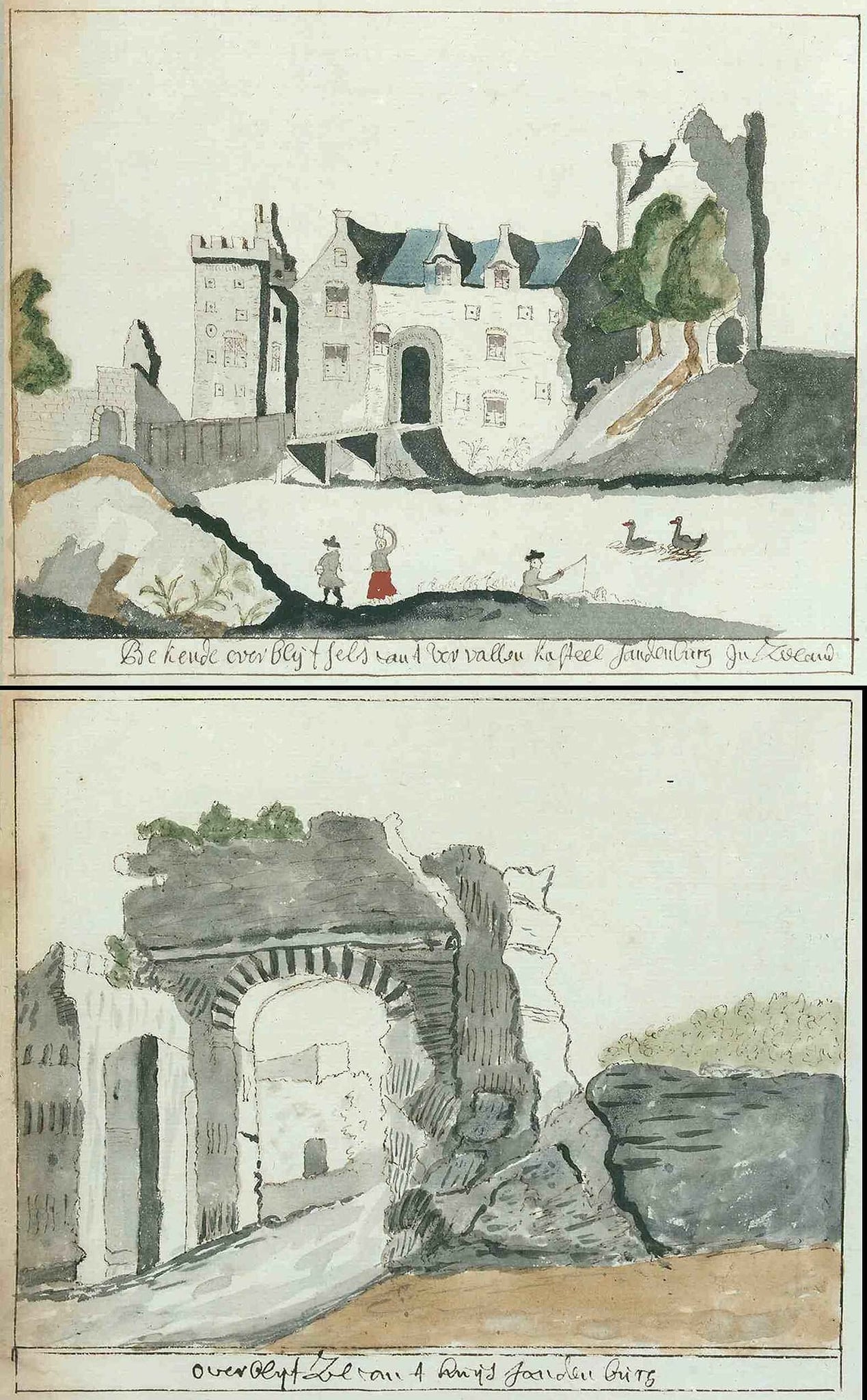
Haamstede Castle
Haamstede Castle, also known locally as Slot Haamstede, is a historic medieval fortress located in the village of Haamstede on the island of Schouwen-Duiveland, in the province of Zeeland, Netherlands. This castle's origins trace back to the 12th century, making it one of the region's significant early medieval fortifications. The site itself holds archaeological evidence of Roman habitation, indicating its strategic importance long before the castle was constructed.
Early history and origins
The original Haamstede Castle was likely a motte-and-bailey structure, typical of the High Medieval period, featuring a wooden keep situated on a raised earthwork (motte) surrounded by a protective moat. This early fortification served as a defensive residence for local lords and played a role in regional power dynamics.
By around 1200, the castle came into the possession of Floris IV, Count of Holland, a notable medieval ruler. In 1229, the castle was transferred to the Lords of Zierikzee through a land exchange with Floris IV. The new occupants adopted the surname Van Haamstede, establishing a noble lineage associated with the castle.
Architectural evolution in the 13th and 14th centuries
At the end of the 13th century, a significant architectural transformation took place. The original wooden keep was replaced by a more durable square brick keep, constructed to the west of the earlier structure. This keep was enclosed within a rectangular defensive wall, enhancing the castle's fortifications and reflecting the evolving military architecture of the period.
Following the extinction of the Van Haamstede line around 1300, the castle reverted to the control of John II of Avesnes, Count of Holland. He granted the castle to his half-brother Witte van Haemstede, an illegitimate son of Count Floris V, who continued the castle's noble lineage and influence.
Later medieval ownership and expansion
In the mid-15th century, the descendants of Witte van Haemstede faced financial difficulties, which led to the loss of the castle. Ownership passed to Louis de Gruuthuse, a prominent Flemish nobleman from Bruges. Under his stewardship, the castle was significantly enlarged, reflecting the wealth and status of its new owner.
Destruction and rebuilding in the early modern period
The castle suffered a devastating fire in 1525, reportedly caused by a party that got out of control. This fire destroyed much of the castle except for the sturdy 13th-century keep, which survived the blaze. The rest of the castle fell into ruin for several decades.
In the 17th century, the castle was rebuilt. The medieval keep was augmented with two square towers on either side, one of which served as a stair tower. This reconstruction reflected architectural trends of the period and restored the castle's residential and defensive functions.
19th and 20th-century restorations
Haamstede Castle underwent two major renovations during the 19th and 20th centuries, which shaped its current appearance. These restorations aimed to preserve the castle's historical character while adapting it for modern use and conservation standards.
Current status and access
Today, Haamstede Castle is owned by the Vereniging Natuurmonumenten, a Dutch society dedicated to the preservation of nature monuments. The castle is not generally open to the public but can be visited on special occasions. Its status as a national heritage site underscores its cultural and historical importance in the Netherlands.
Architectural significance
Haamstede Castle exemplifies the transition from early wooden fortifications to more permanent brick structures characteristic of the High Medieval period. Its surviving square keep and defensive walls illustrate medieval military architecture. The later additions of towers and renovations demonstrate evolving architectural styles and the adaptation of the castle through centuries of Dutch history.
Location and cultural context
Situated on Schouwen-Duiveland, an island in Zeeland, Haamstede Castle held strategic importance controlling local trade routes and regional power. Its proximity to the North Sea and the historical maritime activities of Zeeland add to its significance. The castle's long history from the 12th century to modern times reflects the broader historical developments of the Dutch coastal region.
Frequently asked questions (FAQ)
- Can I visit Haamstede Castle regularly?
- Haamstede Castle is generally not open to the public for regular visits. However, it can be accessed during special events or occasions organized by the Vereniging Natuurmonumenten.
- What is the historical significance of Haamstede Castle?
- Haamstede Castle is a significant medieval fortress dating back to the 12th century, illustrating the evolution of Dutch castle architecture and regional noble lineage.
- When was Haamstede Castle rebuilt after the fire?
- After the devastating fire in 1525, the castle was rebuilt in the 17th century, including the addition of two square towers flanking the medieval keep.
- Who owns Haamstede Castle today?
- The castle is currently owned by the Vereniging Natuurmonumenten, a Dutch society focused on preserving natural and historical monuments.
- What architectural style is Haamstede Castle?
- Haamstede Castle primarily reflects the characteristics of a motte-and-bailey castle from the High Medieval period, with later additions from the 17th century.
Information
Current owner
Vereniging Natuurmonumenten
Website
Visit websiteAddress
Ring 2, Haamstede, Netherlands
Sources & official resources
Verify the information above using these authoritative references.
Loading map...
Visitor reviews
No reviews yet. Been here? Write the first review and help other travelers!
Write the first reviewVisited this castle? Share your experience
Your review helps other travelers and adds first-hand knowledge to our encyclopedia.