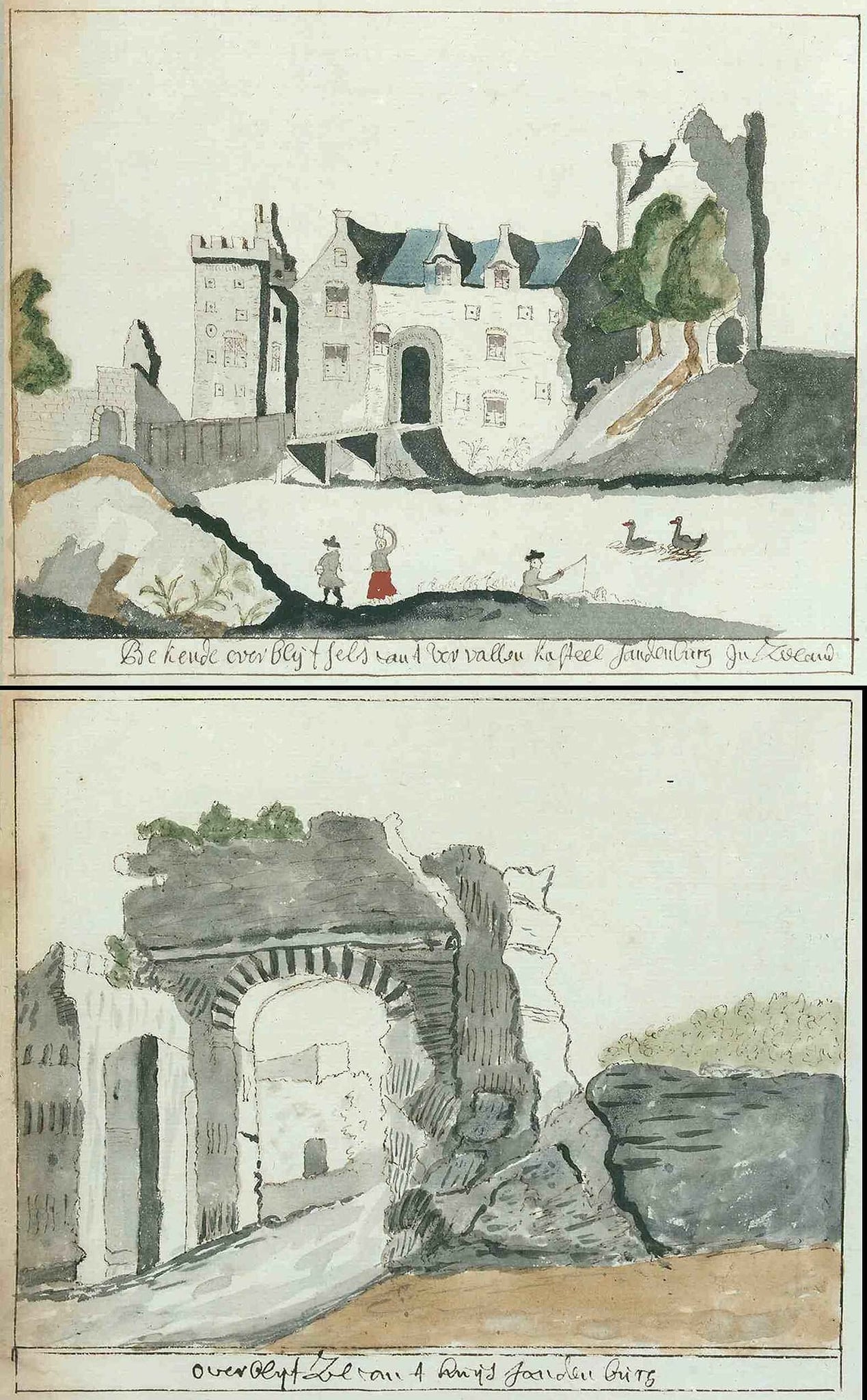
Zandenburg Castle
Zandenburg Castle, also known as Sandenburgh, was a significant medieval fortress located near the town of Veere in the province of Zeeland, Netherlands. Established around 1280 by Wolfert I of Borselen, it served as the seat of the powerful Lords of Borselen and played a pivotal role in regional politics and maritime affairs for several centuries.
The foundation and early history of Zandenburg Castle
The castle was founded in the late 13th century, a period marked by feudal consolidation and territorial disputes in the Low Countries. Wolfert I of Borselen dedicated the castle to Floris V, Count of Holland, indicating its strategic and political importance within the County of Holland's sphere of influence. The castle was built as a rectangular moated fortress, typical of late medieval defensive architecture, and was likely constructed on or near an existing motte, a raised earthwork that provided a strong defensive position.
Its location near a small harbor catalyzed the development of the town of Veere in the following decades, highlighting the castle's role not only as a military stronghold but also as a center of trade and administration.
Architectural features and layout
Zandenburg Castle was characterized by its rectangular plan surrounded by a moat, a common defensive feature in the Low Countries designed to hinder attackers and protect the castle from siege engines. The presence of a round moated hill adjacent to the main castle site suggests the original motte, a typical feature of early medieval fortifications, which may have been incorporated into or superseded by the later stone structures.
The castle complex would have included fortified walls, towers, living quarters, a chapel, and service buildings, arranged around a central courtyard. The chapel was a notable feature, serving both religious functions and as a symbol of the lord's status.
The castle's prominence in the 15th and 16th centuries
The 15th century marked the zenith of Zandenburg Castle's importance. The Lords of Borselen were influential nobles within the Burgundian Netherlands, and the castle was a hub of political and military activity. In 1437, Henry II of Borselen hosted Philip the Good, Duke of Burgundy, underscoring the castle's status as a noble residence of considerable standing.
Henry's son, Wolfert VI of Borselen, further elevated the castle's prestige through his marriage to Mary Stewart, Countess of Buchan, linking the castle to Scottish royalty. Wolfert VI was appointed Admiral of the Burgundian Netherlands in 1466, reflecting the family's maritime influence. The castle welcomed Charles the Bold, Duke of Burgundy, on two occasions, in 1451 and 1470, emphasizing its role as a center of Burgundian power.
The Burgundian and Habsburg periods
In 1485, Wolfert VI was stripped of his offices by Maximilian I of Austria, Holy Roman Emperor, following his support for Flemish revolts. After Wolfert's death in 1486, the castle passed to the House of Burgundy through the marriage of his daughter Anna to Philip of Burgundy-Beveren.
The 16th century saw the castle maintain its prominence as a noble court within the Habsburg Netherlands. Despite suffering a fire in 1505, which destroyed part of the castle, it was promptly rebuilt, demonstrating its continued importance. The castle hosted several notable figures, including Philip I of Castile in 1500, Charles V, Holy Roman Emperor in 1515 and 1540, and Philip II of Spain in 1556.
Successive Admirals of the Netherlands from the Burgundy-Beveren line—Philip, his son Adolf, and grandson Maximilian II—resided at Zandenburg, reinforcing its maritime and political significance.
Decline and destruction
The castle's decline began after the death of Maximilian II of Burgundy in 1558 without an heir. Neglect led to its deterioration. During the early stages of the Eighty Years' War, the nearby town of Veere sided with William the Silent, Prince of Orange. The castle was garrisoned by French troops who, in 1572, demolished the chapel and several ruined sections of the castle. The salvaged stones were repurposed to fortify Veere, signaling the castle's reduced military role.
By the 19th century, only ruins remained. In 1812, the last remnants of Zandenburg Castle were demolished, and the site was converted to farmland. Today, no visible structures survive, but archaeological traces and historical records preserve its legacy.
Historical significance and legacy
Zandenburg Castle played a crucial role in the political and maritime history of Zeeland and the Burgundian and Habsburg Netherlands. It was a center of noble power, maritime administration, and regional governance from the late 13th century through the 16th century. The castle's connections to prominent historical figures and events reflect its importance in the medieval and early modern periods.
Although no physical remains exist today, the site of Zandenburg Castle remains an important cultural heritage location. Its history is intertwined with the development of Veere and the broader geopolitical shifts in the Low Countries during the late medieval and Renaissance eras.
Frequently asked questions (FAQ)
- How do I get to Zandenburg Castle?
- Zandenburg Castle is located in Veere, Netherlands, easily accessible by car or public transport. If you are traveling by train, the nearest station is in Middelburg, from where you can take a bus or taxi to the castle.
- What is the historical significance of Zandenburg Castle?
- Zandenburg Castle dates back to the 14th century and played a crucial role in the defense of the region. It has witnessed many historical events and changes in ownership, making it a key landmark in the history of Zeeland.
- When was Zandenburg Castle constructed?
- Construction of Zandenburg Castle began in the late 14th century, with significant modifications made in the following centuries. Its architecture reflects the transition from medieval fortifications to Renaissance influences.
- Can I take guided tours of Zandenburg Castle?
- Yes, guided tours are available at Zandenburg Castle, providing visitors with in-depth insights into its history and architecture. These tours are conducted by knowledgeable guides who can answer any questions you may have.
- Why is Zandenburg Castle an important architectural site?
- Zandenburg Castle is notable for its unique blend of medieval and Renaissance architectural styles, showcasing the evolution of castle design in the region. It features impressive stonework, towers, and a scenic moat that enhance its historical charm.
- Is it possible to hold events at Zandenburg Castle?
- Yes, Zandenburg Castle offers facilities for private events, including weddings and corporate gatherings. The picturesque setting and rich history make it a memorable venue for special occasions.
- What are the opening hours for Zandenburg Castle?
- Zandenburg Castle is typically open to visitors from 10 AM to 5 PM, Tuesday to Sunday. However, it's advisable to check the official website for any seasonal changes in hours or special closures.
- What are the ticket prices for visiting Zandenburg Castle?
- Ticket prices for Zandenburg Castle are generally affordable, with discounts available for children and seniors. It's best to purchase tickets online in advance to avoid queues and ensure your visit.
- When is the best time to visit Zandenburg Castle?
- The best time to visit Zandenburg Castle is during the spring and early autumn when the weather is pleasant and the gardens are in full bloom. Additionally, visiting during weekdays can help you avoid larger crowds.
- Are there any nearby attractions to Zandenburg Castle?
- Yes, visitors can explore other nearby attractions such as the charming town of Veere, the picturesque harbor, and the beautiful beaches of Zeeland. These sites complement your visit to Zandenburg Castle and offer a full day of exploration.
Information
Address
Next to Kreekweg, Veere, Netherlands
Loading map...
Visitor reviews
No reviews yet. Been here? Write the first review and help other travelers!
Write the first reviewVisited this castle? Share your experience
Your review helps other travelers and adds first-hand knowledge to our encyclopedia.