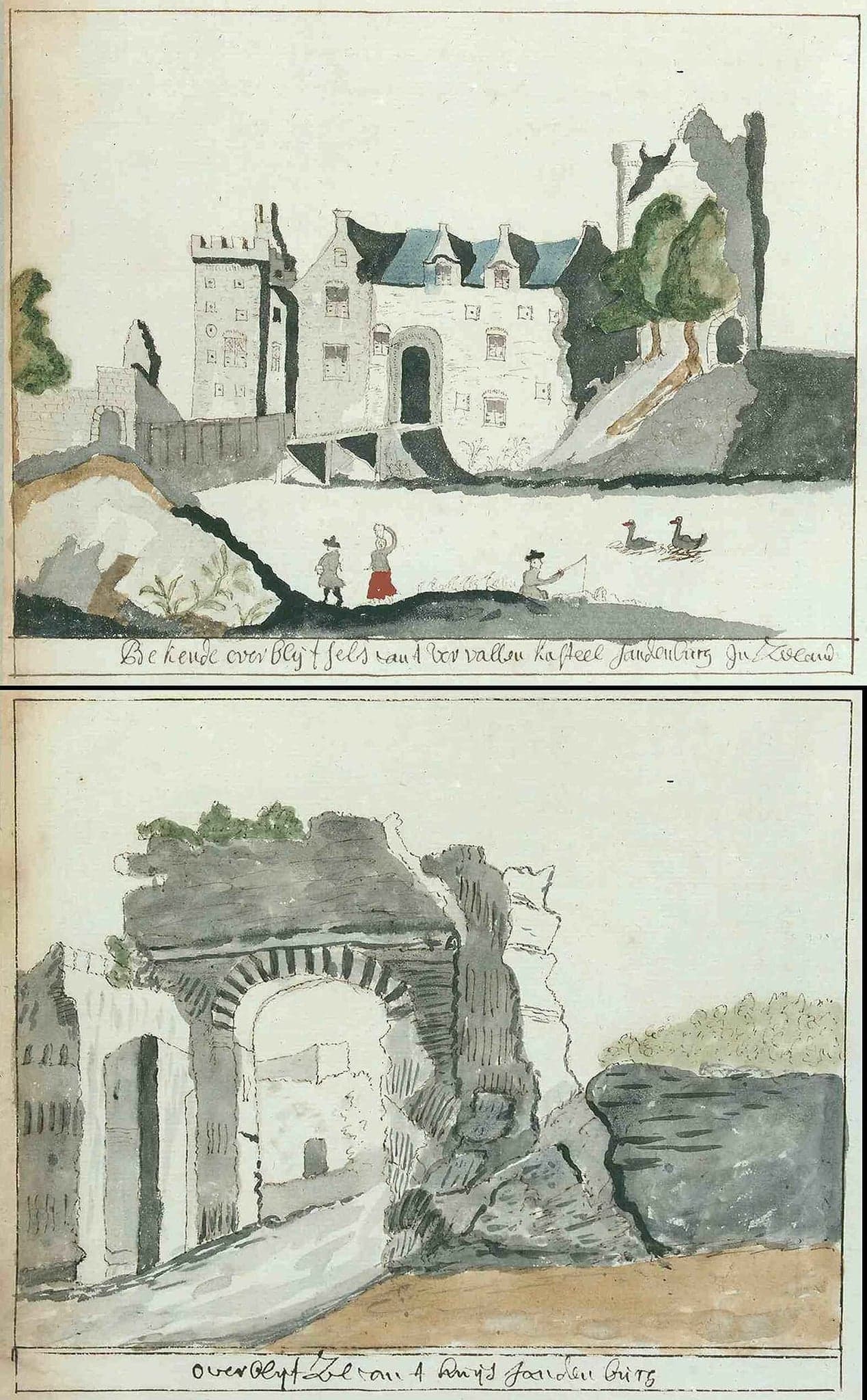
Zandenburg
Zandenburg was a prominent medieval castle located just south of the town of Veere in the Netherlands. Although the castle itself no longer stands above ground, its historical significance endures through the archaeological ruins that remain visible as foundations below the surface. These remnants offer valuable insights into the castle's former structure and the defensive strategies employed during its period of use.
Historical significance and location
The castle of Zandenburg played a notable role in the medieval history of the Zeeland region. Positioned strategically near Veere, it was part of the defensive network protecting the area from both land-based and maritime threats. The castle's location south of Veere allowed control over important trade routes and access to waterways, which were vital for commerce and military movements during the Late Medieval period.
Architectural characteristics and layout
While no above-ground structures survive, archaeological investigations have revealed the layout of Zandenburg's foundations. The castle was likely constructed as a water castle, a common type in the Netherlands, utilizing surrounding water bodies as natural defenses. Its design would have included moats, curtain walls, and possibly a central keep or residential buildings within the fortified perimeter.
Defensive features
The use of water defenses was a hallmark of castles in this region, and Zandenburg's moat system would have been integral to its protection. The castle's walls were probably reinforced with towers at key points to provide vantage points for archers and to strengthen the fortification against siege warfare prevalent in the Late Medieval era.
Destruction and current condition
Zandenburg eventually fell into disuse and was destroyed, with no visible ruins remaining today. The site is classified as archaeological ruins, with only the underground foundations preserved. These remains have been studied to understand the castle's historical footprint and architectural style, but the lack of standing structures limits the visual impression of its former grandeur.
Archaeological research and heritage value
Excavations at the Zandenburg site have provided valuable data on medieval castle construction in the Zeeland region. The findings contribute to the broader understanding of water castles in the Netherlands and their adaptation to the local landscape. The site is important for historians and archaeologists studying medieval fortifications and regional history.
Visiting the site
Today, visitors to the area near Veere can explore the general location of Zandenburg, though no castle structures are visible above ground. Interpretive signs and local museums may provide additional context about the castle's history and significance. The site is accessible for those interested in medieval history and archaeology, offering a glimpse into the past through its preserved foundations.
Frequently asked questions (FAQ)
- What is Zandenburg castle?
- Zandenburg was a medieval castle near Veere in the Netherlands, now existing only as archaeological ruins with foundations visible underground.
- When was Zandenburg castle built?
- Zandenburg was constructed during the late medieval period, although the exact date is not well documented.
- Can I visit the ruins of Zandenburg castle?
- The site of Zandenburg is accessible to visitors, but no above-ground structures remain; the castle is known only through archaeological remains.
- What type of castle was Zandenburg?
- Zandenburg was likely a water castle, typical of the Zeeland region, using moats and water defenses to protect the site.
- Why is Zandenburg historically important?
- Zandenburg played a strategic role in the defense and control of trade routes near Veere during the late medieval era.
Photo gallery

Photo by Andries Schoemaker / Gerrit Schoemaker / Cornelis Pronk / Abraham de Haen•Public domain
Information
Loading map...
Visitor reviews
No reviews yet. Been here? Write the first review and help other travelers!
Write the first reviewVisited this castle? Share your experience
Your review helps other travelers and adds first-hand knowledge to our encyclopedia.



