Gwydir Castle
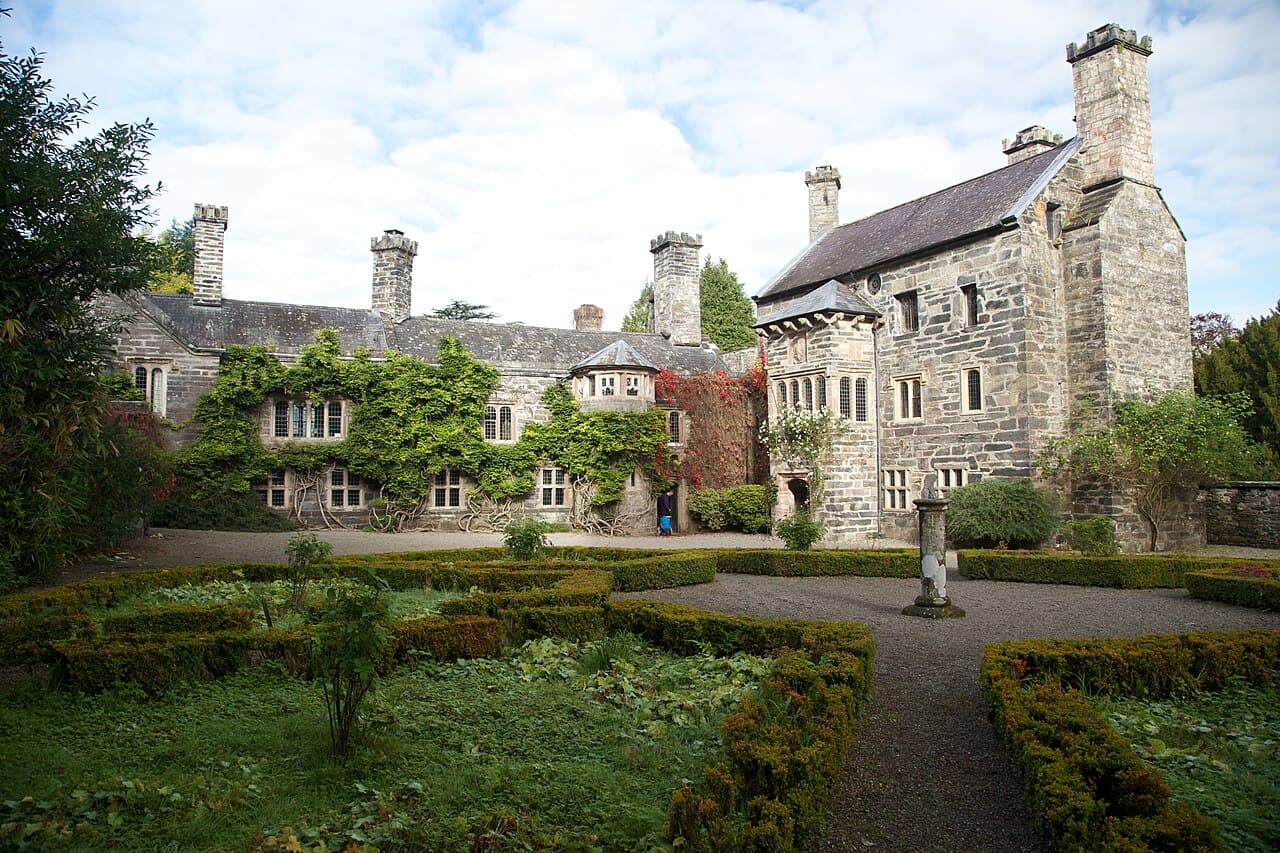
Gwydir Castle stands as a remarkable example of a Tudor courtyard house nestled near Llanrwst in the Conwy valley of Wales, United Kingdom. Its history is deeply intertwined with the region's early medieval past, with origins tracing back to fortifications from around AD 600. This site witnessed the power struggles of Welsh kingdoms, marking it as a strategically significant location for centuries.
The earliest substantial construction at Gwydir dates to the 14th century under the ownership of Hywel Coetmor, a Welsh knight renowned for his role in the Hundred Years’ War. The Coetmor family established defensive walls and a fortified entrance hall, which remain the oldest surviving architectural features of the castle. These medieval fortifications laid the groundwork for the site's evolution from a military stronghold to a stately residence.
The wynn family and tudor transformation
Following the Wars of the Roses in the late 15th century, Meredith ap Ieuan ap Robert, the progenitor of the Wynn family, undertook a comprehensive rebuilding of Gwydir Castle around 1490. The Wynns, descended from the royal line of Gwynedd, transformed the castle into their principal seat. Significant Tudor modifications ensued throughout the 16th century, including the incorporation of stone salvaged from the dissolved Maenan Abbey, reflecting the widespread reuse of monastic materials after the Dissolution of the Monasteries.
A distinctive feature from this period is the spiral staircase added circa 1540 to the Solar Tower, exemplifying Tudor craftsmanship and architectural innovation. The castle's layout centers around a courtyard with a prominent gatehouse bearing the initials of John Wyn ap Maredudd and the date 1555, showcasing elaborately carved stonework with Gothic stylistic influences.
17th-century royal connections and estate expansion
In the mid-17th century, King Charles I visited Gwydir Castle in 1645, underscoring its importance in the region. By the late 17th century, the estate had expanded to approximately 36,000 acres, though much of the land was rugged and mountainous, containing slate and mineral mines that saw limited exploitation.
Ownership passed through marriage in 1678 to the Barons Willoughby de Eresby, linking the castle to English nobility. Around 1600 and again in the 19th century, the castle underwent further alterations, including partial demolition and remodeling led by Lord Willoughby. The 19th-century landscaping was enhanced by the renowned architect Sir Charles Barry, who designed the Knot Garden in 1828 featuring a Tudor rose motif.
Architectural features and interior highlights
The castle today reflects its Tudor heritage with a courtyard design largely constructed from stone reclaimed from Maenan Abbey. The Solar Tower and its spiral staircase remain key architectural highlights. The main dining room, designed in the 1640s by Richard Wynn, features finely carved and gilded wood paneling and decorative leatherwork. This room's design may have been influenced by the prominent architect Inigo Jones. Although the paneling was removed in the early 20th century and housed abroad, it was restored to the castle in 1998.
Fire damage and restoration efforts
In 1922, devastating fires damaged the roof of the Solar Tower and parts of the West Wing, leaving the castle uninhabitable for decades. Restoration efforts began in 1944 under Arthur Clegg and continued into the late 20th century, with significant work by Peter Welford and Judy Corbett, who chronicled the restoration in her book "Castles in the Air." These efforts preserved original features alongside later architectural interventions.
Gardens and landscape heritage
The castle is set within a Grade I listed garden of about ten acres, featuring ancient cedars including one planted in 1625 to commemorate King Charles I's wedding. The garden also contains a yew tree estimated to be between 600 and 1,000 years old, a raised terrace with a Renaissance-style arch from the 1590s, and an Old Dutch garden with ancient yew topiary and an octagonal fountain.
Additional garden areas include the Royal and Statesman’s gardens with Welsh oaks planted to honor the 1899 royal visit by King George V and Queen Mary, as well as plantings from 1911. The Elizabethan-era causeway called the Chinese Walk leads from the castle grounds to the River Conwy and the historic site of Gwydir Quay, linking the estate to historic river transport routes.
Associated structures and heritage protection
Close to the castle is the Gwydir Uchaf Chapel, built in 1673 by Sir Richard Wynn as a family memorial. This chapel, notable for its painted ceiling, is protected by Cadw, the Welsh historic environment service. It is distinct from the nearby Gwydir Chapel attached to the Llanrwst parish church, emphasizing the estate's layered religious and familial heritage.
Overall, Gwydir Castle embodies a rich historical narrative spanning from early medieval fortifications through Tudor architectural innovation to Victorian landscape design. Its preservation and restoration efforts have maintained its status as a significant cultural and architectural landmark in Wales.
Frequently asked questions (FAQ)
- How do I visit Gwydir Castle?
- Gwydir Castle is privately owned and visits are usually by appointment. It is best to check locally for availability and arrange a guided tour if possible.
- What architectural styles are visible at Gwydir Castle?
- Gwydir Castle showcases a mix of late medieval and Tudor architectural styles, with Gothic influences evident in its stonework and a distinctive Tudor spiral staircase in the Solar Tower.
- When was Gwydir Castle originally built?
- The site has early medieval origins around AD 600, with the earliest significant fortifications established in the 14th century by the Coetmor family. The main Tudor reconstruction occurred around 1490.
- What notable historical figures are associated with Gwydir Castle?
- The Wynn family, descended from the royal line of Gwynedd, were principal owners who rebuilt the castle in Tudor times. King Charles I visited in 1645, and later the estate passed to the Barons Willoughby de Eresby.
- Are the gardens at Gwydir Castle open to the public?
- The Grade I listed gardens are part of the estate and may be accessible during special events or by arrangement. They feature historic plantings including ancient cedars and yews, as well as Renaissance and Tudor garden elements.
Photo gallery

Information
Opening hours
By appointment only
Ticket prices
Varies, check locally
Current owner
Private owner
Website
Visit websiteSources & official resources
Verify the information above using these authoritative references.
Loading map...
Visitor reviews
No reviews yet. Been here? Write the first review and help other travelers!
Write the first reviewVisited this castle? Share your experience
Your review helps other travelers and adds first-hand knowledge to our encyclopedia.