Conwy Castle
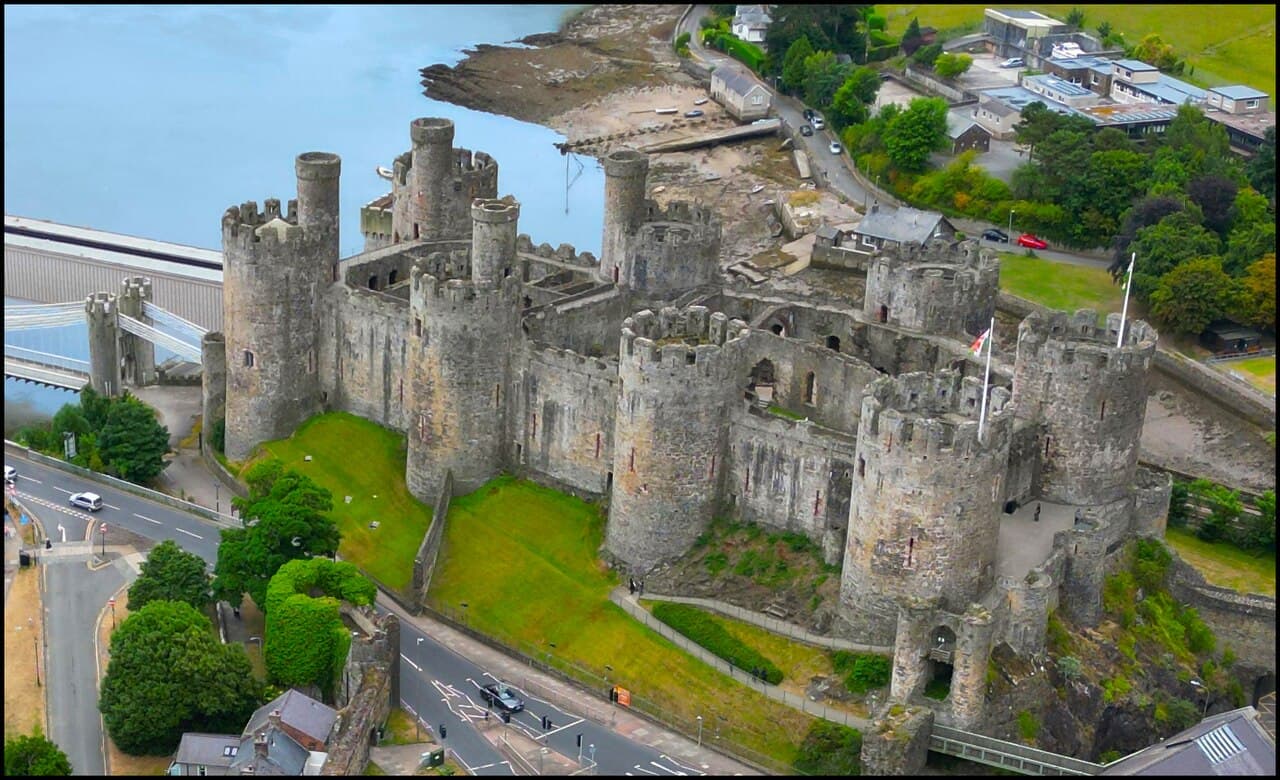
Conwy Castle stands as a monumental example of late 13th-century military architecture in Wales, constructed between 1283 and 1287 under the direction of King Edward I during his campaign to conquer Wales. This hill castle was part of a larger strategic plan to establish English dominance in the region by building a fortified town and castle on the site of the former Aberconwy Abbey, which was relocated to make way for the new constructions. The castle's location on a rocky coastal ridge overlooking the River Conwy provided a commanding view of an important crossing point, making it a critical military and administrative center.
The castle's design and construction were overseen by the master mason James of St. George, whose expertise brought continental influences from the Kingdom of Savoy to North Wales, evident in architectural features like the distinctive triple finial crenellations and the earliest surviving stone machicolations in Britain. Built primarily from local grey sandstone and limestone, with imported sandstone used for detailed carving, the castle exhibits a rectangular layout divided into an Inner and Outer Ward, each protected by four massive towers approximately 21 meters tall. Two barbicans guard the main western and eastern entrances, with a hidden postern gate leading down to the river for resupply by sea.
Historical significance and military role
Conwy Castle played a pivotal role in the turbulent history of Wales and England. It withstood the siege during the Welsh uprising led by Madog ap Llywelyn in 1294–95, demonstrating its formidable defenses. The castle also served as a refuge for King Richard II in 1399 amid political upheaval. In 1401, it was captured by forces loyal to the Welsh rebel Owain Glyndŵr, who held it for several months during his national rebellion. During the English Civil War (1642–1646), Conwy Castle was held by royalist troops loyal to Charles I before surrendering to Parliamentary forces, after which it was partially slighted to prevent further military use.
Following the war, the castle fell into ruin when valuable materials such as iron and lead were stripped and sold in 1665. Despite this, the castle's ruins became a popular subject for artists in the late 18th and early 19th centuries, attracting painters like J. M. W. Turner. Restoration efforts began in the 19th century and have continued under the stewardship of Cadw, the Welsh Government's historic environment service, which manages the site today as a major tourist attraction.
Architectural features and layout
The outer ward and defenses
The Outer Ward of Conwy Castle was designed to house administrative and service buildings essential for the castle's operation. Its eight towers—four on each side—are substantial and imposing, each about 70 feet tall with diameters of 12 to 13 meters. The western barbican, serving as the main entrance, features the earliest stone machicolations in Britain, allowing defenders to drop projectiles on attackers below. Originally accessed by a drawbridge and masonry ramp, this entrance was heavily fortified with a portcullis and thick walls.
Within the Outer Ward, the north-west tower contained the porter's lodge and storage rooms, while the south-west tower served as quarters for the constable or garrison and included a bakehouse. The southern side housed the great hall and chapel, built above vaulted cellars with surviving 14th-century stone arches. The constable's tower also contained prison facilities, including a debtors' chamber and an underground dungeon. To the north, a complex of service buildings included a kitchen, brewhouse, and additional bakehouses, supported by the tall kitchen tower.
The inner ward and royal apartments
The Inner Ward was originally separated from the Outer Ward by a ditch and drawbridge, now filled in. It contained the royal private apartments, considered some of the best-preserved medieval royal living quarters in England and Wales. These chambers were arranged around a courtyard on the first floor and included a great chamber, outer chamber, and inner chamber, designed to provide privacy and security for the royal household.
The four towers surrounding the Inner Ward held service rooms, with the north-east tower containing a private chapel for the royal family. These towers also featured watchtower turrets intended for security and the display of the royal flag. The Inner Ward functioned as a miniature palace within the castle, capable of being sealed off during sieges and supplied by sea through the eastern barbican, which enclosed a garden space that evolved over centuries from lawn to vineyards and ornamental flowers.
Conwy Castle in later centuries
After the medieval period, the castle's military importance declined. By the 16th century, it was used as a prison, depot, and occasional residence. The castle fell into disrepair by the early 17th century and was sold into private hands. During the English Civil War, it was garrisoned and saw conflict before being slighted by Parliamentary order to prevent further military use.
In the 18th and 19th centuries, Conwy Castle became a symbol of romantic ruin, inspiring artists and attracting tourists. Restoration efforts in the 19th and 20th centuries, including significant work by Arnold Taylor, helped preserve the structure. Today, the castle is part of the UNESCO World Heritage Site "Castles and Town Walls of King Edward in Gwynedd" and is managed by Cadw, welcoming hundreds of thousands of visitors annually.
Architectural influences and legacy
The design of Conwy Castle reflects the influence of continental European military architecture, particularly from the Kingdom of Savoy, brought by James of St. George. Features such as the triple pinnacled merlons, window styles, and putlog hole arrangements are closely linked to Savoyard castles like Castello di San Giorio di Susa, which Edward I visited in 1273.
Conwy Castle remains a remarkable example of Edwardian castle building, combining military functionality with royal residential comfort. Its preservation offers invaluable insight into medieval fortification techniques and the political history of Wales and England during a period of conquest and rebellion.
Visiting Conwy Castle today
Managed by Cadw, Conwy Castle is open to the public as a well-preserved historic site. Visitors can explore the extensive curtain walls, imposing towers, and the royal apartments, gaining a vivid sense of medieval life and military strategy. The castle's location near the Irish Sea and the town of Conwy provides stunning views and access to other heritage attractions.
The site includes a visitor center and interpretive panels that detail the castle's rich history and architectural features. Its designation as a UNESCO World Heritage Site underscores its cultural and historical significance, making it a must-visit destination for those interested in medieval history and castle architecture.
Frequently asked questions (FAQ)
- How do I get to Conwy Castle?
- Conwy Castle is located in the town of Conwy, North Wales, easily accessible by car, bus, or train. The castle is a short walk from Conwy railway station and well signposted within the town.
- What are the opening hours of Conwy Castle?
- Conwy Castle is open daily from 9:30 AM to 5:00 PM, with the last admission typically 30 minutes before closing. Hours may vary seasonally, so it is advisable to check ahead before visiting.
- Is there an admission fee to enter Conwy Castle?
- Yes, there is an admission fee to visit Conwy Castle. Tickets cost £8.50 for adults, £5.00 for children, and £22.00 for families. Cadw members and children under 5 usually enter for free.
- What is the historical significance of Conwy Castle?
- Conwy Castle is one of the finest examples of Edwardian military architecture in Europe, built by King Edward I during his conquest of Wales. It played key roles in Welsh uprisings, royal refuge, and the English Civil War.
- Can I climb the towers at Conwy Castle?
- Yes, visitors can climb several of the castle's towers, including those in the Inner and Outer Wards, offering panoramic views of Conwy town, the River Conwy, and the surrounding landscape.
- Is Conwy Castle accessible for people with limited mobility?
- Due to the castle's medieval structure and uneven terrain, full access for visitors with limited mobility is challenging. However, the visitor center and some areas near the entrance are accessible, and staff can provide assistance.
- What nearby attractions can I visit after Conwy Castle?
- Nearby attractions include the Conwy town walls, Plas Mawr Elizabethan townhouse, and the scenic Conwy Quay. The area also offers coastal walks and the Snowdonia National Park within short driving distance.
Photo gallery

Information
Opening hours
09:30-17:00, daily
Ticket prices
£8.50 adult, £5.00 child, £22.00 family
Current owner
Cadw
Website
Visit websiteSources & official resources
Verify the information above using these authoritative references.
Loading map...
Visitor reviews
No reviews yet. Been here? Write the first review and help other travelers!
Write the first reviewVisited this castle? Share your experience
Your review helps other travelers and adds first-hand knowledge to our encyclopedia.