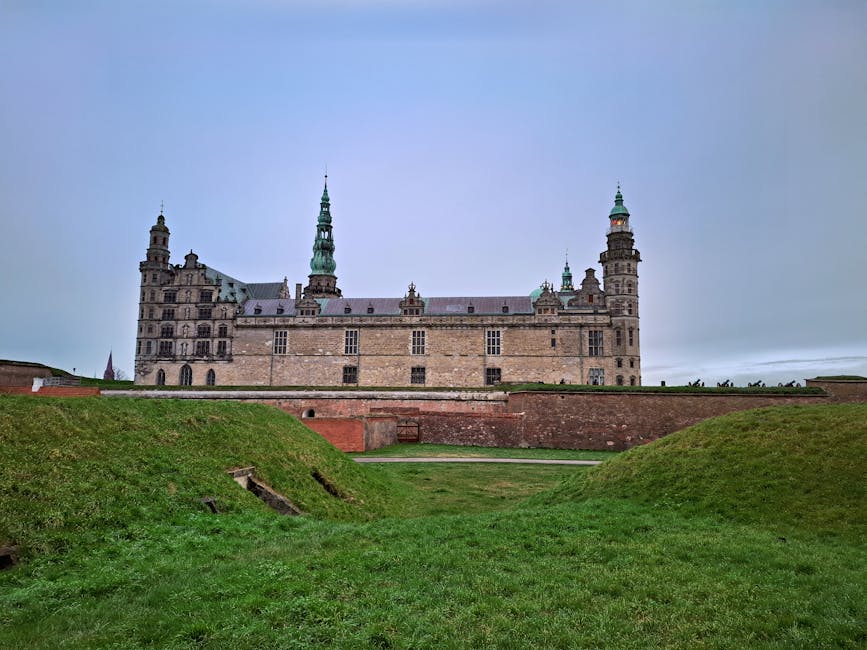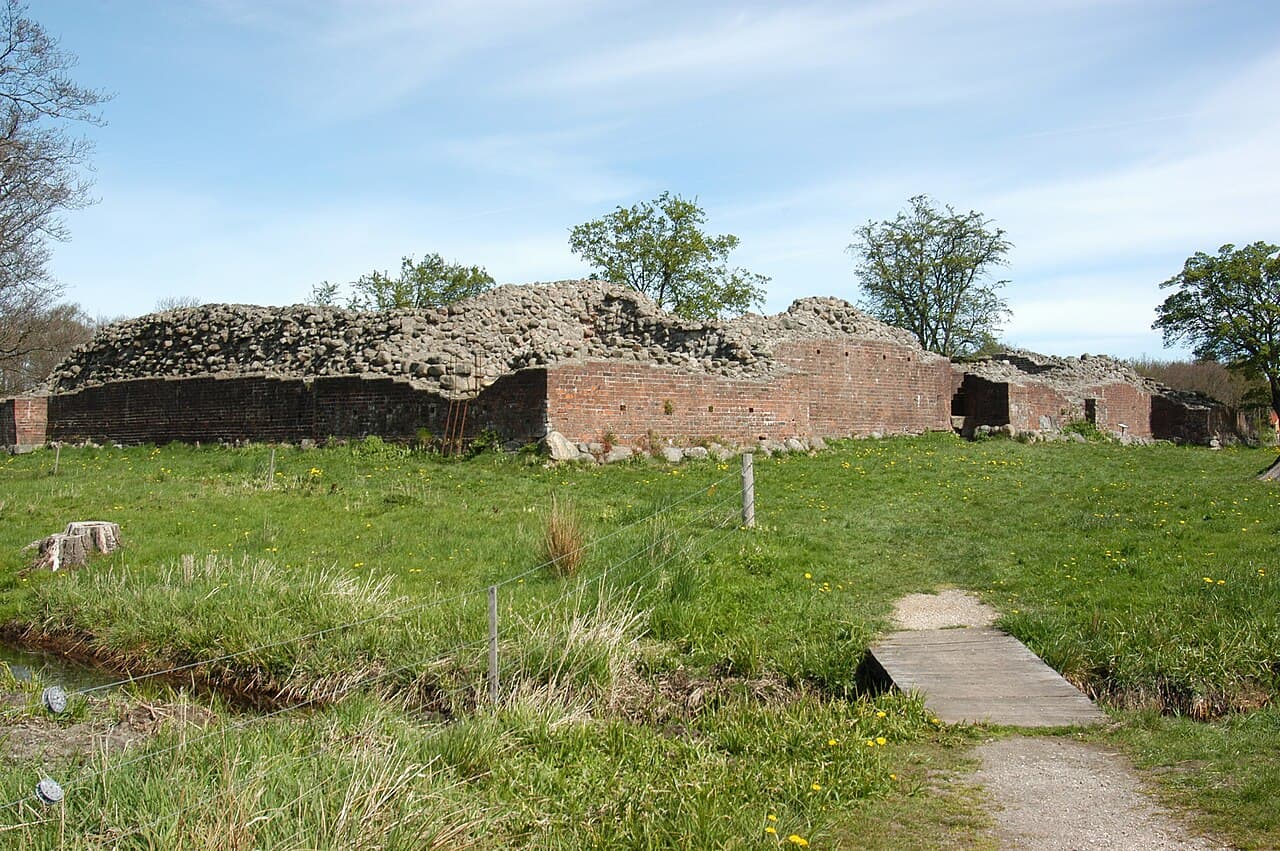
Gurre Castle Ruins
Gurre Castle is a historic medieval fortress located near the village of Kvistgård in North Zealand, Denmark. Originally constructed in the 12th century, this royal castle served as a significant stronghold and residence for Danish kings throughout the High Medieval period. The castle is renowned not only for its architectural features but also for its association with the legendary love story of King Valdemar IV Atterdag and his mistress Tove Lille, which has profoundly influenced Danish cultural heritage.
Early construction and historical context
The initial phase of Gurre Castle's construction likely began in the late 13th century during the reign of King Erik Menved (1286–1319), although the site itself dates back to the 12th century. The castle was strategically built on a natural hill overlooking Gurre Lake, offering both defensive advantages and control over the surrounding region. The earliest core structure was a robust donjon or main tower, designed as a secure last refuge during sieges, with no entrance at ground level to prevent enemy access.
This central tower was surrounded by an outer enclosure, separated by a moat, which formed the initial defensive perimeter. The castle's location near the village of Gurre and its proximity to Helsingør placed it within an important political and military landscape of medieval Denmark.
Expansion under valdemar iv atterdag
In the 1350s and 1360s, significant expansions were undertaken by King Valdemar IV Atterdag (reigned 1340–1375), who transformed Gurre Castle into a more formidable fortress. He added a ring wall with four corner towers constructed of stone and brick, enclosing a roughly rectangular area measuring approximately 230 by 180 meters. This new defensive wall enhanced the castle's protection and defined a compact fortress complex.
The outer bailey was also expanded with new brick buildings, erected on raised artificial mounds to adapt to the marshy terrain surrounding the castle. These buildings included a large three-aisled hall measuring 48 by 15 meters, featuring tiled floors and a stone foundation that once supported a 14th-century tiled stove. The side aisles likely served as quarters for the royal cavalry, while the central aisle was reserved for other functions.
Additional brick structures within the bailey, such as a 10 by 17 meter building with a tiled floor, indicate the castle's role as both a military and residential center. Nearby facilities included a brick kiln, a smithy for metalworking, and a lime kiln essential for producing mortar for construction and repairs.
Historical significance and legends
Gurre Castle is closely linked to the legend of King Valdemar IV Atterdag and his mistress Tove Lille, a tale of love and jealousy that has become a national myth in Denmark. The story was immortalized in poetry by Jens Peter Jacobsen and inspired the German composer Arnold Schönberg to create the cantata "Gurrelieder." This cultural legacy adds a rich layer of historical and literary significance to the castle ruins.
Valdemar IV died at Gurre Castle in 1375, marking the end of an era for the fortress. During the 14th and early 15th centuries, the castle also functioned as a minting site for coins known as "Gurre Gros," underscoring its administrative importance.
Ownership shifted in the early 16th century, with the castle passing between the Danish Crown and Bishop Joakim Rønnow before falling into disuse. By the mid-1500s, under King Frederik II, the castle was dismantled, and many of its stones were repurposed for other building projects.
Archaeological excavations and preservation
Interest in Gurre Castle's ruins began in the early 19th century, with initial excavations starting in 1817 and more extensive digs from 1835 onward. Archaeological investigations revealed the castle's layout, including its defensive walls, towers, and residential buildings. Restoration work between 1936 and 1939 uncovered additional structures and a well within the central tower, highlighting the castle's self-sufficiency during sieges.
Later excavations around 2000 uncovered paved surfaces indicating former courtyards or pathways, further illuminating the castle's complex infrastructure. Today, the ruins are protected as a listed ancient monument, preserving the site for historical study and public visitation.
Architectural remains and features
The visible remains of Gurre Castle include the central donjon, standing about three meters high, and sections of the surrounding ring wall with four corner towers, some reaching up to 3.5 meters in height. The donjon's design, with no ground-level entrance, reflects medieval defensive strategies.
The outer bailey's brick buildings, partially preserved despite peat coverage and collapse, demonstrate the castle's adaptation to its marshy environment through raised artificial mounds. The large hall with three aisles and tiled floors illustrates the combination of comfort and military function within the fortress.
Nearby industrial facilities such as the brick kiln, smithy, and lime kiln reveal the castle's role as a center of production and maintenance, essential for sustaining its operations. The foundations of St. Jacob's Chapel, dedicated to the Apostle James and recipient of papal relics in 1364, mark the spiritual dimension of the castle complex.
Defensive structures
The ring wall and corner towers provided a strong defensive perimeter, with curtain walls constructed from stone and brick. The moat surrounding the initial enclosure added an extra layer of protection. The discovery of a well inside the donjon ensured a water supply during sieges, a critical feature for prolonged defense.
Residential and administrative areas
The castle served as a royal residence and administrative center, evident from the minting of coins and the presence of well-crafted brick buildings with tiled floors. These structures accommodated the royal household, military personnel, and administrative functions.
Cultural heritage and tourism
Today, Gurre Castle ruins attract visitors interested in medieval history, architecture, and Danish folklore. The site's connection to legendary figures and its role in national myths enhance its appeal. Preservation efforts maintain the ruins as a cultural landmark, with interpretive signage and pathways allowing exploration of the castle's remains.
The castle's picturesque setting near Gurre Lake and the surrounding North Zealand landscape offers a scenic backdrop for visitors and historians alike. The site serves as a valuable resource for understanding medieval Danish royal architecture and the historical narratives that shaped the region.
Frequently asked questions (FAQ)
- What is the historical significance of Gurre Castle Ruins?
- Gurre Castle Ruins are the remnants of a royal castle dating back to the early 15th century, associated with King Eric of Pomerania. The castle played a vital role in Danish history, particularly during the Kalmar Union, and its ruins are a testament to the medieval architecture and royal life of that era.
- When was Gurre Castle built?
- Gurre Castle was originally constructed around 1400 and was later expanded in the 16th century. It served as a royal residence and military stronghold until it was abandoned, with significant destruction occurring in the 17th century.
- Can I visit Gurre Castle Ruins?
- Yes, visitors are welcome to explore the Gurre Castle Ruins. While the site is largely in ruins, it offers a fascinating glimpse into Denmark's medieval past, and visitors can enjoy walking around the site and taking photographs.
- What are the opening hours of Gurre Castle Ruins?
- Gurre Castle Ruins are typically open to the public year-round, but it's always best to check local guidelines for any seasonal changes. The site is accessible during daylight hours, allowing visitors ample time to explore.
- Is it possible to take guided tours of Gurre Castle?
- Currently, there are no formal guided tours available at Gurre Castle Ruins. However, visitors can explore the area independently and may find informational plaques that provide insights into the castle's history and significance.
- What is the best time to visit Gurre Castle Ruins?
- The best time to visit Gurre Castle Ruins is during the late spring and early autumn months when the weather is mild and conducive for outdoor exploration. These seasons also allow for beautiful scenery and fewer crowds, enhancing the visitor experience.
- Are there any nearby attractions to Gurre Castle Ruins?
- Yes, nearby attractions include the beautiful Lake Gurre, which offers scenic walking trails and picnic spots. Additionally, the charming town of Hillerød, home to Frederiksborg Castle, is just a short drive away and makes for an excellent day trip.
- What are the ticket prices for visiting Gurre Castle Ruins?
- Admission to Gurre Castle Ruins is free, making it an accessible destination for history enthusiasts and families alike. Visitors may wish to bring a picnic to enjoy on the grounds while soaking in the historical ambiance.
- How do I get to Gurre Castle Ruins?
- Gurre Castle Ruins are located just outside of Kvistgård, Denmark, and can be reached by car or public transport. The nearest train station is in Hillerød, from where you can take a short taxi ride or enjoy a scenic walk to the ruins.
Photo gallery

Information
Sources & official resources
Verify the information above using these authoritative references.
Loading map...
Visitor reviews
No reviews yet. Been here? Write the first review and help other travelers!
Write the first reviewVisited this castle? Share your experience
Your review helps other travelers and adds first-hand knowledge to our encyclopedia.