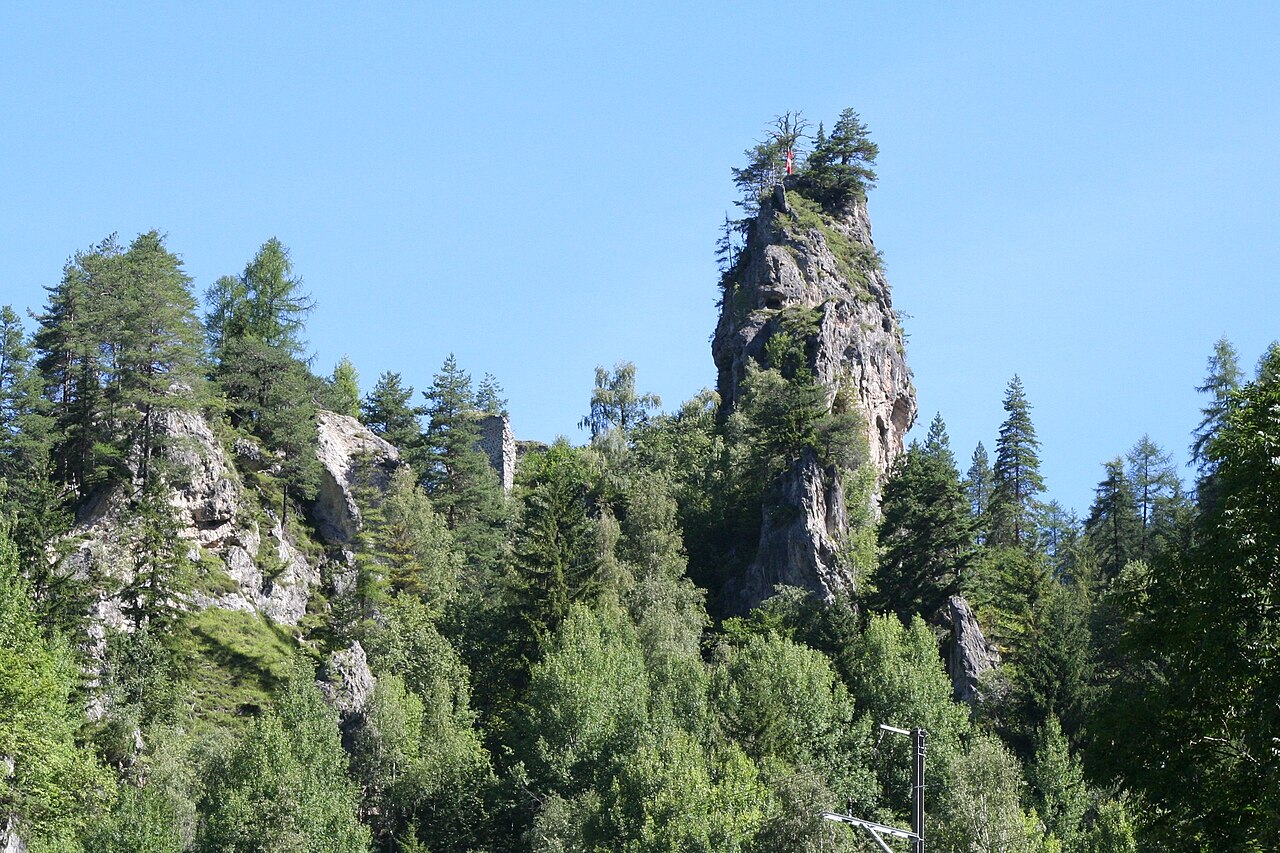
Guardaval Castle
Guardaval Castle is a striking example of a 13th-century hill castle located near Madulain in the Upper Engadine region of Switzerland. Founded around 1250 by the Bishop of Chur, Volkard von Neuenburg, the castle was strategically positioned to control a vital mule track linking Zuoz to the Albula Pass. This location enabled the bishop to exercise authority over the region by collecting tolls from travelers and managing his extensive estates.
Historical context and ownership
The castle's initial construction centered on a single main tower, or bergfried, which served as a symbol of episcopal power and a defensive stronghold. Over the following decades, the castle evolved with the addition of a curtain wall, a gatehouse on the southern side, an outer courtyard known as a zwinger, and residential quarters to the east. These enhancements reinforced Guardaval's dual function as both a military fortification and an administrative center.
In the 14th century, ownership of the castle shifted to the influential Planta family from nearby Zuoz. The Plantas were prominent landowners engaged in regional industries such as mining and fishing. Their alliance with the League of God's House, a political coalition established in 1367 to curb episcopal power, marked a significant shift in local governance. Despite their increasing autonomy, the bishop retained authority over the castle, requiring the Planta family to maintain it for military readiness.
Financial pressures forced the bishop to pledge Guardaval to the League of God's House in 1409, signaling the beginning of the castle's decline as an administrative hub. By the late 15th century, the castle was abandoned, and by the early 17th century, it had fallen into ruin. Historical accounts from around 1550 describe the castle as largely intact but deserted.
Architectural features and layout
Guardaval Castle is perched on a rocky outcrop at an elevation of 1785 meters, commanding views of the surrounding landscape. The centerpiece is the bergfried, a tower approximately 10 meters tall with a high entrance on its second floor facing southeast. The tower's interior lacks permanent living quarters but contains narrow arrow-slit windows with inwardly angled benches, allowing defenders to observe and fire upon approaching enemies. Beam holes near the top indicate the presence of a former wooden gallery or balcony used for surveillance and defense.
The tower's stone walls retain patches of medieval plaster with visible trowel marks, highlighting the craftsmanship of the period. A distinct masonry joint reveals where the original freestanding tower was later integrated into a surrounding ring wall, which encloses an irregular rectangular courtyard. The bergfried forms much of the western boundary of this courtyard.
On the southern side, a gatehouse and a small zwinger once stood as key defensive features designed to slow attackers. Unfortunately, this area suffered significant damage during the 19th century when a restaurant was constructed on the site, leading to the loss of much original masonry. This building was later removed during restoration efforts beginning in 1935.
Within the courtyard, the western side contains the remains of a long building subdivided into smaller rooms, interpreted as living quarters and stables. To the east, a residential wing with two large rooms likely served accommodation or administrative purposes. Defensive measures included a ditch on the mountain-facing northern side, enhancing protection against assault.
Restoration and preservation efforts
Despite the damage inflicted by 19th-century construction, restoration campaigns that began in 1935 have stabilized and preserved the ruins. Further conservation work between 2005 and 2006 improved the site's condition, allowing visitors and scholars to appreciate the castle's significant architectural and historical value. These efforts have helped maintain the integrity of the main structures, including the bergfried, curtain walls, and residential wings.
Historical significance and cultural legacy
Guardaval Castle played a crucial role in the medieval administration of the Upper Engadine region. Its strategic position allowed for effective control of trade routes and collection of tolls, reflecting the bishop's temporal power. The castle's transition to the Planta family and eventual pledge to the League of God's House illustrate the shifting political dynamics in the region during the Late Middle Ages.
Local folklore speaks of a harsh bailiff residing at the castle, although historical records do not support this narrative. The Planta family, known custodians of Guardaval, maintained generally positive relations with neighboring communities, underscoring the castle's role as a center of regional governance rather than oppression.
Visiting Guardaval Castle today
Today, Guardaval Castle stands as a well-preserved hill castle ruin offering insight into medieval fortification and administration in the Swiss Alps. Its elevated position provides visitors with panoramic views of the surrounding mountains and valleys. The site is accessible via hiking trails from Madulain and nearby villages, making it a popular destination for history enthusiasts and nature lovers alike.
Interpretive signage and guided tours help visitors understand the castle's architectural features and historical context. The preservation of the bergfried and curtain walls allows for an immersive experience of medieval castle life and defense strategies. Guardaval Castle remains a testament to the complex feudal and political landscape of medieval Switzerland.
Frequently asked questions (FAQ)
- How do I get to Guardaval Castle?
- Guardaval Castle is accessible via hiking trails from the village of Madulain in the Graubünden region of Switzerland. The trails offer scenic views and are suitable for visitors with moderate fitness levels.
- What is the historical significance of Guardaval Castle?
- Guardaval Castle was built in the mid-13th century to control a key mule track and collect tolls, serving as an administrative center for the Bishop of Chur. It later came under the Planta family and the League of God's House, reflecting regional political shifts.
- Can I explore the castle ruins?
- Yes, visitors can explore the well-preserved ruins of Guardaval Castle, including the bergfried, curtain walls, and residential quarters. Interpretive signs provide historical context to enhance the experience.
- When is the best time to visit Guardaval Castle?
- The best time to visit Guardaval Castle is during the late spring to early autumn months when hiking trails are clear and weather conditions are favorable for outdoor exploration.
- Is there an admission fee to visit Guardaval Castle?
- No, visiting Guardaval Castle is free of charge. The site is open year-round and accessible to the public without an admission fee.
Information
Opening hours
Open year-round, accessible via hiking trails
Ticket prices
Free
Current owner
Municipality of Madulain
Loading map...
Visitor reviews
No reviews yet. Been here? Write the first review and help other travelers!
Write the first reviewVisited this castle? Share your experience
Your review helps other travelers and adds first-hand knowledge to our encyclopedia.