Gruyeres Castle
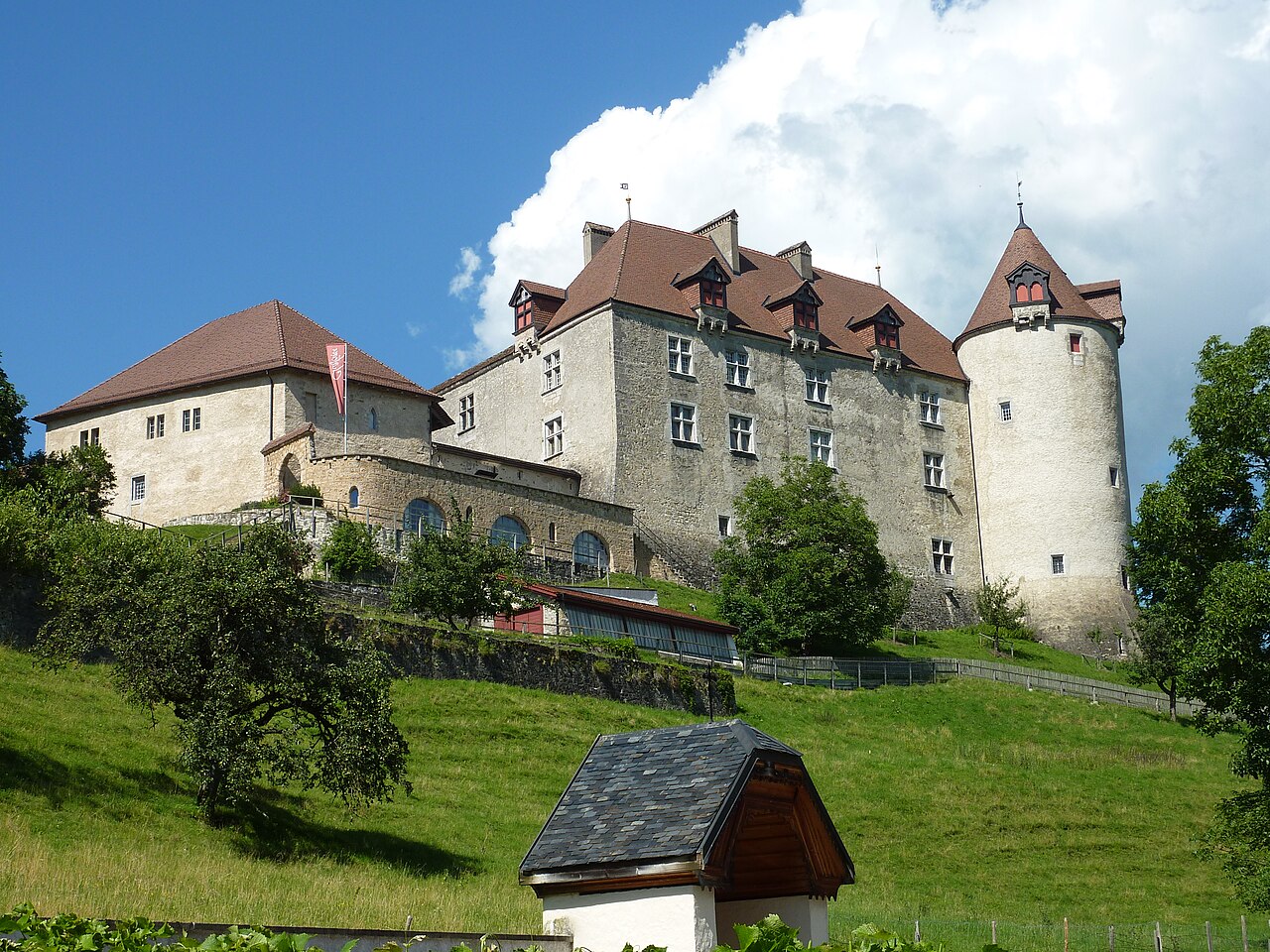
Gruyeres Castle stands as one of Switzerland's most iconic medieval fortresses, perched above the picturesque town of Gruyeres in the canton of Fribourg. Constructed in the 13th century, this castle exemplifies the typical square plan fortifications characteristic of the Savoy region during the High Medieval period. Its strategic location and robust architecture reflect its historical role as a seat of power and defense.
The castle was originally the ancestral home of the Counts of Gruyères, a noble lineage that governed the region for several centuries. The earliest construction phase dates from approximately 1270 to 1282, during which the main defensive structures, including the curtain walls, towers, and gatehouse, were established. These elements highlight medieval military architecture with thick stone walls, battlements, and arrow slits designed for defense against sieges.
Historical significance and ownership transitions
Throughout its history, Gruyeres Castle has witnessed significant political and social changes. The last count, Michel of Gruyères, faced financial ruin leading to his bankruptcy in 1554. Consequently, the castle and its associated lands were divided between the cantons of Fribourg and Bern, marking the end of the Gruyères noble line. From 1555 to 1798, the castle served as the residence of the bailiff of Fribourg, who administered the region on behalf of the canton. Later, it became the home of the prefect until the political reforms of 1848.
In 1849, the castle was sold to the Bovy and Balland families, who used it as a summer residence. These owners were instrumental in restoring the castle, preserving its medieval character while adapting it for residential use. Their restoration efforts involved collaboration with artists and craftsmen, enriching the castle’s cultural heritage.
Architectural features and layout
Gruyeres Castle is constructed on a hilltop, offering commanding views of the surrounding landscape. The fortress follows a square layout, typical of Savoyard military architecture, with four corner towers connected by fortified walls. The main entrance is protected by a gatehouse and defensive towers, emphasizing security and control.
Inside, the castle contains a variety of medieval rooms including the great hall, chapel, dungeons, and residential chambers. The interiors feature original stonework, wooden beams, and period furnishings that evoke the castle’s historical ambiance. The castle’s defensive elements, such as battlements and arrow slits, remain well-preserved, illustrating the military engineering of the time.
Art collections and cultural heritage
Today, Gruyeres Castle functions as a museum that preserves and displays its rich history and art collections. It houses notable artifacts such as the three capes of the Order of the Golden Fleece, war trophies captured by Swiss forces at the Battle of Morat in 1476. These capes include a rare black velvet sacerdotal vestment embroidered with the emblem of Philip the Good, Duke of Burgundy.
The museum also exhibits a significant collection of 19th-century landscape paintings by artists like Jean-Baptiste-Camille Corot and Barthélemy Menn. These artworks enhance the castle’s cultural value, attracting visitors interested in both medieval history and fine art.
Conservation and public access
The canton of Fribourg acquired Gruyeres Castle in 1938, converting it into a public museum. Since 1993, a dedicated foundation has overseen the castle’s conservation and the promotion of its art collections. This foundation ensures that the castle remains a well-preserved example of medieval architecture and a vibrant cultural institution.
Visitors to the castle can explore permanent exhibitions that detail its history and architectural evolution, as well as temporary exhibitions that showcase various aspects of regional heritage. The castle’s well-maintained condition allows for an immersive experience into medieval life and Swiss history.
Visitor experience and educational value
Gruyeres Castle offers guided tours, educational programs, and cultural events that engage a wide audience. Its location in the medieval town of Gruyeres provides an authentic historical setting, complemented by the castle’s impressive architecture and curated collections. The museum’s interpretive materials help visitors understand the castle’s role in regional politics, military history, and art.
Overall, Gruyeres Castle stands as a remarkable testament to medieval fortification design and Swiss heritage. Its combination of historical significance, architectural integrity, and cultural richness makes it a must-visit destination for history enthusiasts and tourists alike.
Frequently asked questions (FAQ)
- How do I get to Gruyeres Castle?
- Gruyeres Castle is located in the picturesque village of Gruyeres, Switzerland. You can reach it by train from major Swiss cities to Bulle, followed by a regional bus or a scenic walk of about 30 minutes. The castle is well-signposted, making it easy for visitors to find.
- What is the historical significance of Gruyeres Castle?
- Gruyeres Castle dates back to the 13th century and played a crucial role in the region's history as a stronghold for the Counts of Gruyere. It has witnessed many historical events and changes in ownership, reflecting the feudal system of medieval Switzerland. Today, it stands as a symbol of the region's rich heritage.
- When was Gruyeres Castle built?
- The construction of Gruyeres Castle began in 1270, and it was completed in the late 13th century. Over the centuries, the castle has undergone several renovations and expansions, which have contributed to its distinctive architecture. Visitors can appreciate the blend of styles that represent various historical periods.
- Can I take guided tours of Gruyeres Castle?
- Yes, guided tours are available at Gruyeres Castle, providing visitors with in-depth knowledge about its history, architecture, and artifacts. Tours are offered in multiple languages, ensuring that everyone can enjoy the experience. Audio guides are also available for those who prefer to explore at their own pace.
- Why is Gruyeres Castle a popular tourist attraction?
- Gruyeres Castle is renowned for its stunning views of the surrounding Alps and its well-preserved medieval architecture. The castle also hosts fascinating exhibitions that showcase the art and culture of the region. Its unique location, combined with the charm of the village of Gruyeres, makes it a must-visit destination.
- Is it possible to visit Gruyeres Castle year-round?
- Yes, Gruyeres Castle is open to visitors throughout the year, although opening hours may vary by season. It is advisable to check the official website for up-to-date information on visiting hours and any seasonal events. The castle's enchanting atmosphere is captivating in both summer and winter.
- What are the ticket prices for Gruyeres Castle?
- Ticket prices for Gruyeres Castle typically range from CHF 12 to CHF 15 for adults, with discounts available for students, seniors, and children. Family tickets are also offered, making it an affordable outing for all. Tickets can be purchased on-site or online in advance.
- What is the best time to visit Gruyeres Castle?
- The best time to visit Gruyeres Castle is during the spring and fall when the weather is mild, and the landscape is particularly beautiful. Summer can be quite busy with tourists, while winter offers a serene atmosphere, especially if you enjoy a snowy backdrop. Regardless of the season, the castle offers a unique experience year-round.
- Are there any nearby attractions to visit?
- Yes, Gruyeres is home to several nearby attractions, including the HR Giger Museum and the charming village of Bulle. The region is also famous for its cheese production; visitors can explore local cheese dairies. The scenic countryside and hiking trails make it an excellent destination for nature lovers.
Information
Website
Visit websiteSources & official resources
Verify the information above using these authoritative references.
Loading map...
Visitor reviews
No reviews yet. Been here? Write the first review and help other travelers!
Write the first reviewVisited this castle? Share your experience
Your review helps other travelers and adds first-hand knowledge to our encyclopedia.