Castle of the Counts of Gruyères
The Castle of the Counts of Gruyères stands as a remarkable example of medieval fortification and aristocratic residence in the heart of Switzerland. Perched atop a commanding hill overlooking the Sarine valley, this hill castle embodies centuries of architectural evolution, historical significance, and cultural heritage. Its origins trace back to the 11th century when the ancestors of the Counts of Gruyères established a fortified residence, gradually expanding it into a formidable stronghold and symbol of their power.
The site itself bears witness to a much older human presence, with archaeological evidence revealing habitation from the Mesolithic period (8000-5000 BCE). Subsequent Roman settlements and control by the Vandals highlight the region's layered past before the castle's medieval phase. The castle's earliest surviving architectural element, a chapel apse fragment, dates from the mid-13th century, underscoring the early integration of religious structures within the fortress complex.
Medieval origins and architectural development
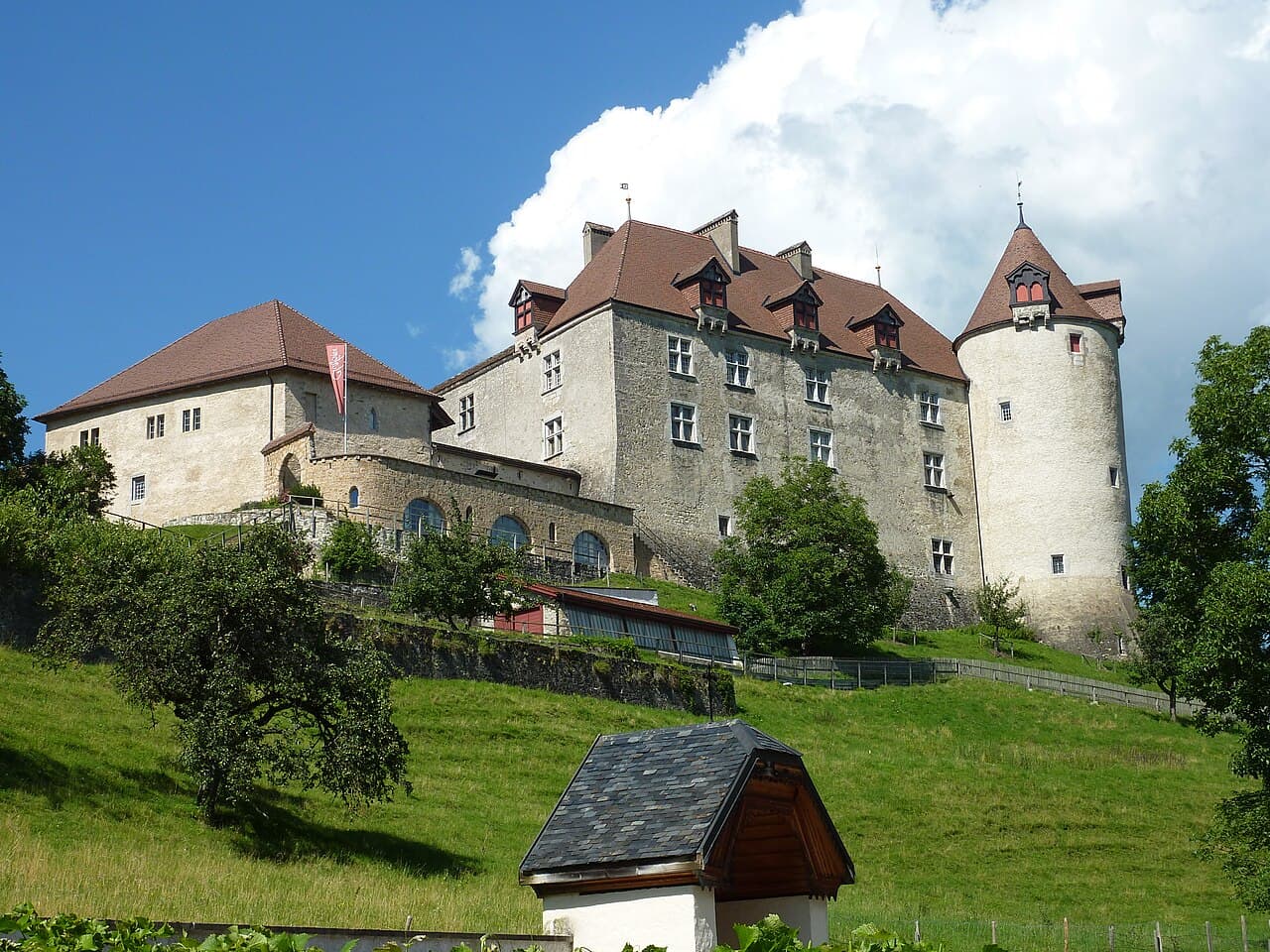
The castle's principal construction phase occurred between 1270 and 1280 under Count Pierre II de Gruyère. This period shaped much of the castle's medieval layout, featuring a nearly square plan characteristic of the Savoyard square style. The fortress includes a large round bergfried tower over 11 meters in diameter, positioned at the southeast corner, serving as a key defensive and symbolic element.
Originally, the castle featured three additional towers at the other corners of the inner curtain wall; however, only their lower sections remain today. The defensive walls, up to four meters thick, reflect the castle's military purpose. In later medieval times, wooden galleries atop the walls were replaced with stone structures, including a stair tower that connected different levels, though construction ceased around 1540.
The chapel of saint john the baptist
Within the castle, the chapel of Saint John the Baptist, dating from 1480, is integrated into a defensive wall tower. Its stained glass windows from 1482 depict religious scenes such as Saint John baptizing Christ and the Virgin of Pity, adorned with heraldic emblems linked to Count Louis de Gruyère and his wife. This chapel exemplifies the blend of spiritual and military functions typical of medieval castles.
Historical transitions and ownership
The castle remained the seat of the Counts of Gruyères until the mid-16th century. Financial difficulties forced the last count, Michel de Gruyère, to sell the castle and its lands to the city of Fribourg in 1555. Subsequently, the castle served as the residence for the city's appointed bailiffs, known as vogts, until 1798. It later housed prefects until the administrative center moved to Bulle in 1848.
In 1849, the castle was acquired by the Bovy brothers from Geneva, who transformed it into a summer residence and cultural venue. Under Daniel Bovy's direction, the castle underwent artistic renovations, enriching its interiors and gardens with 19th-century aesthetic sensibilities. The city of Fribourg repurchased the property in 1938, establishing it as a museum that continues to host exhibitions and cultural events.
Architectural features and interior highlights
The castle's layout follows a nearly square plan with a prominent bergfried tower and thick defensive walls. The inner courtyard is enclosed by stone galleries and bordered by a 17th-century esplanade containing a well and the chapel of Saint John the Baptist. The castle entrance is marked by two modern bronze sculptures, "Shield of Mars" and "Shield of Venus," by English artist Patrick Woodroffe, blending contemporary art with historic architecture.
Residential and ceremonial rooms
The southern wing historically housed the residential quarters, while the eastern wing contained living spaces rebuilt during the counts' tenure. The second floor features notable rooms such as the Burgundy Hall, displaying ceremonial robes of the Order of the Golden Fleece, and the Corot Salon, decorated with works by the French painter Camille Corot. The Count's Hall contains medieval furnishings, including a chair once owned by the counts.
The Chamber of the Beautiful Luce commemorates a local medieval legend, while the Bailiff’s Hall preserves 16th and 17th-century elements like stained glass, wall paintings, and furniture from the period of Fribourg’s administration.
Upper floors and artistic treasures
The top floor houses the Fantastic Art Hall, showcasing contemporary artworks linked to the castle, and the Baroque Hall, featuring a 17th-century decorated ceiling and works by medallist Antoine Bovy. The Music Salon contains an 1835 piano made for Franz Liszt. The Hunting Hall displays hunting trophies, and the Knights’ Hall is the artistic centerpiece with fourteen murals illustrating historical and legendary episodes related to the castle and its counts.
Defensive structures and courtyard features
Among the castle's defensive elements are two main towers: a square tower and a pentagonal tower, the latter having served as a powder magazine. The Prisoner’s Tower north of the courtyard is believed to have functioned as a prison, though its exact use remains uncertain.
The courtyard arcades feature a mural painted circa 1900 by Francis Furet depicting the legend of the Beautiful Luce, accompanied by wooden benches from 1904 bearing the coats of arms of the Gruyère, Bovy, and Balland families. These artistic additions reflect the castle's enduring cultural significance and its role in preserving regional folklore.
Gardens and surrounding landscape
The castle's gardens have evolved over centuries, originally medieval in style, transformed into a French-style garden in the 17th century. The 19th-century renovations by the Bovy family reshaped the gardens into a formal promenade area, enhancing the aesthetic appeal of the castle grounds and complementing the historic architecture.
Overall, the Castle of the Counts of Gruyères remains a vital cultural landmark in Switzerland. It offers visitors a rich journey through medieval history, architectural innovation, and artistic heritage, making it a must-visit destination for those interested in the medieval past and its enduring legacy.
Frequently asked questions (FAQ)
- How do I get to the Castle of the Counts of Gruyères?
- The castle is located in the town of Gruyères in the Canton of Fribourg, Switzerland. It is accessible by car and public transport, with regular bus services connecting Gruyères to nearby cities like Fribourg and Montreux.
- What are the opening hours of the castle?
- The Castle of the Counts of Gruyères is generally open to visitors daily from 10:00 to 18:00, with extended hours in the summer months. It is advisable to check the official website for seasonal variations and special closures.
- What can I see inside the castle?
- Visitors can explore the castle's medieval kitchens, residential quarters, ceremonial halls like the Burgundy Hall, and artistic spaces such as the Fantastic Art Hall. The castle also features murals, stained glass windows, and exhibitions on local legends like the Beautiful Luce.
- Is the castle suitable for families and children?
- Yes, the castle offers engaging exhibits and interactive displays suitable for families. The legends and artistic decorations provide an educational and entertaining experience for visitors of all ages.
- Are there guided tours available?
- Guided tours are available at the Castle of the Counts of Gruyères, providing detailed insights into its history, architecture, and art. Tours can be booked in advance through the castle's official website or visitor center.
Photo gallery

Information
Sources & official resources
Verify the information above using these authoritative references.
Loading map...
Visitor reviews
No reviews yet. Been here? Write the first review and help other travelers!
Write the first reviewVisited this castle? Share your experience
Your review helps other travelers and adds first-hand knowledge to our encyclopedia.