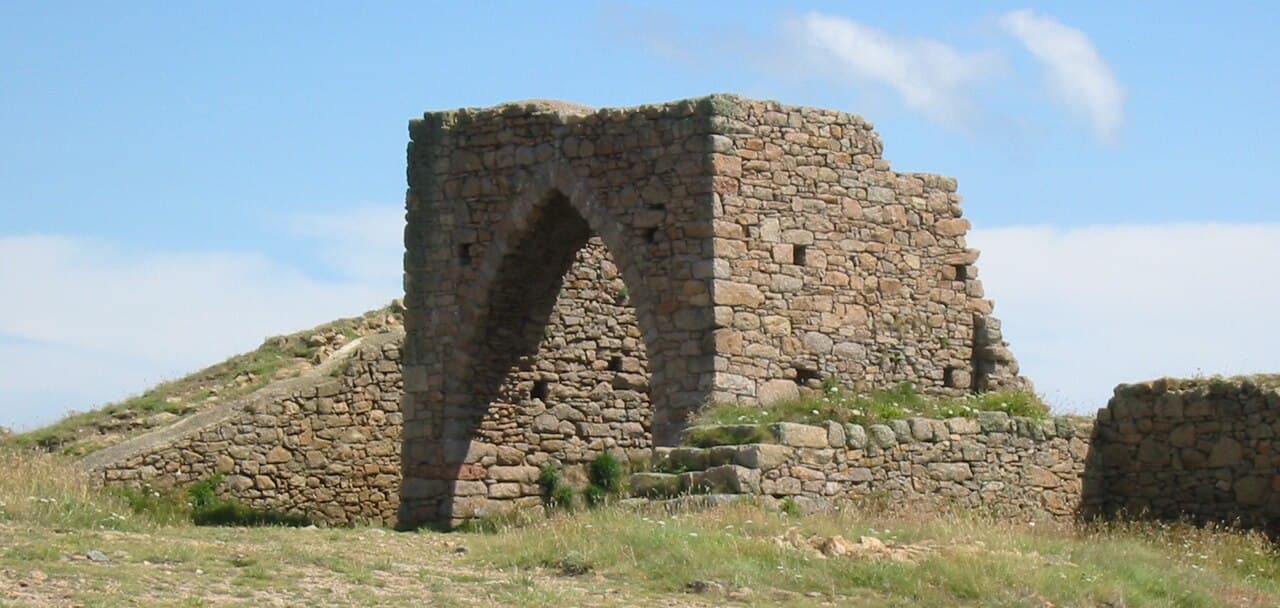
Grosnez Castle
Grosnez Castle is a ruined 14th-century castle located on the Grosnez headland in Saint Ouen, at the north-west corner of the island of Jersey in the Channel Islands. The castle's remains stand as a reminder of the turbulent period during the Hundred Years' War, although much of its history remained obscured until archaeological excavations in the late 19th century uncovered its foundations beneath large rubble deposits.
The castle was constructed during a time of renewed conflict following the Treaty of Brétigny in 1360, which temporarily halted hostilities between England and France. Around 1369-1370, Sir Renaud de Carteret, the Seigneur of St. Ouen, initiated the building of Grosnez Castle as a defensive stronghold to protect the island against French incursions. Its strategic position on the headland provided commanding views over the surrounding sea approaches, making it a key fortification despite its relatively short operational life.
Construction and architectural features
The castle's design reflects typical late medieval military architecture of the 14th century, adapted to the rugged coastal environment. The surviving ruins include the remains of a gatehouse, which was the most prominent feature visible before excavation. The castle was built using local stone, with thick defensive walls intended to withstand siege warfare common in the period.
Grosnez Castle was likely designed as a water castle in terms of its defensive strategy, utilizing the natural cliffs and sea as barriers on several sides. The fortification included a courtyard and defensive walls with battlements, though the full extent of the internal buildings remains uncertain due to the ruinous state and limited documentary evidence.
Historical context and military significance
During the Hundred Years' War, the Channel Islands were a strategic possession contested between England and France. Grosnez Castle was constructed in response to the renewed hostilities after the treaty had broken down. The castle's primary purpose was to serve as a defensive refuge and military stronghold for the island's inhabitants and garrison.
Its brief operational history culminated in the 1373 invasion of Jersey by the Duc de Bourbon and Bertrand du Guesclin, Marshal of France. This military expedition aimed to seize the Channel Islands for France, extract tributes, and capture prisoners for ransom. Grosnez Castle was seized during this campaign, likely before it was fully completed.
The 1373 siege and aftermath
Following its capture, the castle was deliberately damaged by the French forces to prevent its reuse by the islanders. This destruction was a common tactic to deny strategic positions to enemies in medieval warfare. The islanders were compelled to pay tributes to the French invaders until the end of 1375, highlighting the castle's role in the conflict's broader political and economic context.
Archaeological investigations and historical interpretations
Prior to the late 19th century, Grosnez Castle's history was largely unknown, with no surviving contemporary records detailing its construction or use. Archaeological excavations uncovered the buried remains, including the gatehouse and defensive walls, allowing historians to piece together its story.
Over the past century, various theories emerged regarding the castle's origins and purpose. Recent scholarly research has revisited these interpretations, proposing alternative timelines and emphasizing the castle's short-lived existence tied closely to the 1373 invasion. This research underscores the importance of combining archaeological evidence with historical records to understand the castle's place in Jersey's medieval history.
Current status and cultural heritage
Today, Grosnez Castle remains a ruined archaeological site, accessible to visitors interested in medieval history and coastal fortifications. Its dramatic cliffside location offers scenic views and a tangible connection to the island's past conflicts. Conservation efforts focus on preserving the remaining structures and promoting awareness of the site's historical significance.
Grosnez Castle exemplifies the challenges of interpreting medieval fortifications with limited documentary evidence, relying heavily on archaeological findings to reconstruct its story. It stands as a symbol of the Channel Islands' strategic importance during the late medieval period and the enduring legacy of the Hundred Years' War in shaping regional history.
Frequently asked questions (FAQ)
- How do I get to Grosnez Castle in Jersey?
- Grosnez Castle is located on the Grosnez headland in Saint Ouen, Jersey. It is accessible by car or on foot via coastal paths from nearby villages. Parking is available near the site.
- What is the historical significance of Grosnez Castle?
- Grosnez Castle was built in the 14th century during the Hundred Years' War to defend Jersey from French invasions. It was captured and destroyed in 1373 by French forces, marking its brief but important military role.
- Can visitors explore the ruins of Grosnez Castle?
- Yes, visitors can freely explore the ruins of Grosnez Castle. The site is open daily from dawn to dusk and offers scenic views of the coastline along with insights into medieval fortifications.
- Is there an entry fee to visit Grosnez Castle?
- No, Grosnez Castle is open to the public free of charge. Visitors can enjoy the site without any ticket fees.
- When is the best time to visit Grosnez Castle?
- The best time to visit Grosnez Castle is during the spring and summer months when the weather is mild and the coastal scenery is at its most vibrant. The site is open year-round but can be windy and exposed in winter.
Photo gallery

Photo by Man vyi•Public domain
Information
Opening hours
Open daily, dawn to dusk
Ticket prices
Free
Current owner
States of Jersey
Loading map...
Visitor reviews
No reviews yet. Been here? Write the first review and help other travelers!
Write the first reviewVisited this castle? Share your experience
Your review helps other travelers and adds first-hand knowledge to our encyclopedia.



