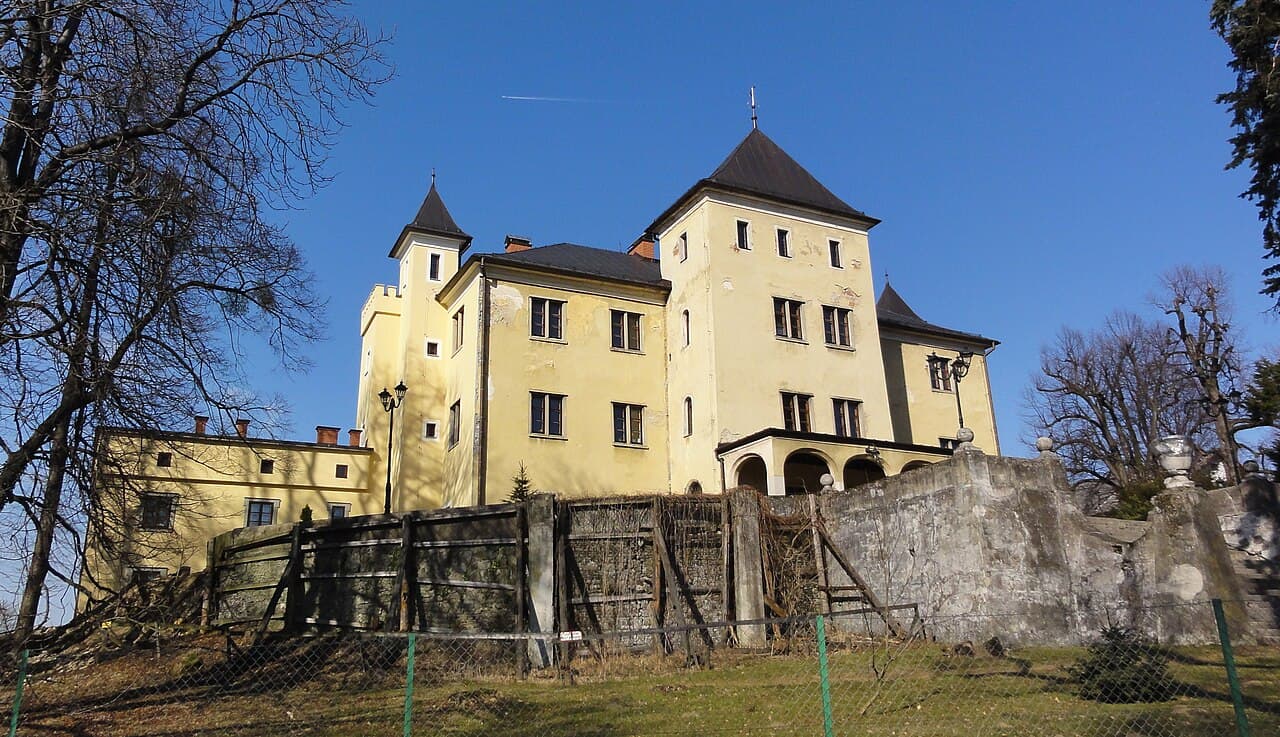
Grodziec
Grodziec Castle stands majestically atop a basalt hill rising 389 meters above sea level in the village of Grodziec, Poland. This hill castle boasts a long and complex history that dates back to the early medieval period, with its origins as a fortified stronghold of the Bobrzan tribe. Over the centuries, it evolved through multiple architectural styles and phases of destruction and restoration, ultimately becoming a remarkable example of Renaissance and Baroque castle architecture in the region.
The earliest known mention of Grodziec Castle is from 1442, though some historians suggest that a fortification existed here as early as the 14th century. The castle's strategic location made it an important defensive site and administrative center, serving as the seat of a castellany after the lands were incorporated into the emerging Polish state. According to Silesian chronicles, the castle was fortified by Władysław II the Exile in the mid-12th century, and it is referenced in the papal bull of Pope Hadrian IV in 1155, confirming its significance at that time.
Medieval origins and gothic transformation
Originally, Grodziec was a wooden stronghold built by the Bobrzan tribe. By the early 14th century, the castle had transitioned to a stone fortress under the ownership of the knight Swolo from the Bożywoj family, following its sale by Duke Bolesław III the Generous in 1320. The castle was likely already equipped with defensive walls and a tower at this point.
In the mid-14th century, the castle underwent significant expansion under Duke Frederick I of Legnica, who transformed it into a fortified Gothic castle. The layout was based on an elongated hexagonal plan featuring a prominent gate tower and high defensive walls reinforced by corner defensive bastions. This design reflected the military architectural advances of the time, emphasizing strong fortifications against siege warfare.
Renaissance rebuilding and fortification
The castle experienced its golden age in the 16th century, particularly during the rule of Duke Frederick II of Legnica. Between 1522 and 1524, the castle was extensively remodeled in the Renaissance style by the renowned Silesian architect Wendel Roskopf from Zgorzelec. This renovation included the construction of a large residential building known as the palace on the western side and two substantial bastions to the south and north, designed to accommodate the use of firearms, a reflection of evolving military technology.
During this period, Grodziec Castle served not only as a defensive fortress but also as a temporary residence for the Legnica-Brzeg dukes and a secure location for storing treasures, highlighting its dual military and residential functions.
Baroque modifications and ownership changes
In the mid-17th century, around 1650, the castle was acquired by the Marklowski family, who remodeled it in the Baroque style. Later, at the end of the century, Karol Jerzy Sobka added an additional floor and constructed two smaller towers on the shorter sides of the castle, further enhancing its defensive and residential capabilities.
The 18th century saw the western extension of the castle's main body, while the 19th century introduced a stair terrace on the garden side and two more towers at the front facade. These modifications reflected changing tastes and the castle's transition from a purely defensive stronghold to a more comfortable noble residence.
Ownership of the castle changed hands frequently, including notable owners such as Leopold Gotlib Kalisz and later his granddaughter Anna Eleonora Zamojska. In 1884, the castle was sold to Franciszek Strzygowski, a factory owner from Biała, and in 1927 it was purchased by Dr. Ernest Habicht, a former director at the Polish Ministry of Foreign Affairs.
Destruction and decline in the 17th and 18th centuries
The castle's military significance declined sharply during the Thirty Years' War. In 1633, it was captured by Austrian forces who looted its treasury and destroyed much of its interior. From 1633 to 1646, Grodziec served as the headquarters for the imperial army under Albrecht von Wallenstein. Briefly, in 1642, Protestant troops and local peasants seized the castle, but it soon returned to Austrian control.
In December 1646, the Austrians deliberately damaged the castle to prevent its further military use, leaving only the residential building and some defensive walls intact. Attempts to rebuild were interrupted by the death of the last Piast duke, George William, in 1675. Subsequently, a Baroque palace was constructed at the foot of the hill, and the castle itself was gradually abandoned and fell into ruin.
Further damage occurred in 1751 when part of the donjon collapsed, and in 1766 a lightning strike caused a fire that inflicted more destruction. In 1801, Jan Henryk VI, owner of the nearby Księżna estate, purchased the castle and began restoration efforts on the residential palace. However, in 1813, French soldiers stationed there accidentally started a fire during celebrations for Napoleon's birthday, causing additional damage. Restoration resumed in 1822, and a landscaped park was established on the lower castle grounds, with efforts to secure the ruins.
20th century restoration and modern status
Between 1906 and 1908, under the initiative of the last private owner, Driksen, the renowned architect Bodo Ebhardt undertook a significant reconstruction aimed at transforming Grodziec Castle into a tourist attraction. This reconstruction was somewhat imaginative, lacking strict adherence to historical accuracy, but it helped preserve the castle's silhouette and made it accessible to visitors.
During World War II, the castle suffered further damage. Partial restoration took place between 1960 and 1962, allowing the castle to be opened to the public. Today, the oldest surviving elements include parts of the Gothic castle and the Renaissance residence within the main residential building, while other structures reflect the early 20th-century reconstruction.
Architectural features and layout
Grodziec Castle is characterized by its elongated hexagonal plan and a combination of defensive and residential elements. The castle originally featured a gate tower, multiple defensive bastions, and high curtain walls designed to withstand sieges. The Renaissance palace added spacious living quarters and aesthetic enhancements.
The later Baroque modifications introduced additional towers and extended the castle's footprint. The presence of bastions adapted for firearms illustrates the castle's evolution in response to changing military technologies. The castle's position atop a basalt hill provided natural defense advantages and commanding views of the surrounding landscape.
Cultural and historical significance
Grodziec Castle holds an important place in the history of Silesia and Poland. Its continuous occupation and adaptation over centuries reflect the region's turbulent history, including shifts in political power, warfare, and architectural trends. The castle's association with the Piast dynasty and later noble families underscores its role as a political and military center.
Today, Grodziec Castle is a popular tourist destination, attracting visitors interested in medieval and Renaissance architecture, military history, and panoramic views. Efforts to preserve and study the castle contribute to understanding Poland's rich cultural heritage.
Frequently asked questions (FAQ)
- When was Grodziec Castle originally built?
- Grodziec Castle's origins date back to the early medieval period, with the first written mention in 1442 and probable construction in the 14th century.
- What architectural styles are present in Grodziec Castle?
- The castle features a mix of Gothic, Renaissance, and Baroque architectural styles due to successive modifications over centuries.
- Can visitors tour Grodziec Castle today?
- Yes, Grodziec Castle is open to visitors, featuring preserved ruins and reconstructed sections accessible for tours.
- What caused the decline of Grodziec Castle?
- The castle was heavily damaged during the Thirty Years' War, deliberately destroyed by Austrian forces in 1646, and suffered further damage from fires and neglect.
- Who was responsible for the Renaissance rebuilding of Grodziec Castle?
- The Renaissance reconstruction was commissioned by Duke Frederick II of Legnica and executed by architect Wendel Roskopf in the early 16th century.

Information
Current owner
Institute of Animal Reproduction and Food Research of the Polish Academy of Sciences
Loading map...
Visitor reviews
No reviews yet. Been here? Write the first review and help other travelers!
Write the first reviewVisited this castle? Share your experience
Your review helps other travelers and adds first-hand knowledge to our encyclopedia.



