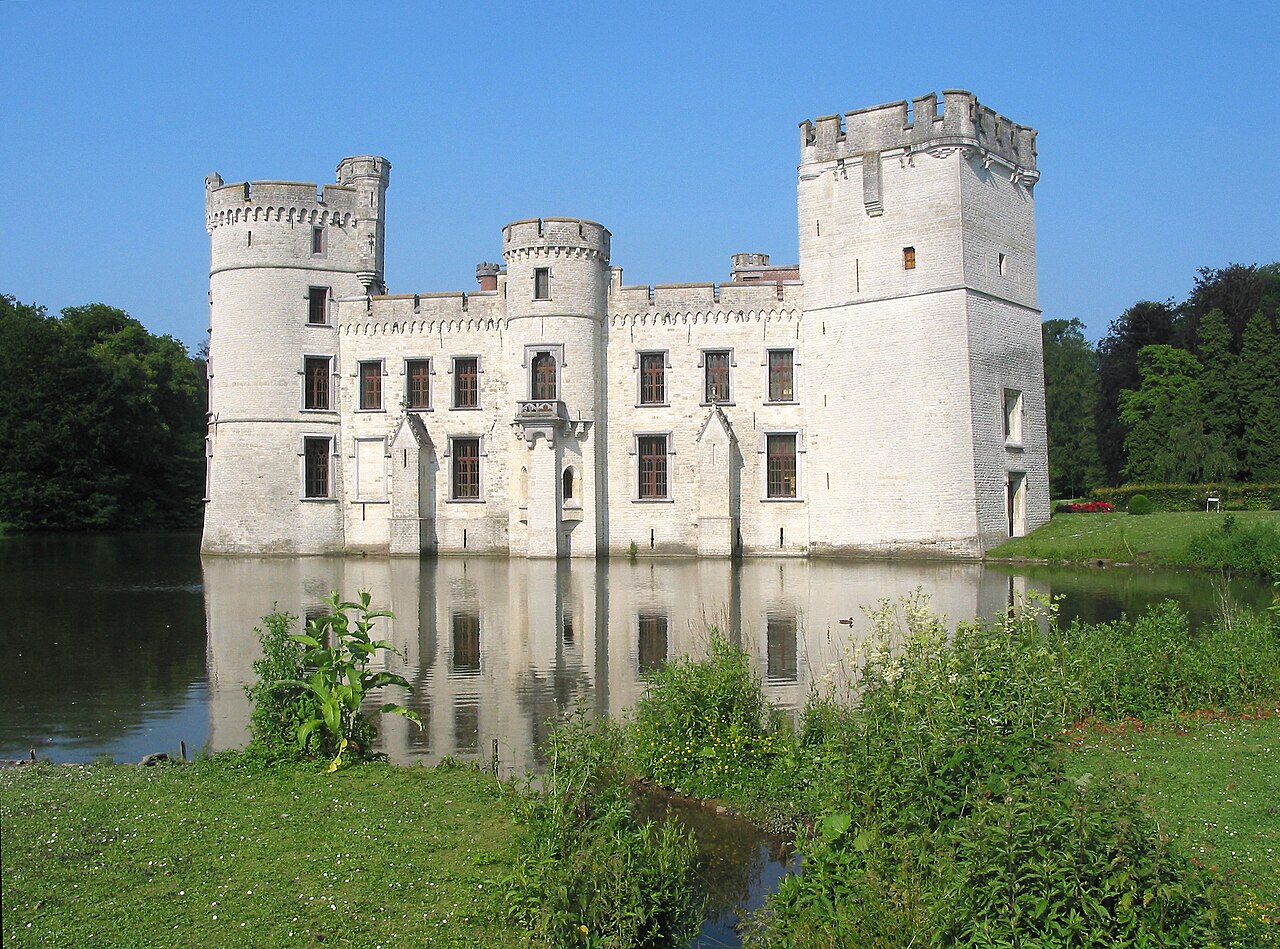
Grimbergen Castle
Grimbergen Castle, also known as Prinsenkasteel or the Prince's Castle, is a notable medieval fortress located in the town of Grimbergen, within the province of Flemish Brabant in Belgium. This hill castle stands on a small moated island in the forested area called Prinsenbos, contributing to its picturesque and strategic setting. The castle's origins trace back to the 13th century, with foundations likely dating from this period, marking it as a significant high medieval stronghold in the region.
The castle was historically the residence of the powerful Lords of Grimbergen, descendants of the Berthout family, who played a key role in the area's medieval history. The original fortress, known as Boksem, suffered considerable damage during the Grimbergen Wars in the 12th century and later endured sieges in the late 15th century led by Maximilian I and Albert III, Duke of Saxony. Despite these assaults, parts of the original keep and a round tower in the northwest corner survived, forming the basis for the castle as it was rebuilt around 1500.
Historical development and ownership
The castle's history is intertwined with the region's political and military conflicts. After the destruction of the earlier family stronghold, the site was acquired in the early 14th century, possibly through a land exchange with the Norbertine abbey documented in 1217. The late 15th-century sieges left the fortress in ruins, but reconstruction efforts around 1500 introduced new architectural elements, including a large gate tower, a smaller corner tower, and curtain walls that remain partially preserved today.
In the early 17th century, between 1610 and 1620, the castle was rebuilt and expanded by Jacques van Bergen-Glymes, who enlarged the castle grounds and enhanced its defensive and residential features. The elevation of Philippe-François de Glymes to Prince of Grimbergen in 1686 by King Charles II of Spain marked a significant change, giving the castle its princely title, Prinsenkasteel.
The castle underwent further restorations and decorative enhancements in the 17th and 18th centuries, including repairs after damage sustained during the War of the Austrian Succession. Ownership passed to the House of Mérode through marriage in 1757, with Henri de Mérode becoming the first Mérode prince of Grimbergen. The Mérode family maintained the estate until the mid-20th century.
Architectural features and castle layout
Prinsenkasteel was originally designed as a water castle, surrounded by a moat that enhanced its defensive capabilities. The castle featured a prominent central keep (donjon) and at least one round corner tower in the northwest, both of which survived multiple sieges and the devastating fire of 1944. The surviving gate tower and curtain walls reflect the castle's late medieval military architecture.
The castle's cellar contains pillars decorated with the coats of arms of the Van Bergen family, linking the site to its noble lineage. These heraldic elements indicate the dual function of the castle as both a fortified residence and a symbol of noble power. The complex also included service buildings such as stables and a carriage house, which together with an adjacent farm formed the Guldendal annex. This annex was acquired by the municipality in 1978 and now houses the Museum of Old Techniques (MOT), preserving the region's industrial heritage.
Defensive structures and moats
The castle's moat and island location in Prinsenbos forest provided natural defense, typical of hill castles adapted for water defenses. The curtain walls, battlements, and gatehouse were constructed to resist artillery and infantry assaults common in the late medieval period. The surviving towers were strategically placed to provide overlapping fields of fire and observation.
20th-century history and destruction
In the early 20th century, the castle was restored under the guidance of architect Pierre Langerock in 1907, making it habitable again. From 1901 to 1933, it served as a residence for Premonstratensian nuns expelled from France. The castle was maintained by a caretaker until the outbreak of World War II.
During the war, German forces occupied the castle and used it as a munitions depot. In September 1944, as the Germans retreated, they deliberately set fire to the castle to destroy evidence and ammunition. This catastrophic event left the castle in ruins, with only the southwest keep and northwest round tower remaining intact. The fire marked the end of the castle as a residence and military site.
Conservation and current status
After the war, the castle became property of the municipality of Grimbergen in 1947. It was declared a protected monument in 1959, ensuring its preservation as a historic site. Since then, efforts have focused on stabilizing the ruins and integrating them into the cultural landscape of Grimbergen.
The castle ruins lie within Prinsenbos Park, a green space managed by the Flemish Agency for Nature and Forestry. Although the ruins themselves are not accessible to the public, the surrounding park is maintained for visitors and locals. Plans have been proposed to develop the site into a permanent exhibition showcasing a 16th-century building site, though opinions vary on the impact this would have on the castle's romantic ruinous character.
The adjacent Guldendal annex remains an important cultural asset, housing the Museum of Old Techniques since 1982. The entire estate, including the castle ruins and annex, is recognized as a rural heritage site since 1980, highlighting its archaeological and cultural significance.
Historical significance and legacy
Grimbergen Castle stands as a testament to the region's turbulent medieval history, noble lineage, and architectural evolution. Its transformation from a fortified medieval stronghold to a princely residence reflects broader political changes in the Low Countries. The castle's ruins today evoke the layered history of sieges, restorations, and wartime destruction, making it a site of considerable heritage value.
The preservation of the ruins and the integration of the site into cultural institutions like the Museum of Old Techniques ensure that Grimbergen Castle continues to contribute to the understanding of medieval and early modern life in Belgium. Its status as a protected monument and rural heritage site secures its place in the region's historical narrative for future generations.
Frequently asked questions (FAQ)
- What is the historical significance of Grimbergen Castle?
- Grimbergen Castle, dating back to the 12th century, is a prime example of medieval architecture in Belgium. It has played a vital role in the region's history, serving as a residence for noble families and a strategic military site during various conflicts.
- When was Grimbergen Castle built?
- Grimbergen Castle was originally constructed in the 12th century and has undergone several renovations throughout the centuries. Its architecture reflects various styles, showcasing the castle's evolution through different historical periods.
- What are the opening hours for Grimbergen Castle?
- Grimbergen Castle is open to visitors from Tuesday to Sunday, from 10 AM to 5 PM. It is recommended to check the official website for any seasonal changes or special events that may affect these hours.
- Can I take guided tours of Grimbergen Castle?
- Yes, guided tours are available at Grimbergen Castle, providing visitors with in-depth information about its history and architecture. Reservations are recommended, especially during peak tourist seasons, to ensure availability.
- Is it possible to access Grimbergen Castle with mobility aids?
- Grimbergen Castle strives to be accessible to all visitors, with some areas equipped for those with mobility aids. However, due to the castle's historical structure, certain parts may have limitations, so it's advisable to check in advance regarding specific accessibility options.
- What is the best time to visit Grimbergen Castle?
- The best time to visit Grimbergen Castle is during the spring and early fall when the weather is mild and the gardens are in full bloom. Additionally, these seasons tend to be less crowded, allowing for a more enjoyable experience.
- Are there any nearby attractions to visit along with Grimbergen Castle?
- Yes, nearby attractions include the beautiful Grimbergen Abbey and the scenic parks surrounding the castle. Visitors can also explore local cafes and shops in the charming village of Grimbergen, enhancing their overall experience.
- How much do tickets cost for Grimbergen Castle?
- Ticket prices for Grimbergen Castle are reasonably priced, typically around 10 euros for adults and reduced prices for children and seniors. Special group rates and family tickets are also available, making it an affordable outing for everyone.
Information
Website
Visit websiteSources & official resources
Verify the information above using these authoritative references.
Loading map...
Visitor reviews
No reviews yet. Been here? Write the first review and help other travelers!
Write the first reviewVisited this castle? Share your experience
Your review helps other travelers and adds first-hand knowledge to our encyclopedia.