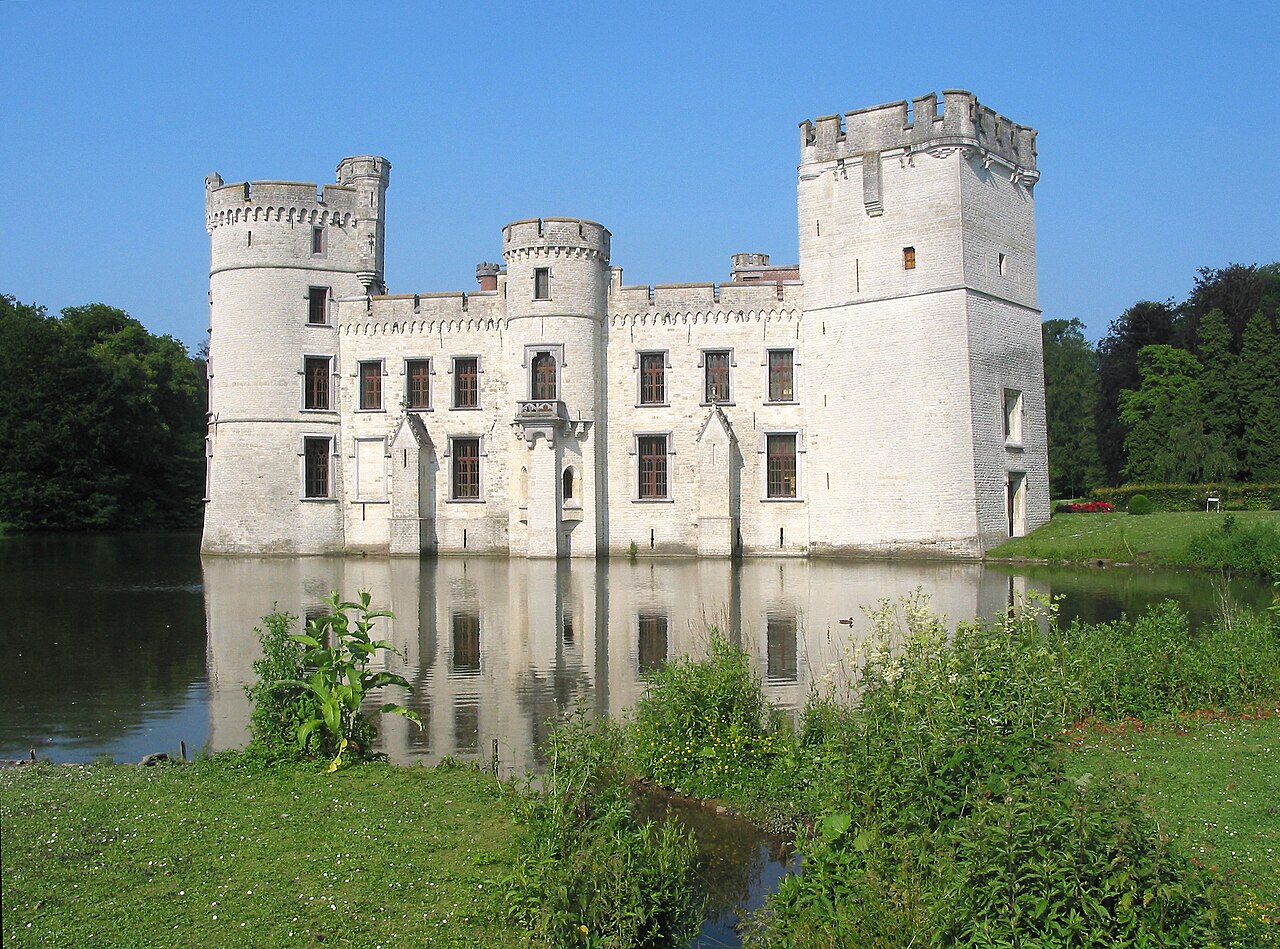
Boechout Castle, also known locally as Kasteel Boechout or Bouchout, is a historic castle situated in the town of Meise, within the province of Flemish Brabant in the Flemish region of Belgium. This castle stands within the grounds of the National Botanic Garden of Belgium, offering visitors a blend of architectural heritage and natural beauty.
Early origins and medieval architecture
The origins of Boechout Castle date back to the 12th century, marking it as a significant high medieval fortress. The earliest construction phase is reflected in the remains of a square tower dating from the 14th century, which is the oldest surviving part of the castle. This tower exemplifies typical medieval defensive architecture with its robust stone walls and strategic vantage point.
Renaissance transformation and ownership
At the turn of the 17th century, the castle underwent a major transformation under the ownership of Christoffel d'Assonleville. Around 1600, he completely rebuilt the castle, its moats, and gardens, adopting an Italian Renaissance style that introduced elegant symmetry and classical elements to the estate. This redesign marked a shift from purely defensive purposes to a more aesthetic and residential function.
By the late 16th century, the castle had come into the possession of the Roose family, who maintained the property for several generations.
19th-century renovations and royal connections
In 1830, the castle passed through marriage to Countess Elisabeth Roose and Count Amedé de Beauffort. Count Amedé undertook significant renovations, converting the castle into an art museum and redesigning the surrounding gardens. These changes contributed to the castle's present-day appearance, blending historic elements with 19th-century aesthetic sensibilities.
The castle's royal significance was further enhanced in 1879 when it was purchased by King Leopold II for his sister, Charlotte of Belgium. Charlotte was the widow of Archduke Ferdinand Maximilian of Austria, the ill-fated Emperor of Mexico, who was executed in 1867. Following this tragic event, Charlotte resided at Boechout Castle, where she lived until her death in 1927. Her presence added a poignant chapter to the castle's history, intertwining it with European royal and imperial narratives.
Modern era and current use
After Charlotte's death, the castle was acquired by the Belgian state. Between 1980 and 1988, extensive restoration work was carried out to preserve its historical and architectural integrity. Today, Boechout Castle serves as a venue for conferences and cultural events.
Visitors to the castle can explore several rooms in the west and north wings as well as the western towers, which host small art exhibitions. Access to the castle is through the National Botanic Garden, which charges a modest entrance fee. The castle's setting within these gardens enhances its appeal, offering a tranquil environment that complements its architectural grandeur.
Architectural highlights and surroundings
The castle's blend of medieval and Renaissance features creates a unique architectural ensemble. The square tower remains a focal point, showcasing medieval defensive design. The Renaissance-era modifications introduced refined moats and gardens with Italian influences, reflecting changing tastes and functions over centuries.
The landscaping and garden design, particularly from the 19th century, provide a scenic backdrop that enhances the visitor experience. The castle's integration into the National Botanic Garden allows for a harmonious combination of cultural heritage and natural beauty, making it a noteworthy destination for history enthusiasts and tourists alike.
Frequently asked questions (FAQ)
- How do I visit Boechout Castle?
- Boechout Castle is located within the National Botanic Garden of Belgium in Meise. Visitors must purchase an entrance ticket to the garden to access the castle and its surroundings.
- What architectural styles are visible at Boechout Castle?
- The castle features a mix of medieval and Italian Renaissance architectural styles, with a 14th-century square tower and Renaissance-era moats and gardens.
- Who was Charlotte of Belgium and what is her connection to the castle?
- Charlotte of Belgium was the widow of Archduke Ferdinand Maximilian of Austria, Emperor of Mexico. She lived at Boechout Castle from 1879 until her death in 1927.
- Is Boechout Castle open for tours?
- While the castle is primarily used for conferences, several rooms and towers are open to the public, often hosting small art exhibitions.
- When was the castle restored?
- Boechout Castle underwent extensive restoration from 1980 to 1988 to preserve its historical and architectural features.
Information
Current owner
Belgian state
Address
Nieuwelaan 38, Belgium
Loading map...
Visitor reviews
No reviews yet. Been here? Write the first review and help other travelers!
Write the first reviewVisited this castle? Share your experience
Your review helps other travelers and adds first-hand knowledge to our encyclopedia.