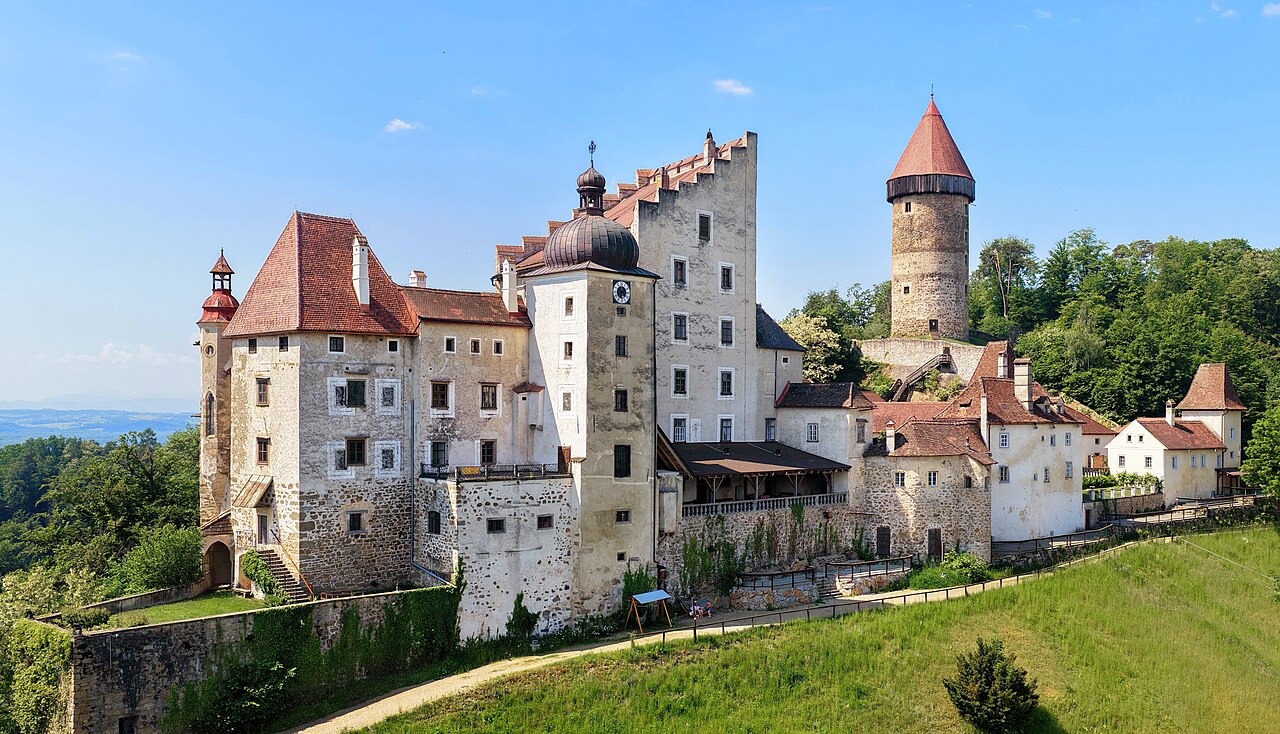
Greinburg Castle
Greinburg Castle, perched on a granite outcrop above the town of Grein in Austria, is one of the country's most significant late medieval fortresses and the oldest residential castle in Austria. Constructed between 1488 and 1495 by the Prüschenk brothers, Heinrich and Siegmund, with the imperial sanction of Emperor Friedrich III, the castle was strategically built to protect the Machland region from incursions by Bohemian, Hungarian, and Turkish forces. Its commanding position on the steep rock called Hohenstein allowed for effective defense and control over the surrounding landscape, particularly the Danube River valley below.
The castle's architectural ensemble is a remarkable example of a late medieval hill castle arranged around a rectangular plan, a design that was among the earliest of its kind north of the Alps. The complex consists of four main wings forming a square, complemented by a gate tower that controls access, and multiple towers providing both residential and defensive functions. The castle's structure reflects the transition from purely military fortifications to a more residential and administrative role, particularly after its acquisition by Johann Leble in 1533, who gave the castle much of its present-day form.
Historical development and ownership
The origins of Greinburg Castle trace back to the late 15th century when the Barons of Stettenberg, represented by Heinrich and Siegmund Prüschenk, secured permission from Emperor Friedrich III to erect the fortress. Initially named Stettenfels, the castle was renamed Heinrichsburg in 1504, likely in honor of one of its founders. By 1533, it adopted the name Greinburg as it became the administrative seat of the Machland regional court, marking its growing importance in local governance.
Throughout the 16th and 17th centuries, the castle passed through several prominent hands. Johann Leble, an imperial treasurer, acquired it in 1534 and was responsible for significant renovations that shaped its Renaissance character. In 1621, the castle was sold to Earl Leonhard Helfrich of Meggau, who introduced notable architectural features such as the three-storeyed columned arcade around the inner courtyard and the Sala terrena, a ground-floor hall decorated with intricate pebble mosaics. The Rittersaal (Hall of Knights) and an adjoining chapel in the southwest tower were redecorated in 1625, reflecting early Baroque influences.
Later ownership included the Dietrichstein family and in 1709, the castle was acquired by Franz Ferdinand Count of Salburg. A major turning point came in 1823 when Duke Ernst I of Saxe-Coburg and Gotha purchased Greinburg, linking the castle to one of Europe's most influential ducal families. This connection extended to Queen Victoria of the United Kingdom through family ties, adding to the castle's historical prestige.
Architectural features and interior highlights
Fortifications and layout
Greinburg Castle exemplifies the late medieval fortress style with its rectangular courtyard plan surrounded by four wings, fortified towers, and a gate tower controlling the main entrance. The castle's position on a granite outcrop enhances its defensive capabilities. The complex includes a palas (main residential building) and a chapel featuring an early Baroque Christmas altar, underscoring the blend of military and religious functions within the castle.
Great knights’ hall and other notable rooms
One of the castle's most striking interiors is the Great Knights’ Hall, measuring approximately 30 meters in length, 16 meters in width, and nearly 14 meters in height. This hall is renowned for its late Gothic diamond vault, a ribbed ceiling with a distinctive interlocking diamond pattern that showcases the architectural sophistication of the period. The hall served as a gathering place for knights and nobility and remains a centerpiece of the castle's historical ambiance.
Adjacent to the Great Hall is the Small Knights’ Hall, also known as the Donau-Saal (Danube Hall), which provided additional space for social and administrative functions. The Sala terrena, introduced in the early 17th century, is notable for its elaborate pebble mosaic floor, a rare decorative technique that adds artistic value to the castle's interior.
Coburg rooms and museum
The second floor houses the Coburg festival rooms, which contain antique furnishings and a collection of portraits related to the ducal family of Saxe-Coburg and Gotha. These rooms are accessible to the public through guided tours, offering insight into the castle's aristocratic heritage.
Since 1970, Greinburg has also served as the home of the Upper Austrian Shipping Museum, which exhibits detailed scale models of inland waterway vessels, including a 15-meter-long ship convoy and the Maria Anna, the first steamship to navigate the Danube. These exhibits highlight the historical importance of river traffic and commerce in the region.
Historical significance and modern use
Greinburg Castle has played a vital role in regional defense, administration, and culture for over five centuries. Its strategic location and robust construction made it a key fortification against external threats during the late medieval and early modern periods. The castle also served as a judicial center for the Machland and Strudengau regions, reinforcing its administrative importance.
During World War II, the castle was repurposed as a branch factory for Voigt & Haeffner and housed a subcamp of the Mauthausen concentration camp, where forced labor was used for construction projects. After the war, the Soviet army occupied the castle until it was returned to the Saxe-Coburg and Gotha family foundation in 1958.
Extensive restoration efforts between 1976 and 1987 preserved the castle's historical fabric and enabled its adaptation as a cultural site. Today, the castle is open to visitors seasonally from May through October, offering access to its representative rooms and museum collections. Its preservation as a well-maintained late medieval hill castle makes it a significant heritage landmark in Austria.
Architectural restoration and preservation
The restoration undertaken in the late 20th century focused on maintaining the castle's original architectural elements while upgrading facilities for public access. The work included structural repairs, conservation of decorative features such as the pebble mosaics in the Sala terrena, and refurbishment of the Coburg festival rooms. The castle's economic buildings, including storerooms and stables, were also restored to preserve the site's historical integrity.
These efforts have ensured that Greinburg Castle remains a vivid example of late medieval fortress architecture adapted for residential and administrative use. Its combination of military, residential, and cultural functions illustrates the evolution of castle design and use over several centuries.
Visiting greinburg castle
Visitors to Greinburg Castle can explore its historic halls, including the Great Knights’ Hall and the Coburg Rooms, as well as the Upper Austrian Shipping Museum. Guided tours provide detailed historical context and highlight architectural features. The castle's location offers scenic views of the Danube and the surrounding Machland region, enhancing the visitor experience.
The castle is typically open from May to October, with seasonal hours that accommodate tourists interested in history, architecture, and regional culture. Its well-preserved state and rich collections make it an essential destination for those interested in Austria's medieval heritage and the legacy of the Saxe-Coburg and Gotha family.
Frequently asked questions (FAQ)
- What is the historical significance of Greinburg Castle?
- Greinburg Castle, built in the 14th century, is one of the oldest and most significant castles in Austria. It served as a stronghold for the noble families of the region and played a vital role in local politics and defense throughout the centuries.
- When was Greinburg Castle constructed?
- Construction of Greinburg Castle began in the early 14th century, specifically around the year 1400. It has undergone several renovations and expansions over the years, preserving its historical integrity while adapting to modern needs.
- Can I visit Greinburg Castle?
- Yes, Greinburg Castle is open to visitors, offering guided tours that delve into its rich history and architectural features. It’s advisable to check the official website for specific visiting hours and any seasonal events that may enhance your experience.
- What are the opening hours for Greinburg Castle?
- Greinburg Castle typically opens its doors to visitors from 10 AM to 5 PM during the tourist season. However, hours may vary depending on the season or special events, so it's best to verify before your visit.
- Is Greinburg Castle accessible to visitors with disabilities?
- The castle is partially accessible, with some areas accommodating visitors with mobility challenges. However, due to its historical architecture, certain sections may have limited access, so contacting the castle administration for specific arrangements is recommended.
- What is the best time to visit Greinburg Castle?
- The best time to visit Greinburg Castle is during the spring and early autumn months when the weather is pleasant and the gardens are in bloom. Additionally, visiting during these seasons can help you avoid the summer tourist crowds.
- Are there any nearby attractions to explore?
- Yes, Greinburg Castle is located near several attractions, including the picturesque town of Grein and the scenic Danube River. Visitors can also explore local museums and enjoy outdoor activities such as hiking and cycling in the surrounding area.
- How much are the ticket prices for Greinburg Castle?
- Ticket prices for Greinburg Castle are generally affordable, with discounts available for children, students, and seniors. It is advisable to check the official website for the most current pricing and any special offers that may be available during your visit.
Information
Website
Visit websiteSources & official resources
Verify the information above using these authoritative references.
Loading map...
Visitor reviews
No reviews yet. Been here? Write the first review and help other travelers!
Write the first reviewVisited this castle? Share your experience
Your review helps other travelers and adds first-hand knowledge to our encyclopedia.