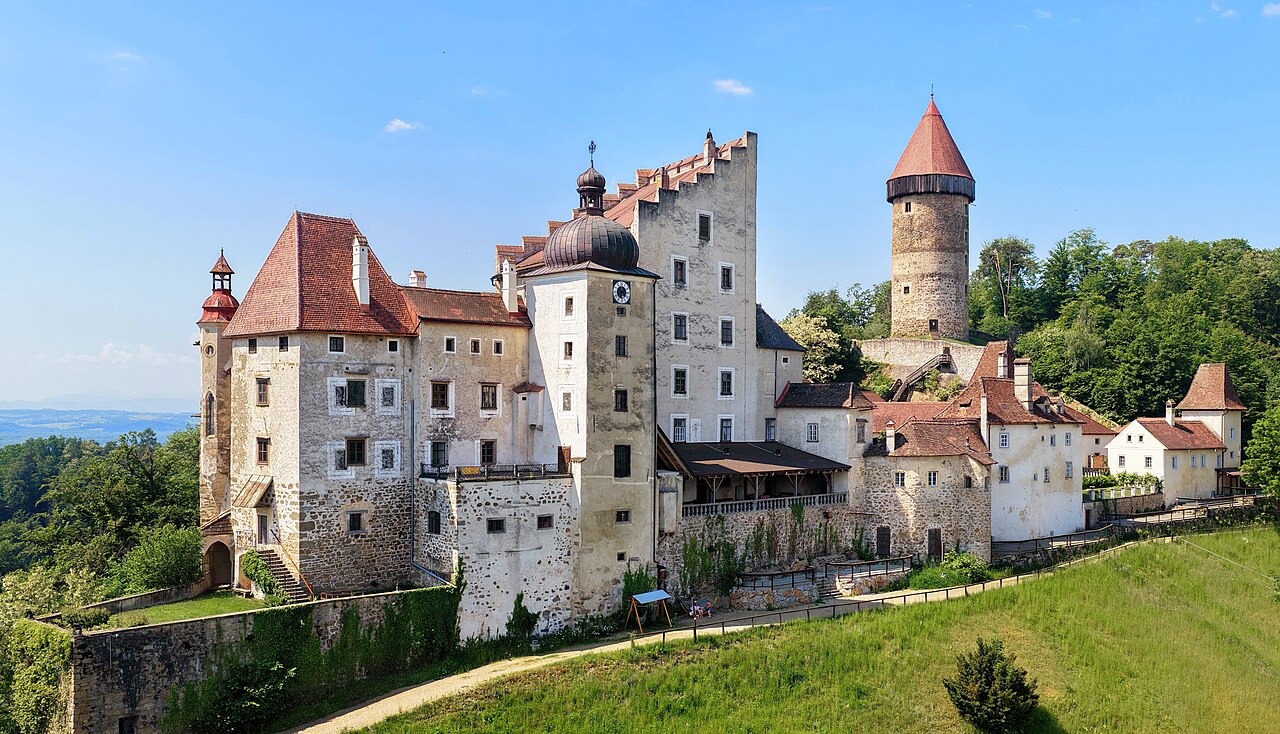
Burg Kreuzen
Burg Kreuzen stands as a remarkable example of a rock castle strategically perched atop a wooded ridge near Neuaigen in Austria. Constructed around the year 900 AD during the early medieval period, it originally served as a refuge fortress for the Bavarian civilization amid turbulent times. Its commanding position, naturally defended by steep slopes on three sides, made it a formidable stronghold in the region.
The castle's history is deeply intertwined with the noble families and historical events that shaped Upper Austria. The earliest written record dates to 1125, when a pilgrim from Creutzen claimed ownership, linking the site to medieval pilgrimage traditions. By 1209, Hermann von Creutzen was documented as the lord of the castle, marking the beginning of a lineage of noble stewardship. Over the centuries, Burg Kreuzen passed through the hands of several influential families, including the Volkensdorfer, who divided the castle into front and rear sections for administrative purposes, and the Prüschenk brothers in 1489.
In the early 16th century, the castle was reunited under Helfried von Meggau, who consolidated the divided sections. The Breuner family inherited it in 1619 through marriage, illustrating the role of noble alliances in property transfer. Burg Kreuzen also played a significant defensive role during the Ottoman incursions of the late 16th century, highlighting its military importance. Subsequent owners included the Dietrichstein family from 1655, Graf Johann Cavriani around 1716, and the counts of Salburg in 1754. The castle's connection to European aristocracy was further cemented when the Sachsen-Coburg and Gotha family acquired it in 1823, with Queen Victoria owning half by 1876.
Tragedy struck in 1880 when a fire devastated much of the upper structures, particularly the roof, leaving the castle in ruins. The 20th century saw the property change hands from a local farmer and mayor in 1965 to the regional tourism association in 1974. Restoration efforts began in the 1980s and were significantly expanded between 2010 and 2012, transforming Burg Kreuzen from a ruin into a vibrant cultural center that honors its rich heritage.
Architectural features and layout
Burg Kreuzen is notable for its impressive size, ranking as the second largest castle complex in Upper Austria, surpassed only by the nearby Schaunberg ruins. The castle's original perimeter was fortified by a defensive wall approximately five meters tall, with surviving sections particularly visible near the entrance. The main gate, historically equipped with a drawbridge, has undergone several replacements: a stone bridge in 1983 and a wooden bridge supported by pillars in 2007 due to structural wear.
Adjacent to the entrance stands the porter’s house, distinguished by its cross-ribbed vaulting, an architectural feature where intersecting curved ribs form a supportive and decorative ceiling. From the gate, a pathway ascends to the central courtyard, which houses remnants of an arcade wing featuring barrel vaults. This arcade historically connected the front and rear portions of the castle, facilitating internal communication and movement.
A notable feature on the arcade wing is a sundial dated 1523, bearing the coat of arms of the Meggau family, reflecting their ownership during the early 16th century. Extending from the courtyard’s western wall is a chapel, underscoring the castle’s dual military and religious functions.
The courtyard also contained a well dug to a depth of 42 meters, emphasizing the importance of a reliable water source during sieges. In 1974, a square residential tower measuring 10 by 10 meters with walls 2.5 meters thick was reconstructed. Dating from the 13th century, this tower now serves as an observation point and exhibition space, preserving a significant medieval architectural element.
Additional remains include fragments of the palas or great hall, integrated into a modern youth hostel on the site. Foundations of two round towers to the north and northeast further illustrate the castle’s fortified layout, designed for defense and surveillance.
Historical significance and cultural heritage
Burg Kreuzen’s name is linked to a local legend about a pilgrim who returned from the Holy Land with a relic believed to be a fragment of Christ’s cross. This spiritual association adds a layer of cultural and religious significance to the castle, connecting it to medieval pilgrimage traditions and enhancing its historical narrative.
Throughout its history, the castle has reflected the shifting political and social landscape of Upper Austria. Its role evolved from a refuge fortress in the early medieval period to a noble residence and a defensive bastion during periods of conflict, such as the Ottoman incursions. The castle’s ownership by prominent families and its connection to European aristocracy, including Queen Victoria, highlight its importance beyond regional borders.
The extensive restoration and adaptive reuse of Burg Kreuzen as a cultural center demonstrate a commitment to preserving and celebrating the site’s heritage. The integration of medieval structures with modern functions allows visitors to experience the castle’s historical ambiance while engaging with contemporary cultural activities.
Visiting burg kreuzen today
Today, Burg Kreuzen offers visitors a unique opportunity to explore a well-preserved medieval fortress with significant historical layers. The reconstructed residential tower provides panoramic views of the surrounding landscape, while the courtyard and chapel invite reflection on the castle’s dual role as a military and religious site.
The castle’s location atop a wooded ridge offers natural beauty alongside architectural interest, making it a favored destination for history enthusiasts and cultural tourists. Regular events and exhibitions hosted within the castle complex further enrich the visitor experience, connecting the past with the present.
Access to the castle is facilitated by the wooden bridge at the entrance, and pathways lead visitors through the various preserved and restored sections. Informational displays and guided tours provide insights into the castle’s construction, ownership history, and architectural features, enhancing understanding and appreciation.
Architectural style and construction details
Burg Kreuzen’s architecture primarily reflects early medieval defensive design, evolving through the high and late medieval periods with modifications by successive noble owners. The castle’s stone walls, vaulted ceilings, and fortified towers exemplify typical medieval construction techniques aimed at defense and residential comfort.
The use of cross-ribbed vaulting in the porter’s house and barrel vaults in the arcade wing demonstrate the application of advanced masonry techniques of the time. The integration of a chapel within the courtyard highlights the importance of religious life within the castle walls.
Reconstruction efforts have aimed to preserve these architectural features while adapting the space for modern use, ensuring the castle remains a living monument rather than a static ruin.
Frequently asked questions (FAQ)
- What is the historical significance of Burg Kreuzen?
- Burg Kreuzen is a significant early medieval rock castle that served as a refuge fortress and noble residence, reflecting the region's turbulent history and noble lineage.
- How can I visit Burg Kreuzen and what can I expect?
- Visitors can explore the partially restored castle, including the reconstructed residential tower, chapel, and courtyard. The site offers panoramic views and cultural events in a historic setting.
- When was Burg Kreuzen originally built?
- Burg Kreuzen was constructed around the year 900 AD during the early medieval period, primarily as a refuge fortress for the Bavarian civilization.
- What are the notable architectural features of Burg Kreuzen?
- The castle features a defensive wall, cross-ribbed vaulting in the porter’s house, barrel vaults in the arcade wing, a sundial from 1523, and a deep well within the courtyard.
- Why did Burg Kreuzen fall into ruin?
- A catastrophic fire in 1880 destroyed much of the upper structures, especially the roof, leading to the castle's ruin until restoration efforts began in the late 20th century.
Information
Website
Visit websiteSources & official resources
Verify the information above using these authoritative references.
Loading map...
Visitor reviews
No reviews yet. Been here? Write the first review and help other travelers!
Write the first reviewVisited this castle? Share your experience
Your review helps other travelers and adds first-hand knowledge to our encyclopedia.