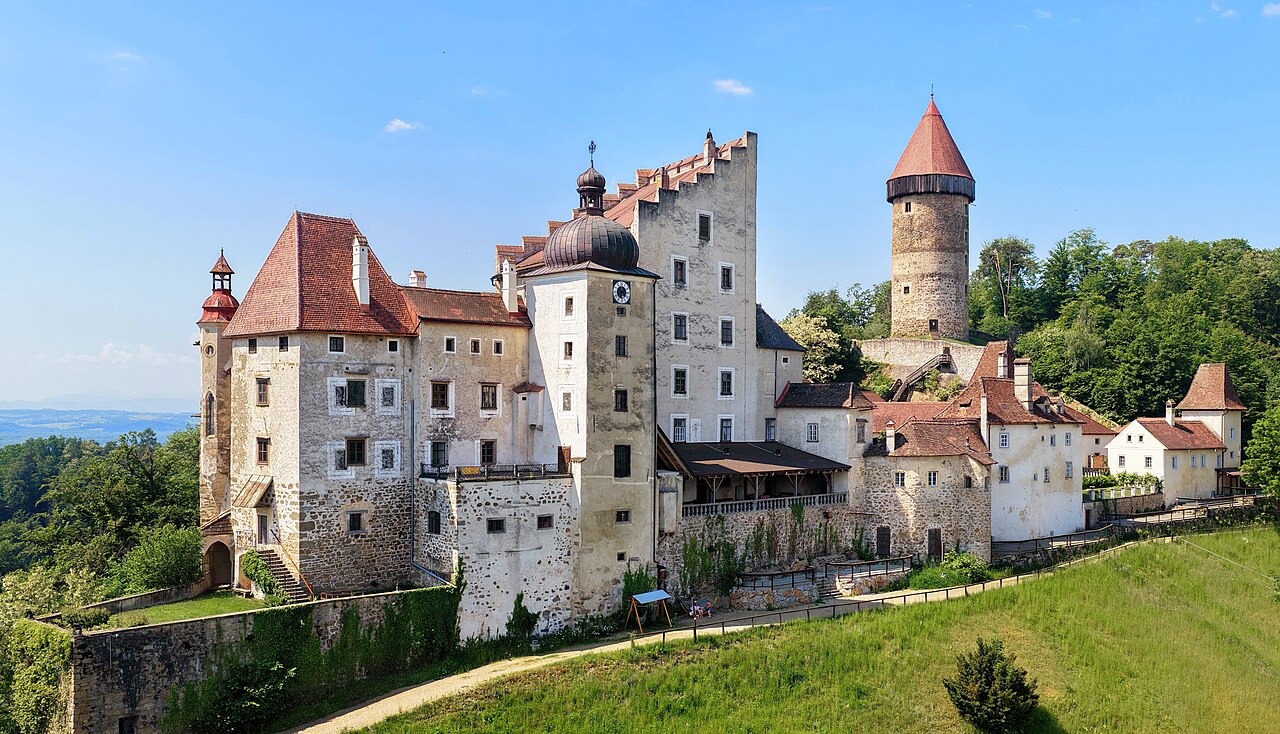
Clam Castle
Clam castle stands as a remarkable example of a High Medieval fortress in Klam, Upper Austria. Constructed in 1149 by Otto von Machland, who held dominion over all of Upper Austria, the castle originally served as a strategic stronghold. The fortress was notable for its two towering structures, one round tower and one rectangular tower, each exceeding 30 meters in height. These towers have endured through centuries and remain largely intact, preserving their original medieval form and dominating the castle's silhouette today.
Early history and medieval significance
Following the death of Otto von Machland, Clam castle fell under the control of robber barons, who were notorious for their lawlessness and were eventually excommunicated by the church. Throughout the Middle Ages, the castle's ownership shifted multiple times, reflecting the turbulent political landscape of the region. In 1454, the castle came into the possession of the ancestors of the counts of Clam, who would maintain ownership for centuries, shaping the castle's development and status.
Architecture and fortifications
The castle's original design as a fortress is evident in its robust defensive features. The two main towers served as lookout points and strongholds against attackers. The round tower provided a wide field of vision and was resistant to siege engines, while the rectangular tower housed living quarters and defensive positions. The castle's walls and battlements were constructed to withstand multiple sieges, a fact proven during the numerous attacks it endured, especially in the Thirty Years' War.
Sieges and military history
During the Thirty Years' War, the Clam family maintained a private army to defend the castle. Despite repeated sieges and the surrounding village of Clam suffering devastation and being burned several times, the castle itself was never captured by hostile forces. This resilience underscores the effectiveness of its medieval fortifications and the strategic acumen of its defenders.
Renaissance transformation and later developments
By the mid-17th century, after the conclusion of the war, the castle was in a state of disrepair. Under the leadership of Johann Gottfried of Clam, extensive renovations were undertaken to transform the fortress into a more comfortable and habitable noble residence. This included the addition of a church, a hospital, and the installation of water pipes to serve the local village population, reflecting a shift from purely military functions to civil and administrative roles.
In the 18th century, the castle complex was further expanded with the construction of wings dedicated to administration, coach houses, and horse stables. These wings now form the outer courtyard of the castle, demonstrating the evolution of Clam castle into a multifunctional estate center.
Modern history and preservation
Clam castle remarkably survived both World War I and World War II without damage. A notable 20th-century addition is a nuclear shelter built within one of the castle's cellars, a reminder of the era's geopolitical tensions. Today, the castle estate encompasses not only the historic buildings but also several farmhouses, a riding school, a hydropower plant, extensive farmland, and forests, reflecting its ongoing role as a significant local landmark and economic hub.
Architectural legacy and cultural importance
Clam castle is an important cultural monument, illustrating the architectural transition from a medieval fortress to a comfortable noble residence. Its preservation of original structures like the twin towers and its adaptation through centuries highlight the historical continuity of aristocratic life in Upper Austria. The castle's defensive features, combined with later civil improvements, provide valuable insight into the changing functions of castles in European history.
Frequently asked questions (FAQ)
- How do I get to Clam castle in Upper Austria?
- Clam castle is located in the town of Klam in Upper Austria. It is accessible by local roads, and visitors can reach it by car or regional public transport. Detailed directions are available at local tourist information centers.
- What are the main architectural features of Clam castle?
- Clam castle features two prominent towers—a round tower and a rectangular tower—both over 30 meters high. It includes medieval defensive walls, an outer courtyard, and later additions such as administrative wings and stables.
- When was Clam castle built and by whom?
- Clam castle was built in 1149 by Otto von Machland, who controlled Upper Austria at the time. The castle has remained a significant medieval fortress since its construction.
- Is Clam castle open to visitors and what are the opening hours?
- Visiting information for Clam castle varies and should be confirmed locally. The castle may offer guided tours during certain seasons, but opening hours can differ. It is recommended to check with local tourist offices before planning a visit.
- Why is Clam castle historically significant?
- Clam castle is historically significant for its well-preserved medieval fortifications and its role in regional defense during the Middle Ages and the Thirty Years' War. It also reflects the evolution of castles from military to residential and administrative functions.
Information
Website
Visit websiteSources & official resources
Verify the information above using these authoritative references.
Loading map...
Visitor reviews
No reviews yet. Been here? Write the first review and help other travelers!
Write the first reviewVisited this castle? Share your experience
Your review helps other travelers and adds first-hand knowledge to our encyclopedia.