Greifenstein Castle
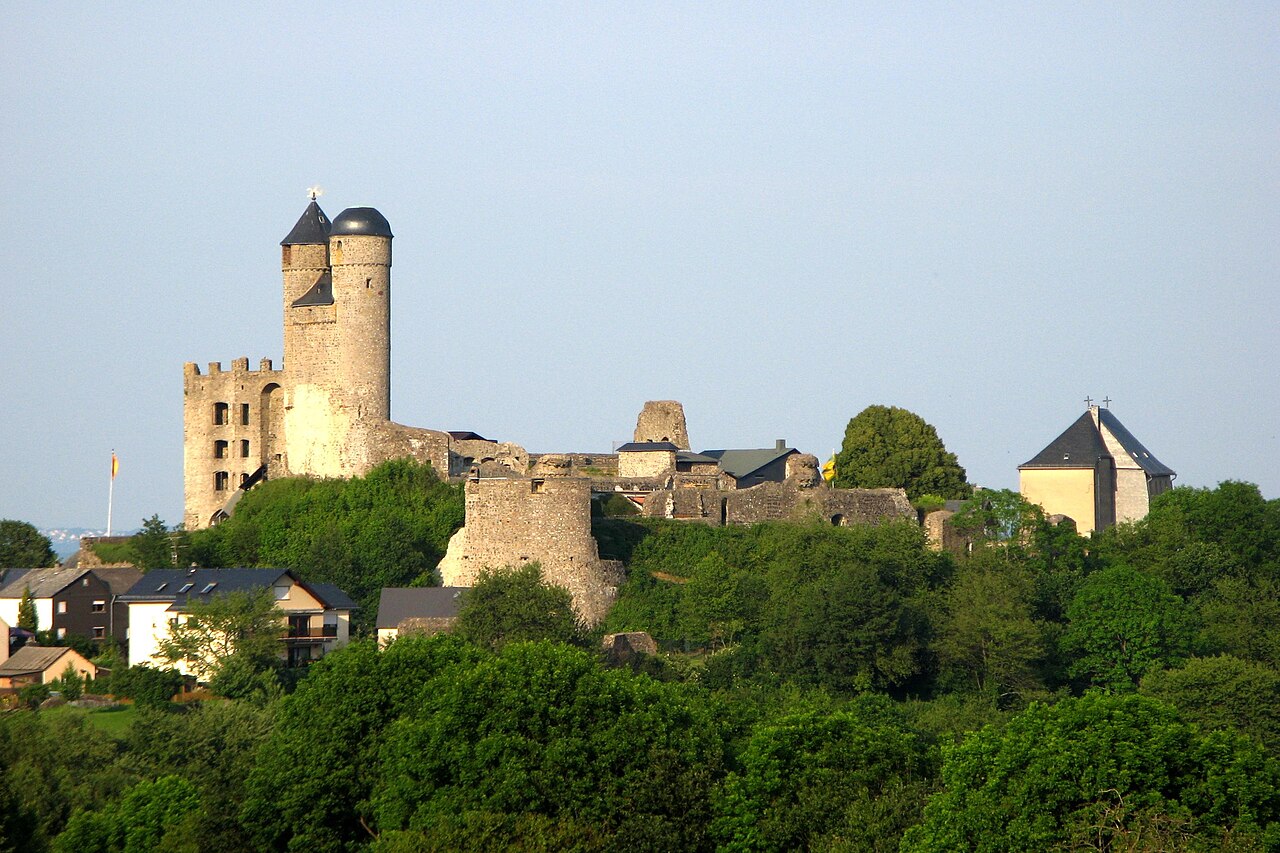
Greifenstein Castle is a striking hill castle perched prominently above the Dill valley in Germany's Westerwald region. Its commanding location offers expansive views and underscores its historic role as a strategic fortress in controlling the surrounding landscape. The castle complex, dating originally from the 12th century, remains a significant heritage site that attracts visitors with its rich history, architectural remnants, and cultural attractions.
The castle's origins trace back to the High Medieval period, when it was constructed by local knights to oversee and protect vital valley routes. It is first documented in 1172, marking it as an enduring symbol of medieval power and defense. Over the centuries, Greifenstein Castle has witnessed considerable historical events, including destruction during the Peasants' War of 1524-1525 and subsequent rebuilding phases that reflect evolving architectural styles and ownership.
Historical development and architectural evolution
Early medieval origins and strategic significance
Greifenstein Castle began as a medieval fortress designed to command the Dill valley, a key geographic corridor. The original structure was a classic example of a hill castle, utilizing the natural rocky outcrop for defense. The castle's earliest known mention in 1172 coincides with the period of territorial consolidation in the Holy Roman Empire, highlighting its role in regional power dynamics.
Destruction and baroque transformation
The castle suffered significant damage during the Peasants' War, a widespread uprising that targeted many noble estates and fortifications. Following this, Greifenstein was rebuilt under the auspices of Marquard Sebastian von Schenk von Stauffenberg, the Prince-Bishop of Bamberg, between 1691 and 1693. This reconstruction introduced Baroque architectural elements under the guidance of the renowned Bavarian architect Leonhard Dientzenhofer. Although often referred to as Greifenstein Palais due to its episcopal connections, it was not the official bishop's palace, which remained in Bamberg.
Modern restoration and preservation efforts
In the 20th century, the castle underwent extensive restoration led by Otto Philipp Schenk, Graf von Stauffenberg from 1975 to 1977. These efforts aimed to stabilize the structure and preserve its historical integrity, ensuring that visitors can appreciate both its medieval origins and later Baroque modifications. Today, the castle is well-preserved and serves as a cultural landmark.
Architectural features and site layout
Castle complex and notable structures
The castle complex includes a rare double chapel, one of the few surviving examples in Germany, illustrating the site's religious as well as military significance. The castle walls and defensive towers remain prominent features, showcasing typical medieval construction techniques using local stone. The presence of a moat and bergfried (main tower) highlights the castle's defensive design.
Surrounding attractions and visitor experience
Greifenstein Castle is not only a historical monument but also a vibrant cultural destination. It hosts the Village and Castle Museum, which offers insights into the local history and the castle's role over the centuries. Visitors can enjoy scenic walks around the castle grounds and explore an educational herb garden, enhancing the site's appeal as a family-friendly and educational attraction.
The dual castles of greifenstein near holzelfingen
Untergreifenstein and obergreifenstein
In a different region, near Holzelfingen in Baden-Württemberg, there exists another historical site known as Greifenstein Castle, consisting of two hilltop fortifications: Untergreifenstein and Obergreifenstein. These castles were built in the 12th century by medieval knights to control the Holzelfinger valley. The two castles are situated close to each other on a rocky ridge, with Obergreifenstein positioned about 100 meters higher, providing a superior defensive vantage point.
Historical conflicts and current state
Both castles were destroyed during the Imperial War of 1311-1312, a conflict that led to widespread damage in the region. By the mid-14th century, the ruins came under the control of the rulers of Württemberg. Today, Obergreifenstein retains parts of its ring wall and the bergfried, while Untergreifenstein is largely reduced to small wall fragments and earthworks. Archaeological finds such as ceramic fragments provide valuable insights into medieval life at the site.
Cultural significance and tourism
Greifenstein Castle remains an important cultural landmark in Germany, blending medieval fortification heritage with later Baroque influences. Its inclusion on the Burgenstraße tourist route makes it a key destination for those exploring German castles. The site's museums, architectural features, and natural surroundings offer a comprehensive experience that appeals to history enthusiasts, architecture lovers, and casual visitors alike.
Overall, Greifenstein Castle stands as a testament to the layered history of German castle architecture, from its High Medieval origins through Baroque transformations and modern preservation, making it a fascinating subject for study and tourism.
Frequently asked questions (FAQ)
- What are the opening hours for visiting Greifenstein Castle?
- Greifenstein Castle is generally open to visitors daily from 10:00 to 16:00, allowing ample time to explore the castle grounds and museum.
- Is there an admission fee to enter Greifenstein Castle?
- Admission fees vary depending on the exhibition and events, but typically there is a moderate charge with discounts for children and groups.
- Can visitors explore the double chapel at Greifenstein Castle?
- Yes, the castle's rare double chapel is accessible to visitors and is a highlight due to its unique architectural and historical significance.
- What facilities are available for families visiting Greifenstein Castle?
- The castle offers family-friendly amenities including an educational herb garden and walking trails, making it an engaging destination for all ages.
- How can I reach Greifenstein Castle?
- Greifenstein Castle is located in the town of Greifenstein, Hesse, Germany, and is accessible by car and local public transportation options.
Information
Website
Visit websiteSources & official resources
Verify the information above using these authoritative references.
Loading map...
Visitor reviews
No reviews yet. Been here? Write the first review and help other travelers!
Write the first reviewVisited this castle? Share your experience
Your review helps other travelers and adds first-hand knowledge to our encyclopedia.