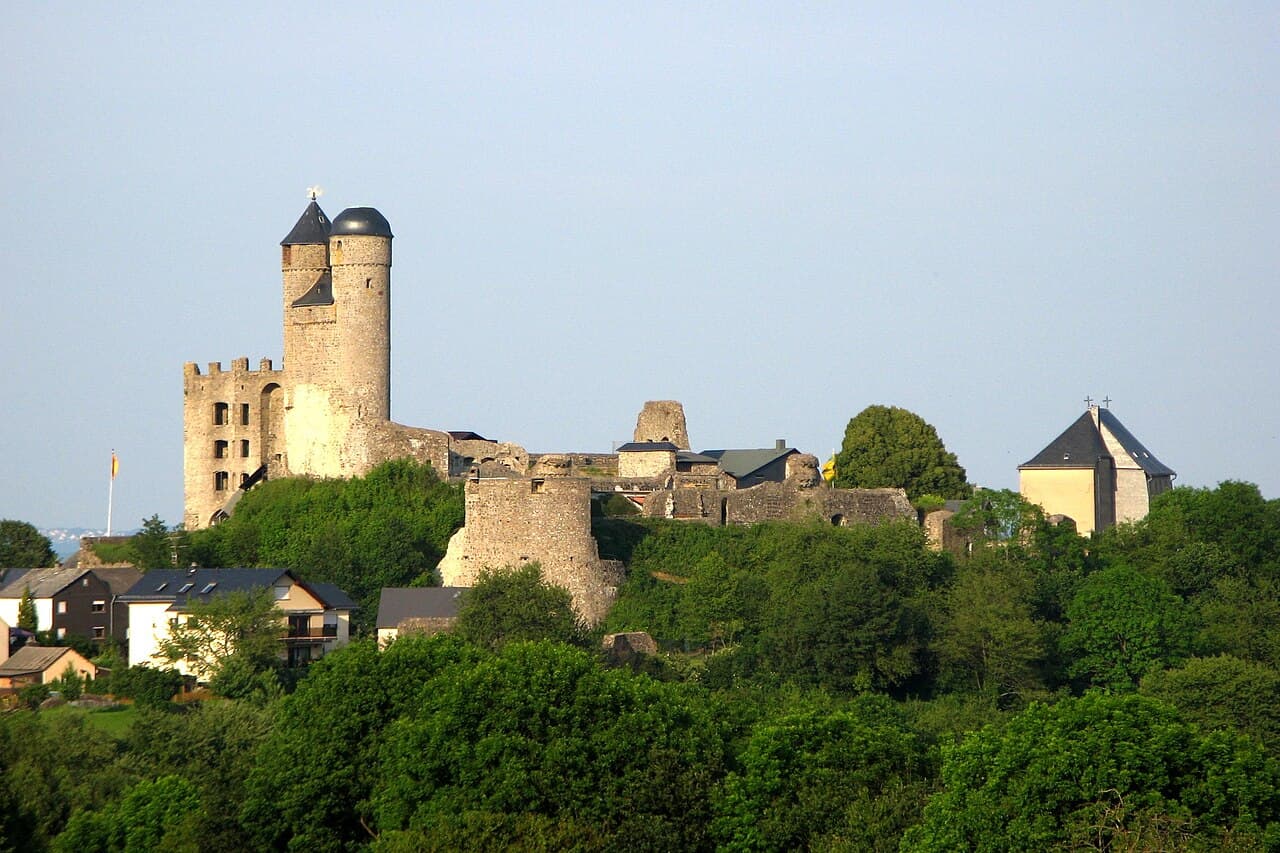
Greifenstein Castle (Hesse) — Germany castle

Greifenstein Castle (Hesse)

Greifenstein Castle in Hesse, Germany
Greifenstein, Germany
High Medieval (11th–13th c.)
Well Preserved

Greifenstein Castle (German: Burg Greifenstein) is a prominent hill castle situated in the village of Greifenstein, within the county of Lahn-Dill-Kreis in Middle Hesse, Germany. This medieval fortress is located within the boundaries of the Westerwald-Lahn-Taunus national geopark, a region known for its diverse geological formations and rich cultural heritage.

Historical background and significance

The origins of Greifenstein Castle trace back to the High Medieval period, with its initial construction likely dating to the 12th or 13th century. The castle was strategically built on a hilltop to oversee and control the surrounding territory, a common practice for fortifications of this type in medieval Germany. Throughout its history, the castle served as a residence and stronghold for various noble families and played a role in regional defense and administration.

Its location in the Lahn-Dill-Kreis placed it within an important corridor for trade and military movement, contributing to its strategic value. Over the centuries, Greifenstein Castle underwent various modifications and expansions to adapt to changing military technologies and residential needs.

Architectural features

The castle exemplifies typical hill castle architecture of the medieval period, featuring robust stone walls that follow the natural contours of the hill. Defensive structures such as battlements, towers, and a gatehouse are integral parts of its design, providing protection and control over access points.

The layout includes a central keep (donjon), which served both as a last refuge during sieges and as the lord's residence. Surrounding the keep is a curtain wall enclosing a courtyard with various ancillary buildings such as stables, workshops, and storage rooms. The castle's elevated position offers commanding views of the surrounding landscape, enhancing its defensive capabilities.

Defensive elements

Greifenstein Castle incorporates several defensive features typical of medieval fortifications. The curtain walls are thick and high, designed to withstand attacks and sieges. The towers provide vantage points for archers and lookouts, while the gatehouse controls entry and could be fortified with a portcullis and drawbridge.

Although the castle does not have a moat, its hilltop location naturally protects it from direct assault. The steep slopes around the castle act as natural barriers, making it difficult for attackers to approach unnoticed or launch effective sieges.

Current condition and accessibility

Today, Greifenstein Castle is well preserved and serves as a cultural and historical monument. It is accessible to visitors who can explore its architectural features and enjoy panoramic views of the surrounding region. The castle is part of local heritage tourism and often hosts events that highlight its medieval past.

Its inclusion within the Westerwald-Lahn-Taunus geopark emphasizes its geological and historical importance, attracting visitors interested in both natural landscapes and cultural history.

Greifenstein village and surrounding area

The village of Greifenstein itself is a small community that retains a traditional atmosphere, with the castle as its focal point. The surrounding landscape of Middle Hesse features rolling hills, forests, and river valleys, offering opportunities for hiking and outdoor activities.

Visitors to the castle often combine their trip with exploring the geopark's trails and natural sites, making Greifenstein Castle a key destination within this scenic and historically rich region.

Architectural style and period

The castle's architectural style is predominantly medieval Gothic, characteristic of many German hill castles built during the High Medieval period. Its stone masonry and defensive design reflect the military and residential needs of the time.

While later modifications may have introduced elements from other periods, the core structure remains a fine example of medieval fortification architecture.

Frequently asked questions (FAQ)

How do I get to Greifenstein Castle?
Greifenstein Castle is located in the village of Greifenstein in Middle Hesse, Germany. It is accessible by car and local public transportation, with parking available nearby. Visitors should check local transit schedules for the most convenient routes.
What are the opening hours for visiting Greifenstein Castle?
The castle is generally open to visitors during daylight hours, with specific times varying seasonally. It is recommended to check the official website or local tourist information for up-to-date opening hours before planning your visit.
Is there an admission fee to enter Greifenstein Castle?
Admission fees may apply for certain areas or guided tours at Greifenstein Castle. Prices can vary depending on the event or season. Visitors should consult the official site or visitor center for current ticket prices.
What architectural styles are represented in Greifenstein Castle?
Greifenstein Castle primarily features Gothic architectural elements typical of the High Medieval period. Its stone walls, towers, and defensive structures reflect the medieval fortification style.
Can I take guided tours at Greifenstein Castle?
Guided tours are often available at Greifenstein Castle, providing detailed historical and architectural insights. Visitors can inquire locally or check the official website for tour schedules and booking information.

Photo gallery

Greifenstein Castle (Hesse)
Click to view

Photo by Oliver Abels (SBT)•CC BY 2.5

1 photo • Click any image to view in full screen

Information

Hill Castle

Current owner

Municipality

Loading map...

Visitor reviews

No reviews yet. Been here? Write the first review and help other travelers!

Write the first review

Visited this castle? Share your experience

Your review helps other travelers and adds first-hand knowledge to our encyclopedia.

Write a review

(5/5)

0/2000 characters

Your review will be visible after admin approval

Nearby castles

0.4 km

Greifenstein Castle

Greifenstein, Germany

Greifenstein Castle is a striking hill castle perched prominently above the Dill valley in Germany's Westerwald region. Its commanding location offers expansive views and underscores its historic role as a strategic fortress in controlling the surrounding landscape. The castle complex, dating originally from the 12th century, remains a significant heritage site that attracts visitors with its rich history, architectural remnants, and cultural attractions. The castle's origins trace back to the High Medieval period, when it was constructed by local knights to oversee and protect vital valley routes. It is first documented in 1172, marking it as an enduring symbol of medieval power and defense. Over the centuries, Greifenstein Castle has witnessed considerable historical events, including destruction during the Peasants' War of 1524-1525 and subsequent rebuilding phases that reflect evolving architectural styles and ownership. Historical development and architectural evolution Early medieval origins and strategic significance Greifenstein Castle began as a medieval fortress designed to command the Dill valley, a key geographic corridor. The original structure was a classic example of a hill castle, utilizing the natural rocky outcrop for defense. The castle's earliest known mention in 1172 coincides with the period of territorial consolidation in the Holy Roman Empire, highlighting its role in regional power dynamics. Destruction and baroque transformation The castle suffered significant damage during the Peasants' War, a widespread uprising that targeted many noble estates and fortifications. Following this, Greifenstein was rebuilt under the auspices of Marquard Sebastian von Schenk von Stauffenberg, the Prince-Bishop of Bamberg, between 1691 and 1693. This reconstruction introduced Baroque architectural elements under the guidance of the renowned Bavarian architect Leonhard Dientzenhofer. Although often referred to as Greifenstein Palais due to its episcopal connections, it was not the official bishop's palace, which remained in Bamberg. Modern restoration and preservation efforts In the 20th century, the castle underwent extensive restoration led by Otto Philipp Schenk, Graf von Stauffenberg from 1975 to 1977. These efforts aimed to stabilize the structure and preserve its historical integrity, ensuring that visitors can appreciate both its medieval origins and later Baroque modifications. Today, the castle is well-preserved and serves as a cultural landmark. Architectural features and site layout Castle complex and notable structures The castle complex includes a rare double chapel, one of the few surviving examples in Germany, illustrating the site's religious as well as military significance. The castle walls and defensive towers remain prominent features, showcasing typical medieval construction techniques using local stone. The presence of a moat and bergfried (main tower) highlights the castle's defensive design. Surrounding attractions and visitor experience Greifenstein Castle is not only a historical monument but also a vibrant cultural destination. It hosts the Village and Castle Museum, which offers insights into the local history and the castle's role over the centuries. Visitors can enjoy scenic walks around the castle grounds and explore an educational herb garden, enhancing the site's appeal as a family-friendly and educational attraction. The dual castles of greifenstein near holzelfingen Untergreifenstein and obergreifenstein In a different region, near Holzelfingen in Baden-Württemberg, there exists another historical site known as Greifenstein Castle, consisting of two hilltop fortifications: Untergreifenstein and Obergreifenstein. These castles were built in the 12th century by medieval knights to control the Holzelfinger valley. The two castles are situated close to each other on a rocky ridge, with Obergreifenstein positioned about 100 meters higher, providing a superior defensive vantage point. Historical conflicts and current state Both castles were destroyed during the Imperial War of 1311-1312, a conflict that led to widespread damage in the region. By the mid-14th century, the ruins came under the control of the rulers of Württemberg. Today, Obergreifenstein retains parts of its ring wall and the bergfried, while Untergreifenstein is largely reduced to small wall fragments and earthworks. Archaeological finds such as ceramic fragments provide valuable insights into medieval life at the site. Cultural significance and tourism Greifenstein Castle remains an important cultural landmark in Germany, blending medieval fortification heritage with later Baroque influences. Its inclusion on the Burgenstraße tourist route makes it a key destination for those exploring German castles. The site's museums, architectural features, and natural surroundings offer a comprehensive experience that appeals to history enthusiasts, architecture lovers, and casual visitors alike. Overall, Greifenstein Castle stands as a testament to the layered history of German castle architecture, from its High Medieval origins through Baroque transformations and modern preservation, making it a fascinating subject for study and tourism.

High Medieval (11th–13th c.)
Details
13.1 km
Dillenburger Schloss — Germany castle

Dillenburger Schloss

, Germany

Dillenburg Castle is a historic hill castle located in the town of Dillenburg in the region of Hesse-Nassau, Germany. Perched at an elevation of 958 feet above the Dill river, it occupies a strategic position approximately 25 miles northwest of Gießen along the Giessen-Troisdorf railway line. The castle's origins date back to the high medieval period, having been founded around the year 1240 by Count Henry the Rich of Nassau. Medieval origins and strategic significance The original Dillenburg Castle was primarily constructed from wood, a common practice in early medieval fortifications, which unfortunately left little of the initial structure intact today. Its position on a hill offered commanding views of the surrounding landscape, serving both defensive and administrative functions for the Counts of Nassau. The castle's location above the Dill river valley was crucial for controlling local trade routes and asserting territorial dominance in the region. Architectural evolution and fortifications Over the centuries, the castle underwent significant transformations. By the 17th century, it featured more substantial stone fortifications that reflected advances in military architecture responding to the introduction of cannon warfare. These fortifications included bastioned walls and defensive earthworks designed to withstand artillery attacks. However, the original medieval wooden structures were replaced or lost over time, leaving primarily these later defensive works visible in the present ruins. Destruction and decline The castle suffered severe damage during the Seven Years' War (1756–1763), particularly from cannon fire that led to a devastating fire. By 1760, the main building was deliberately deconstructed, marking the end of its use as a noble residence and military stronghold. Today, visitors to the site can explore the remains of the 17th-century fortifications, but no original medieval structures survive above ground. Historical significance and notable figures Dillenburg Castle holds a prominent place in European history as the birthplace of Prince William of Orange in 1533, a key figure in the Dutch Revolt against Spanish rule and the founder of the House of Orange-Nassau. The castle and the town below were closely linked to the Protestant Reformation, evidenced by the nearby Evangelical church, formerly known as Johanniskirche, dating back to 1491. This church contains the vault of the princes of Nassau-Dillenburg, underscoring the family's long-standing regional influence. Present condition and visitor experience Currently classified as ruins, the site offers an evocative glimpse into the region's medieval and early modern past. While the original castle buildings have vanished, the surviving 17th-century fortifications provide insight into the military architecture of the period. The hilltop location affords panoramic views of the surrounding countryside, making it a popular destination for history enthusiasts and hikers alike. Interpretive signage and local museums in Dillenburg help contextualize the castle's role in regional history and its connection to the House of Nassau.

High Medieval (11th–13th c.)
Details
13.5 km

Braunfels Castle

Braunfels, Germany

Braunfels Castle stands majestically atop a basalt rock, overlooking the town of Braunfels in Hessen, Germany. This impressive hill castle combines centuries of history with striking neo-Gothic architectural features that define its current silhouette. Originally constructed in the 13th century, Braunfels Castle has been continuously inhabited by the princely family for over 800 years, making it a rare example of a living cultural monument that bridges medieval origins with modern adaptations. Historical evolution and architectural development The castle’s origins date back to the High Medieval period, when it was first established as a fortified stronghold. Over the centuries, Braunfels Castle underwent numerous expansions and renovations reflecting changing tastes and defensive needs. The most transformative phase began in the late 19th century, specifically starting in 1880, when the castle was extensively remodeled according to neo-Gothic plans by the renowned building master Edwin Oppler. This renovation introduced characteristic pointed arches, ornate battlements, and decorative towers that give the castle its fairy-tale appearance today. Despite these later modifications, many original medieval elements remain visible, including parts of the defensive walls and the castle’s strategic placement on a basalt outcrop, which provided natural fortification. The castle’s layout reflects a typical hill castle configuration, designed to maximize defensive advantage through elevation and robust stone construction. Artistic and cultural treasures within the castle Braunfels Castle houses an exceptional collection of artworks and historical artifacts. Among the highlights are masterpieces by the Dutch Masters, which enrich the castle’s interiors with Renaissance and Baroque artistic heritage. Another centerpiece is the historically significant Altenberg Altar, a religious artwork of great importance, alongside the legendary Saint Elizabeth's ring, a symbol tied to local Christian traditions and the castle’s princely lineage. The castle’s interiors also feature richly decorated halls and chambers that showcase the aristocratic lifestyle of its inhabitants across centuries. Visitors can admire period furniture, tapestries, and intricate woodwork that reflect the evolving tastes from medieval austerity to romantic historicism. Living heritage and visitor experience Unlike many castles that have become static museums, Braunfels Castle remains a vibrant cultural hub. The princely family’s continuous residence for eight centuries has preserved a unique sense of living history. Guided tours bring the castle’s past to life by narrating the eventful development of the structure and the stories of the family’s extensive European and American connections. The castle grounds and gardens provide a picturesque setting for cultural events, including open-air opera performances that take advantage of the historic ambiance and scenic backdrop. This blend of heritage and contemporary cultural programming attracts visitors of all ages and interests. The castle’s visitor program is marked by its Christian family traditions and an open-door policy welcoming guests worldwide. With flexible opening hours throughout the year, Braunfels Castle offers a diverse range of tours and events, making it accessible and engaging for a broad audience. Surroundings and seasonal attractions The area around Braunfels Castle is lively with restaurants and beer gardens, especially in the warmer months when visitors can enjoy outdoor seating with views of the castle. The nearby market square adds to the charm of the location, providing a welcoming atmosphere for tourists. During the Christmas season, the castle and its surroundings are beautifully decorated with festive lights, enhancing the magical experience of visiting this historic site. Whether in summer or winter, Braunfels Castle offers a captivating destination rich in history, architecture, and culture.

High Medieval (11th–13th c.)
Details