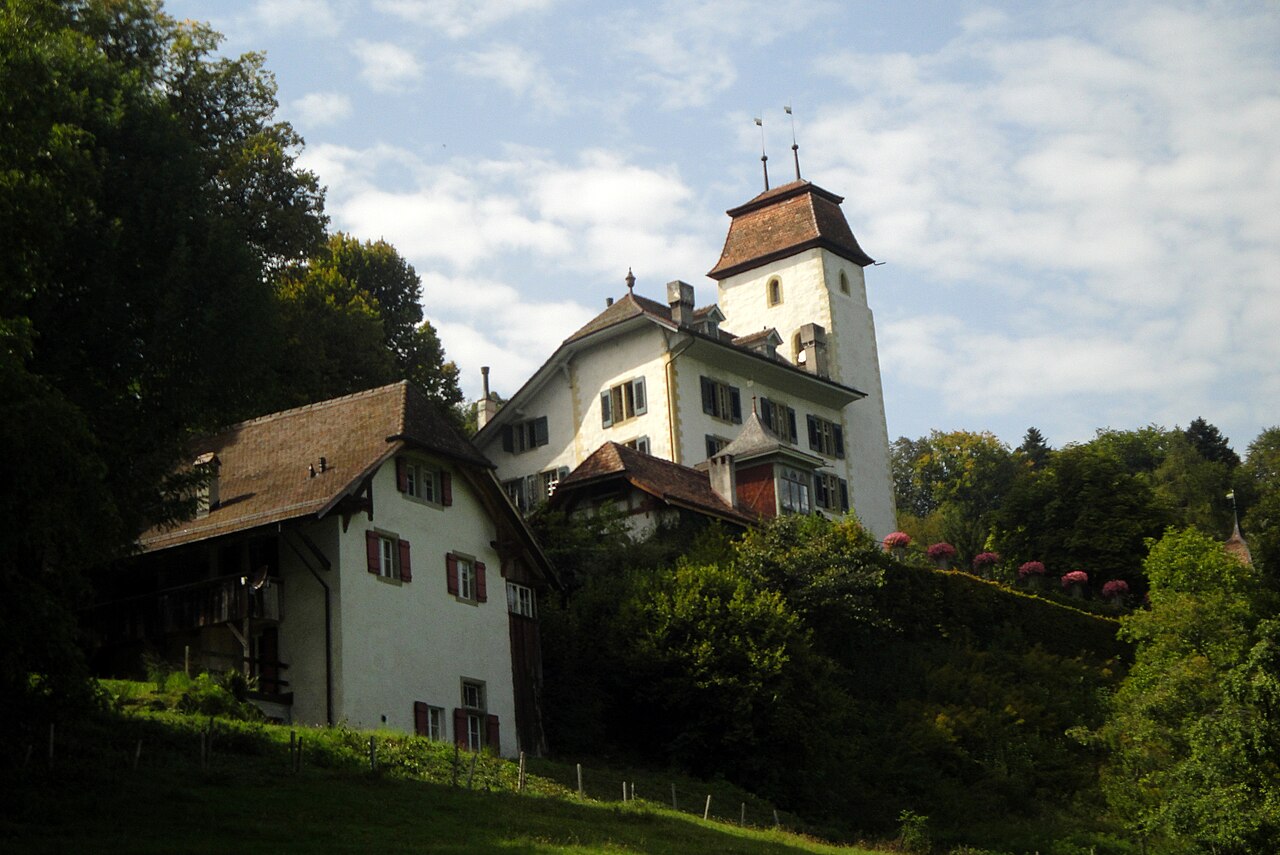
Grasburg Castle
Grasburg Castle stands as a monumental relic of medieval fortification perched on a sandstone promontory overlooking the Sense Gorge near Schwarzenburg, Switzerland. This hill castle, dating back to the 12th century, offers a remarkable glimpse into the region's High Medieval history and feudal power struggles. Its strategic position on a natural rock formation provided formidable defense and control over key medieval routes and river crossings.
Legend and early origins
The castle's origins are steeped in local legend, which narrates the tale of a Roman hunter who first established a fortification on the sandstone spire after slaying a dragon and receiving possession of the land from a red deer. While these legends add a layer of mythical allure, archaeological evidence does not confirm Roman or early medieval fortifications on the site. The earliest stone constructions, dating from the 11th or 12th century, suggest that the first true castle was likely built by a noble family from the Burgundian or Zähringen lineages.
Medieval construction and architectural features
Grasburg Castle was first documented in 1223 as "Grasburc." The castle's layout is typical of High Medieval hill castles, featuring a main castle area, an outer bailey, and a central courtyard spread over a plateau approximately 150 meters long and 50 meters wide. The castle is strategically divided by a broad neck ditch about 16 meters wide, which separates the western elevated core from the rest of the site.
A prominent feature of the castle is the bergfried, a tall tower added during a later construction phase at the eastern end of the site. This tower served as both a lookout and a last defensive refuge. The use of local sandstone, quarried directly from the rock formation, characterizes the castle's robust walls and fortifications. Gothic architectural elements found within the ruins align with the castle's early 13th-century construction period.
Historical ownership and political significance
Initially associated with the Staufer dynasty in the early 13th century, Grasburg Castle was occupied by knights such as Otto and Kuno von Grasburg. The castle served as an administrative center, with figures like Jakob Schultheiss von Grassburg recorded in 1239. During the weakening of imperial power in the Interregnum, control passed to the Kyburg family.
Following the decline of the Staufer dynasty, the castle changed hands several times. It came under the dominion of the Kyburgs, briefly passed to the House of Savoy around 1263-1264, and was granted as a fief to Rudolf of Habsburg, who reinstated it as an imperial stronghold. Local vogts from families such as von Maggenberg, de Corbières, and de Vuippens administered the castle and its lands under Habsburg authority.
In 1310, King Henry VII pledged Grasburg to Amadeus V of Savoy, who retained possession for over a century. By the early 15th century, due to its remote location and deteriorating condition, the castle was sold to the cities of Bern and Fribourg in 1423, which established a condominium rule. The castle functioned as the residence and administrative center for vogts appointed alternately by these cities.
Decline, abandonment, and restoration efforts
By 1575, the castle was abandoned as an administrative seat, with the vogt relocating to nearby Schwarzenburg Castle. Over the centuries, Grasburg gradually fell into ruin. Ownership transferred to the Canton of Bern in 1803 and later to the city of Bern in 1894, which initiated several restoration projects to preserve the site.
Major restoration efforts took place in the early 20th century, including the reinforcement of the main tower between 1902 and 1906, as it was on the verge of collapse. Further conservation work was conducted between 1928 and 1931, and additional repairs were made in 1983-84. These projects have stabilized the ruins, allowing visitors to safely explore the extensive remains.
Architectural remains and site layout
The castle occupies a naturally defensible position on a steep sandstone rock formation, with sheer cliffs protecting most sides except the southeast, where a natural rock saddle connects it to the surrounding terrain. The site is the largest castle ruin in the canton of Bern, extending over an uneven plateau.
The castle's structural remains include substantial stone walls, a broad neck ditch, the foundations of the bergfried tower, and traces of the outer bailey and central courtyard. The use of sandstone and the castle's Gothic features reflect its High Medieval origins. Although roofless and fragmentary, the ruins convey the castle's original role as a fortified stronghold overseeing a critical medieval road connecting Thun and Fribourg and controlling a river crossing on the Sense.
Defensive features
- Neck ditch: A wide defensive trench separating the main castle area from the rest of the plateau.
- Bergfried tower: A tall, slender tower serving as the last refuge and lookout.
- Natural rock cliffs: Sheer sandstone cliffs providing natural defense on most sides.
Strategic importance
The castle's location allowed control of a medieval route between the former Kyburg cities of Thun and Fribourg and oversight of a river crossing on the Sense River approximately 600 meters to the south. This strategic position made Grasburg a significant military and administrative site during the Middle Ages.
Visiting grasburg castle today
Today, Grasburg Castle is a protected historical site open to the public. Visitors can explore the extensive ruins, including the main tower foundations, defensive walls, and the broad neck ditch. The site offers panoramic views of the Sense Gorge and surrounding landscapes, providing a tangible connection to the region's medieval past.
While the castle is roofless and in ruin, ongoing conservation efforts ensure its preservation for future generations. Informational signage and guided tours help visitors understand the castle's complex history and architectural significance.
Access and amenities
The castle is accessible via hiking trails from Schwarzenburg and nearby villages. The uneven terrain and rocky surfaces require suitable footwear and moderate physical fitness. There are no modern facilities on site, so visitors should prepare accordingly. The best time to visit is during the warmer months when the trails are clear and the weather is favorable.
Frequently asked questions (FAQ)
- What is the historical significance of Grasburg Castle?
- Grasburg Castle, dating back to the 13th century, played a crucial role in the defense of the region during the Middle Ages. It served as a strategic stronghold for local nobility and has witnessed numerous historical events that shaped the area.
- When was Grasburg Castle built?
- Grasburg Castle was constructed in the early 1200s, with its foundation believed to be laid around 1230. Over the centuries, it has undergone various renovations, reflecting the architectural trends and historical events of the times.
- What are the opening hours for Grasburg Castle?
- Grasburg Castle is typically open to visitors from 10 AM to 5 PM during the summer months, with reduced hours in the winter. It is advisable to check the official website for any seasonal changes or special events that might affect visiting hours.
- Can I access Grasburg Castle with public transportation?
- Yes, Grasburg Castle is accessible by public transportation. Visitors can take a train to Schwarzenburg, followed by a short bus ride or a scenic walk to the castle, making it convenient for those relying on public transit.
- Is it possible to tour the castle grounds?
- Yes, guided tours of Grasburg Castle are available, allowing visitors to explore the grounds and learn about its rich history. Self-guided tours are also an option for those who prefer to explore at their own pace.
- What are the ticket prices for visiting Grasburg Castle?
- Tickets for Grasburg Castle are reasonably priced, with discounts available for students and seniors. Children under a certain age may enter for free, making it an affordable outing for families.
- When is the best time to visit Grasburg Castle?
- The best time to visit Grasburg Castle is during the late spring and early summer when the weather is pleasant and the surrounding nature is in full bloom. The fall also offers stunning views as the foliage changes color, creating a picturesque setting.
- What nearby attractions should I visit while in Schwarzenburg?
- While visiting Grasburg Castle, consider exploring the charming town of Schwarzenburg itself, known for its quaint shops and cafes. Additionally, the scenic hiking trails in the surrounding area offer beautiful views and opportunities for outdoor activities.
Information
Loading map...
Visitor reviews
No reviews yet. Been here? Write the first review and help other travelers!
Write the first reviewVisited this castle? Share your experience
Your review helps other travelers and adds first-hand knowledge to our encyclopedia.