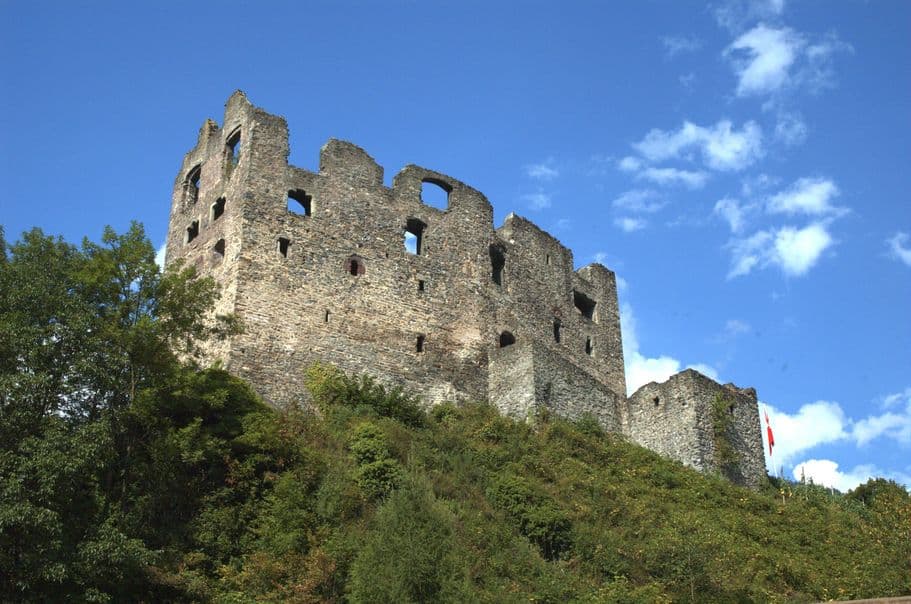
Gräpplang Castle Ruins
Gräpplang Castle stands as a significant medieval ruin located in the municipality of Flums, within the Canton of St. Gallen, Switzerland. Constructed circa 1220 by the Knights of Flums, it is one of the region's notable high medieval castles with a history that reflects the political and social shifts of the period. The castle is recognized as a Swiss heritage site of national significance, highlighting its cultural and historical importance.
Early history and medieval significance
The earliest documented mention of Gräpplang Castle dates to 1249, situating it firmly within the high medieval period. Originally, the castle served as a strategic administrative center for the Hochstift Chur, an ecclesiastical principality of the Holy Roman Empire. In 1292, the castle was pledged to Ulrich von Flums, a local noble, marking its transition into secular hands. This period established Gräpplang as a key seat of power in the region, overseeing local governance and defense.
Role during the old zurich war
During the Old Zurich War (1436-1450), Gräpplang Castle played a defensive role despite not being directly besieged. In 1440, the castle was extorted to provide protection, reflecting its strategic importance in regional conflicts. Although it was never attacked or destroyed during this turbulent period, the castle's involvement underscores its military and political relevance within the shifting alliances of Swiss territories.
Ownership by the tschudi family and architectural changes
In 1528, ownership of Gräpplang Castle transferred to Ludwig Tschudi von Glarus. The Tschudi family maintained possession until 1767, during which time they made significant modifications that gave the castle much of its recognizable form today. However, these renovations were carried out with poor construction quality, leading to structural weaknesses that necessitated costly maintenance over the centuries.
Architectural features and layout
The castle's architecture reflects typical high medieval defensive design, including thick stone walls, a central keep, and fortified courtyards. The Tschudi-era alterations introduced elements that were less robust, contributing to the eventual decline of the structure. Despite this, key features such as the gatehouse, remnants of defensive walls, and foundations of living quarters remain visible, offering insight into medieval castle construction techniques.
Decline and partial demolition
By the early 19th century, interest in preserving Gräpplang Castle had waned. In 1804, the castle was sold for demolition, and valuable materials such as bricks, iron fixtures, woodwork, and building stones were salvaged and sold. This dismantling significantly reduced the castle to ruins, reflecting a common fate of many medieval fortifications that lost their strategic and residential relevance.
Modern preservation and cultural use
The ruins of Gräpplang Castle were acquired by the commune of Flums in 1923, initiating a new phase of preservation and restoration. Over subsequent decades, extensive efforts were undertaken to stabilize and restore the remaining structures, safeguarding the site for future generations. More recently, the formation of the Pro Gräpplang foundation has revitalized the ruins as a cultural venue, organizing events that engage the community and visitors alike.
Heritage status and tourism
Today, Gräpplang Castle ruins are an important heritage site, attracting visitors interested in medieval history, architecture, and Swiss cultural heritage. The site offers a tangible connection to the past through its preserved ruins and interpretive displays, making it a valuable educational resource. Its status as a nationally significant heritage site ensures continued protection and promotion within Switzerland's rich tapestry of historic landmarks.
Frequently asked questions (FAQ)
- How do I visit Gräpplang Castle ruins?
- Gräpplang Castle ruins are accessible to the public year-round. Visitors can reach the site by car or public transport to Flums, followed by a short walk to the ruins. There are no entrance fees, and informational signage is available on-site.
- What is the historical significance of Gräpplang Castle?
- Gräpplang Castle served as an administrative seat for the Hochstift Chur and was involved in regional conflicts such as the Old Zurich War. Its long history reflects the medieval political and military landscape of eastern Switzerland.
- When was Gräpplang Castle built?
- The castle was constructed around 1220 by the Knights of Flums, with the first documented mention occurring in 1249.
- Can I attend events at Gräpplang Castle ruins?
- Yes, the Pro Gräpplang foundation organizes cultural events at the ruins, including concerts and historical reenactments, providing a vibrant cultural experience in a historic setting.
- Is the castle well preserved?
- Gräpplang Castle is preserved as ruins with ongoing restoration efforts. While much of the original structure has been lost, key architectural features remain visible and have been stabilized for safety and educational purposes.
Photo gallery

Information
Current owner
Commune of Flums
Loading map...
Visitor reviews
No reviews yet. Been here? Write the first review and help other travelers!
Write the first reviewVisited this castle? Share your experience
Your review helps other travelers and adds first-hand knowledge to our encyclopedia.