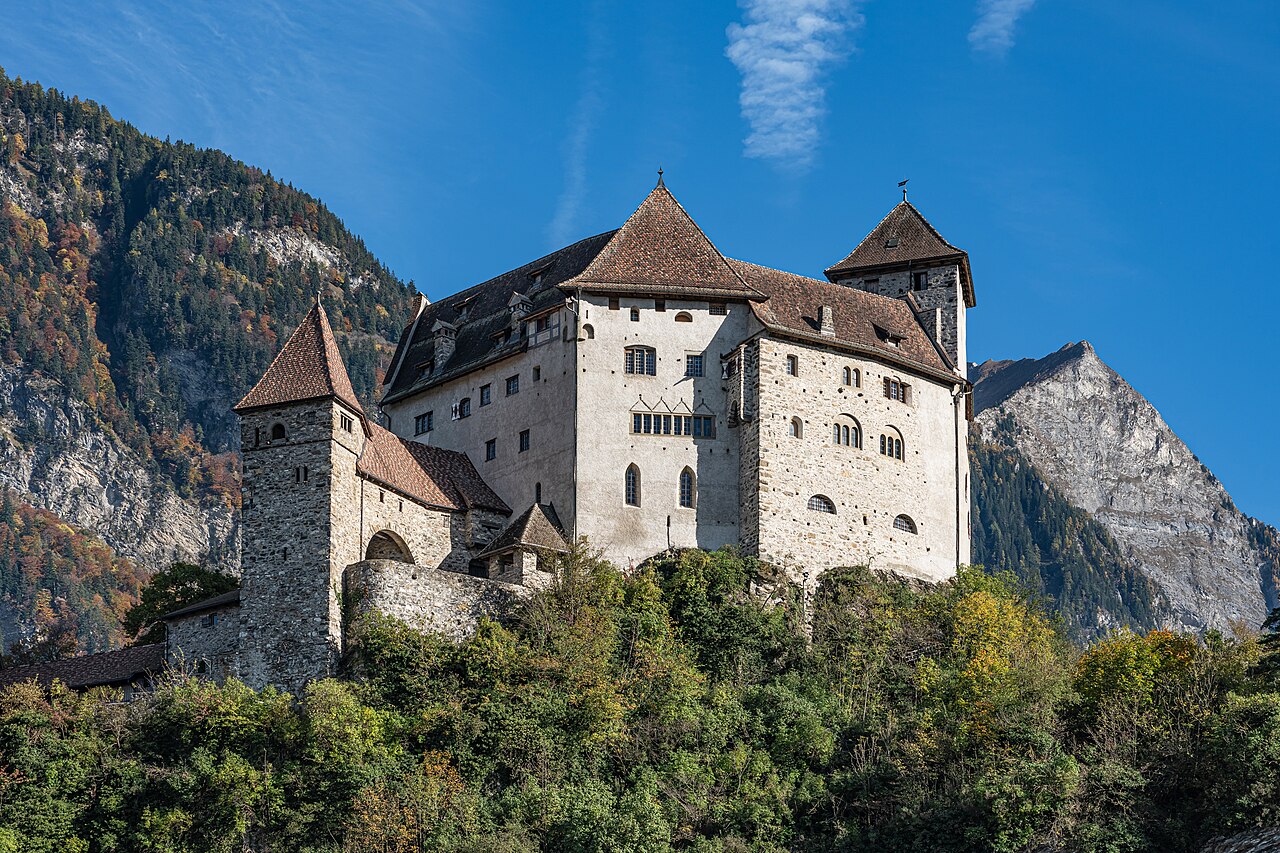
Wartau Castle
Wartau Castle stands as a significant medieval fortress located in the municipality of Wartau, Switzerland. Constructed around 1225, this castle was likely established as an administrative center for royal estates in the region. The site itself has a much older history, with evidence of human settlement dating back approximately 9000 years. Neolithic communities once inhabited nearby sites such as the Ochsenberg and Prochna Burg around 3000 BC. Additionally, a Merovingian fortress was constructed at Prochna Burg but was destroyed around 750 AD, indicating the strategic importance of this area long before the castle's medieval origins.
Early history and ownership
Although no written records detail the initial ownership or exact founding of Wartau Castle, dendrochronological analysis of wooden beams dates its construction to about 1225. It is hypothesized that the castle was built by the Graubünden Freiherr von Sagogn, as it was inherited around 1320 by Count Hugo III von Werdenberg-Heiligenberg from the Freiherr von Wildenberg, who was related to the von Sagogn family. The castle first appears in historical documents in 1342 when Johannes von Belmont pledged it to his wife, Adelheid von Klingen, in exchange for 250 silver marks.
Throughout the 14th century, Wartau Castle was a focal point of regional power struggles. The Belmont family, who controlled the castle, engaged in conflicts with the Werdenberg-Heiligenberg family until the death of Ulrich Walter von Belmont in 1371, which led to the extinction of the Belmont line. Subsequently, the castle likely reverted to the Werdenberg-Heiligenberg family and was occupied by their vassals for several decades. By around 1390, ownership shifted to the related Werdenberg-Sargans family, who held the castle during a notable eleven-day siege in 1393 amid territorial disputes.
Architectural development and features
Wartau Castle originally consisted of either two adjacent square towers or a single rectangular tower divided internally. The north-eastern tower rose to about four stories, while the south-western tower was lower and subdivided into apartments. Around 1300, a crenellated parapet was added to the tops of both towers, enhancing their defensive capabilities.
During the 14th century, the castle underwent several expansions. An additional story was added to both towers, along with new parapets and a flat roof. This upper story is distinguishable due to its construction from different stone, which remains visible today. Around 1500, the upper story was rebuilt, reflecting ongoing modifications to adapt to changing architectural and defensive needs.
The castle is fortified by a ring wall on three sides, which follows the edge of a steep cliff, providing a natural defensive barrier. This strategic positioning on elevated terrain classifies Wartau Castle as a hill castle, typical of medieval fortifications designed to oversee and control surrounding lands.
Later history and decline
By the 15th century, Wartau Castle's prominence began to wane. In 1414, Count Rudolf II sold the castle to his cousin, Count Friedrich VII of Toggenburg, though the sale was quickly converted into collateral for a loan. The extinction of the Werdenberg-Heiligenberg family in 1428 and the death of Friedrich VII in 1436 sparked the Old Zürich War over the Toggenburg inheritance, further destabilizing the region.
After this conflict, the castle passed through several noble families, including the Freiherr von Thierstein, the von Limburg, Montfort-Tettnang, and Sax-Misox families. In 1485, the city of Lucerne acquired Wartau Castle but sold it just eight years later to the Barons of Kastelwart, whose allegiance to the Habsburgs caused friction with the local populace supporting the Swiss Confederation.
The castle changed hands again in 1498, sold to the Swabian von Hewen family. The following year, Matthias von Kastelwart died in the Battle of Dornach fighting against Swiss forces. In 1517, the Hewen family sold the castle and lands to the Canton of Glarus. However, the administrative center moved to Werdenberg Castle, leading to Wartau's abandonment around 1530.
Modern preservation and archaeological work
Following the collapse of the Helvetic Republic and the creation of the Canton of St. Gallen in 1803, Wartau became part of this new administrative region. The castle ruins were sold to a private owner in 1818. In 1911, the ruins were donated to the municipality, which initiated restoration efforts in 1932. Further repairs and restorations took place in 1982, followed by archaeological surveys and excavations in 2002.
Today, Wartau Castle remains a partially restored medieval fortress, offering valuable insights into high medieval castle architecture in Switzerland. Its twin towers, crenellated parapets, and cliffside ring wall are prominent features that attract historians and visitors interested in medieval fortifications and regional history.
Architectural classification and style
Wartau Castle is classified as a hill castle due to its elevated position on a steep cliff. Its construction period places it firmly in the high medieval era, and its architectural style reflects the functional military design typical of that time, with robust towers, defensive walls, and battlements. The castle's modifications over the centuries illustrate the evolution of defensive needs and residential adaptations in medieval fortresses.
Frequently asked questions (FAQ)
- What is the historical significance of Wartau Castle?
- Wartau Castle, dating back to the 12th century, is renowned for its strategic location and role in the defense of the region. It is a prominent example of medieval architecture in Switzerland and has witnessed many historical events, making it a vital part of the local heritage.
- When was Wartau Castle built?
- Wartau Castle was constructed in the early 12th century, with its origins traced back to around 1200 AD. Over the centuries, it has undergone various renovations, preserving its historical essence while adapting to modern needs.
- Can I visit Wartau Castle?
- Yes, Wartau Castle is open to visitors throughout the year. Guided tours are available, allowing guests to explore its rich history and stunning architecture.
- What are the opening hours of Wartau Castle?
- Wartau Castle is typically open from 10 AM to 5 PM during the summer months and has reduced hours in winter. It is advisable to check the official website for specific opening times and any seasonal changes.
- Is it possible to access Wartau Castle by public transportation?
- Yes, Wartau Castle can be easily accessed via public transportation. Local buses connect the castle to nearby towns, making it convenient for visitors without a car.
- What are the ticket prices for visiting Wartau Castle?
- Admission to Wartau Castle is generally affordable, with discounts available for students and seniors. Children under a certain age may enter for free, but it's best to check the latest prices on the official website before your visit.
- When is the best time to visit Wartau Castle?
- The best time to visit Wartau Castle is during the spring and summer months, when the weather is pleasant and the surrounding landscape is lush and vibrant. Additionally, many local events and festivals take place during this time, enhancing the visitor experience.
- Are there any nearby attractions to visit alongside Wartau Castle?
- Yes, there are several attractions near Wartau Castle, including picturesque hiking trails and charming Swiss villages. Visitors can enjoy scenic views of the Rhine Valley and explore local museums that showcase the region's rich history.
- What architectural features are notable at Wartau Castle?
- Wartau Castle features a blend of Romanesque and Gothic architectural styles, with impressive stonework and towering walls. Its well-preserved towers and unique layout offer a glimpse into medieval fortification techniques, making it a fascinating site for architecture enthusiasts.
Information
Loading map...
Visitor reviews
No reviews yet. Been here? Write the first review and help other travelers!
Write the first reviewVisited this castle? Share your experience
Your review helps other travelers and adds first-hand knowledge to our encyclopedia.