Graines Castle
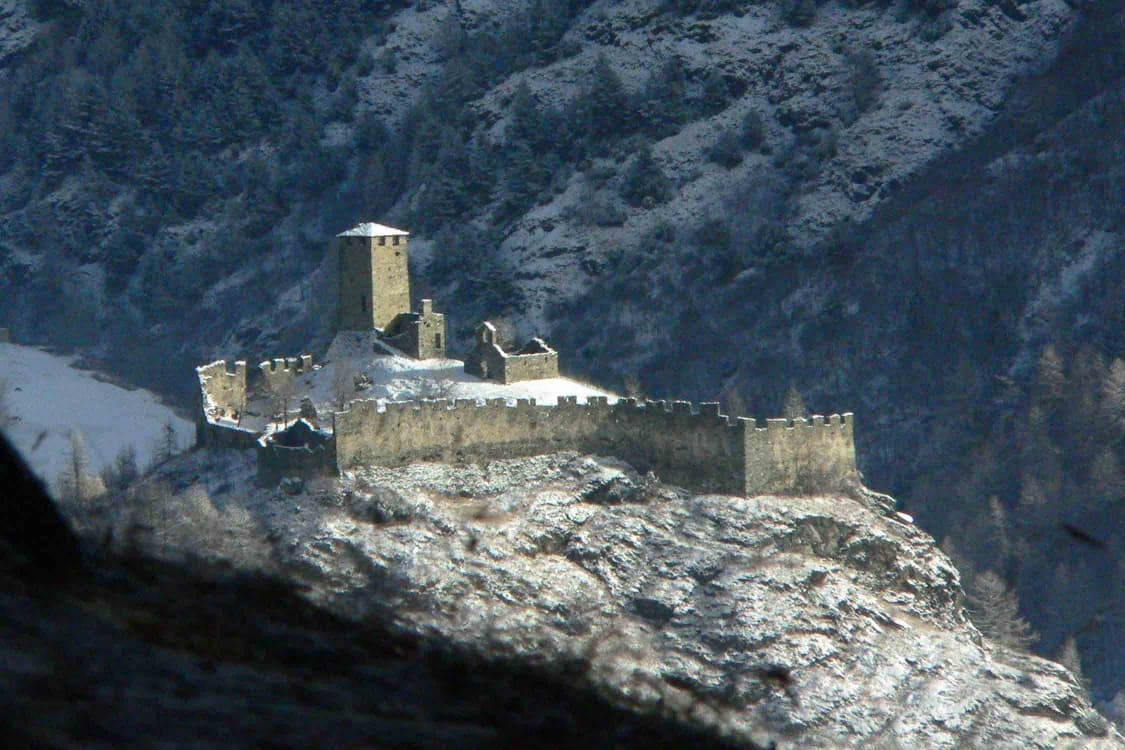
Graines Castle stands prominently atop a rocky spur overlooking the village of Brusson and commanding expansive views across the Val d'Ayas in the Aosta Valley of Italy. This high medieval hill castle dates back to the early 11th century and is a significant example of early medieval military architecture in the region. Its strategic position allowed it to control the surrounding territory and provided a vantage point for defense and surveillance.
Historical background and ownership
The fief of Graines is first documented in the year 515, when King Sigismund of Burgundy donated the lands to the newly reestablished Abbey of Saint-Maurice d’Agaune. This donation was part of the king's efforts to support the abbey, which had been rebuilt in the nearby Valais region. While the castle itself was likely constructed in the 11th century, possibly by the monks of the abbey, the dedication of the internal chapel to Saint Martin rather than Saint Maurice suggests that the monks may not have inhabited the castle directly.
In 1263, the abbey sold the fief to Godefroi of Challant, a loyal vassal of the House of Savoy. The Challant family held the castle and its lands for several centuries, playing a key role in regional politics and military affairs. The castle notably served as a stronghold during the inheritance dispute involving Catherine of Challant in the 15th century.
Following the extinction of the Challant comital line in the 19th century, ownership passed to the Passerin d’Entrèves family before eventually being acquired by the commune of Brusson. Early 20th-century restoration efforts were led by the architect Alfredo d’Andrade and writer Giuseppe Giacosa, with later conservation supported by cross-border initiatives involving the regions of Savoy, Valais, and Valle d’Aosta.
Architectural features and layout
Graines Castle is a classic example of an early medieval hill castle adapted to the natural rocky terrain. The fortress is enclosed by an irregular perimeter wall measuring approximately 80 by 50 meters, which follows the contours of the spur to maximize defensive capabilities.
The most prominent surviving structure is the massive square donjon or keep, which measures over 5.5 meters on each side. This tower served as the residence of the castellan or lord and was the castle's primary defensive stronghold. Its entrance was located about five meters above ground level, accessible only via a removable ladder or staircase, a common medieval defensive feature designed to prevent easy access during sieges. The donjon originally had battlements and a roof that was not visible from below, enhancing its defensibility.
A later addition extended the living quarters with a wing attached to the donjon, reflecting evolving residential needs over time.
The Romanesque chapel of Saint Martin
Within the castle walls lies a small Romanesque chapel dedicated to Saint Martin. This chapel features a single nave approximately eight meters long, culminating in a semicircular apse. Though the roof has long since collapsed, the apse, perimeter walls, and the façade with its distinctive bell gable remain intact. The chapel's dedication to Saint Martin rather than the abbey's patron Saint Maurice is a notable detail, suggesting that the castle's builders or occupants were distinct from the monks of the abbey.
Strategic importance and communication
The castle's elevated position provided a commanding view of the surrounding valley, making it a key military and administrative center in the region. Historically, it was believed that Graines Castle communicated visually with nearby fortifications such as the Bonot Tower and Villa Castle in Challand-Saint-Victor through the use of flags or mirrors. However, modern studies have not confirmed direct lines of sight between these sites, which may suggest that such communication was more limited or symbolic.
The castle's role in regional defense was complemented by its function as a residence and symbol of feudal authority for the Challant family and their successors.
Restoration and current condition
After centuries of decline and partial ruin, Graines Castle underwent significant restoration in the early 20th century under the guidance of Alfredo d’Andrade and Giuseppe Giacosa. These efforts aimed to preserve the castle's architectural heritage and stabilize its structures. Further conservation work has been carried out under the AVER program, a cross-border initiative involving Italy, France, and Switzerland, focused on preserving cultural heritage in the Alpine region.
Today, the castle is partially preserved, with the donjon and chapel standing as the most prominent remnants. Visitors can explore the ruins, appreciating the castle's historical significance and architectural features while enjoying panoramic views of the Val d'Ayas.
Legends and cultural significance
Local legend holds that a large treasure is buried beneath the castle, adding an element of mystery and intrigue to its history. While no treasure has been found, such stories contribute to the castle's cultural allure and attract visitors interested in medieval lore.
Graines Castle remains an important symbol of the medieval history of the Aosta Valley, reflecting the region's feudal past, architectural traditions, and strategic importance in the Alpine landscape.
Frequently asked questions (FAQ)
- How do I visit Graines Castle?
- Graines Castle is open to visitors year-round, with best access during the warmer months. It is advisable to check local tourist information for any seasonal restrictions or guided tour availability.
- What is the historical significance of Graines Castle?
- Graines Castle was a strategic medieval fortress and residence of the Challant family, playing a key role in regional defense and feudal disputes in the Aosta Valley.
- Can I explore the Romanesque chapel inside the castle?
- Yes, visitors can see the remains of the Romanesque chapel dedicated to Saint Martin, including its apse and façade, which highlight the castle's religious and architectural heritage.
- Is Graines Castle accessible for people with mobility issues?
- Due to its hilltop location and rugged terrain, access to Graines Castle may be challenging for visitors with mobility impairments. It is recommended to prepare accordingly and inquire locally about accessibility options.
- When was the castle restored?
- Significant restoration took place in the early 20th century under Alfredo d’Andrade and Giuseppe Giacosa, with ongoing conservation efforts supported by the AVER program.
Photo gallery

Photo by Giuseppe Bozzola•Attribution
Information
Sources & official resources
Verify the information above using these authoritative references.
Loading map...
Visitor reviews
No reviews yet. Been here? Write the first review and help other travelers!
Write the first reviewVisited this castle? Share your experience
Your review helps other travelers and adds first-hand knowledge to our encyclopedia.