Goodrich Castle
Goodrich Castle stands prominently near the village of Goodrich in Herefordshire, England, commanding a strategic position overlooking the River Wye. Established shortly after the Norman Conquest of 1066, this hill castle played a vital role in controlling a key crossing point between Monmouth and Ross-on-Wye. Its location on a steep sandstone outcrop provided natural defensive advantages, making it a significant stronghold along the volatile Welsh-English border.
The castle’s origins trace back to the late 11th century, when Godric of Mappestone likely founded an initial earth-and-timber motte-and-bailey structure. This early fortress served both military and administrative functions during a period of frequent border skirmishes and political instability. By the mid-12th century, the wooden fortifications were replaced with a more permanent stone keep, a hallmark of Norman military architecture. This square Norman keep, sometimes called "Macbeth’s Tower," was constructed between approximately 1120 and 1176. The exact patron remains uncertain, with candidates including Godric, William Fitz Baderon, Richard de Clare ("Strongbow"), or King Henry II.
Medieval expansions and architectural evolution
Throughout the 12th and 13th centuries, ownership of Goodrich Castle shifted among prominent noble families. The de Clare family controlled the castle before it passed to the renowned William Marshal, Earl of Pembroke. In the late 13th century, William de Valence, half-brother to King Henry III, undertook major expansions to transform Goodrich into a formidable concentric fortress. This involved demolishing earlier Marshal-era structures and constructing extensive defensive walls, towers, and refined residential quarters.
William de Valence’s son, Aymer de Valence, further enhanced the castle’s defenses by adding a large barbican modeled on the Tower of London. This outer gate complex featured multiple defensive elements such as portcullises, murder-holes, and a drawbridge, designed to trap and repel attackers. The barbican, although now partially ruined, remains an impressive example of early 14th-century military architecture.
Defensive features and layout
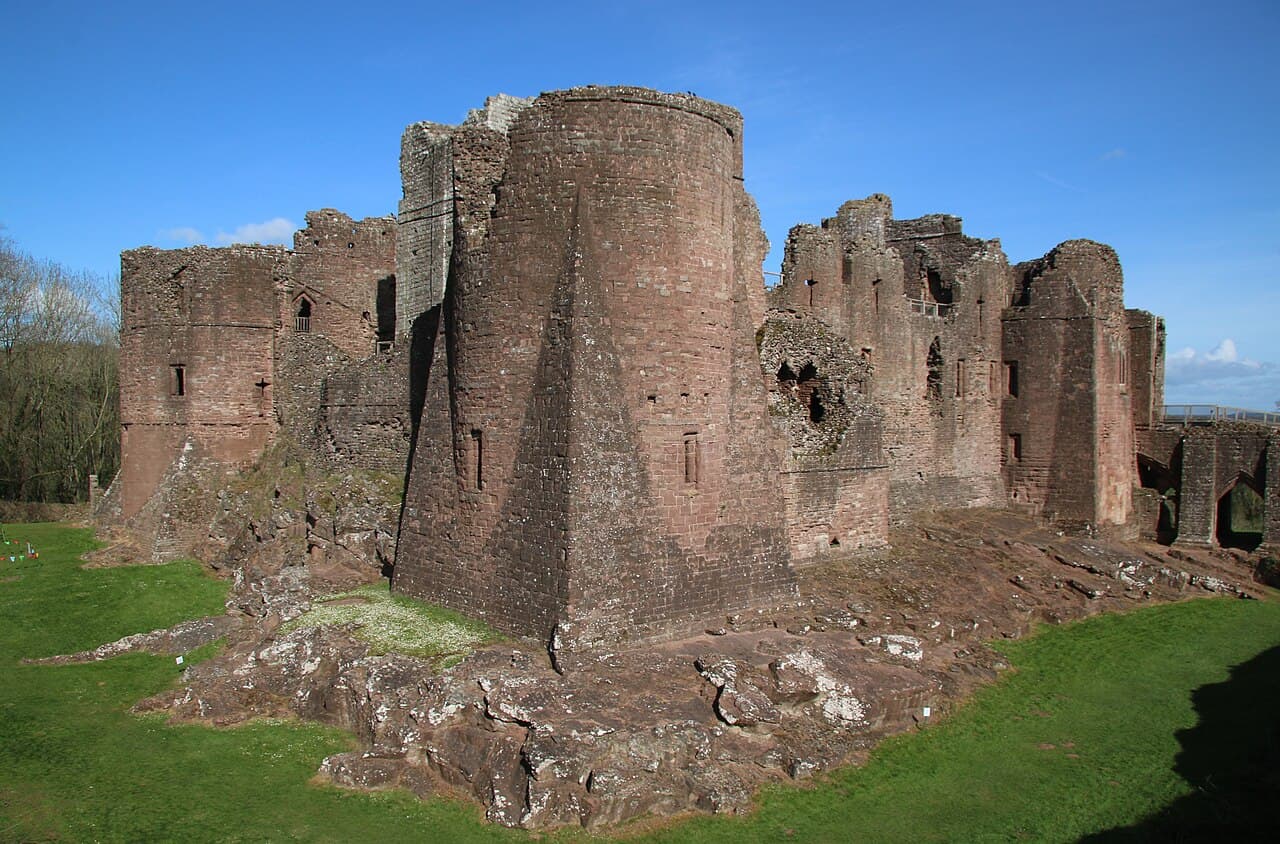
The castle’s curtain wall, built mainly of dark sandstone in the late 13th century, encloses the central keep and bailey. It features three large towers with distinctive "spurs"—square pyramidal buttresses merging with circular walls—an architectural innovation to resist mining and siege engines. On the south and east sides, deep rock-cut ditches over 25 meters long and nearly 10 meters deep were carved into natural fissures, creating formidable obstacles for attackers.
The keep itself is a robust square tower measuring approximately 5.5 by 4.5 meters internally. Its narrow Norman windows and pilaster buttresses emphasize defense over comfort. Originally, its entrance was on the first floor for security, later modified to ground level access. The keep’s base is surrounded by an earth mound, enhancing its defensive strength.
Domestic buildings and chapel
Within the bailey lie substantial domestic buildings, including a great hall measuring about 20 by 9 meters, a solar (private chamber), kitchen, buttery, and pantry. These structures feature numerous garderobes and fireplaces, reflecting the needs of medieval noble life. The great hall overlooks the River Wye, designed to maximize natural light and warmth while maintaining defensibility.
An unusual feature is the chapel located within the gatehouse’s east tower. This cramped placement is rare among castles but was necessitated by spatial constraints. The chapel preserves a restored 15th-century east window with medieval glass crafted by Nicola Hopwood, illuminating the priest’s sedile. The stone altar likely predates much of the castle, and a modern west window commemorates radar scientists and servicemen from the 20th century.
Historical significance and military role
Goodrich Castle played a pivotal role in border defense and noble residence through the medieval period. It was involved in repelling Welsh uprisings led by Owain Glyndŵr in the early 15th century and later aligned with the Lancastrian cause during the Wars of the Roses under the Talbot family, who held the castle from the 14th century onward.
By the 16th century, the castle’s military importance waned due to changing tastes and its remote location. It was partially abandoned as a residence but retained some judicial functions and served as a local prison.
During the English Civil War in the 1640s, Goodrich Castle saw significant military action. Initially held by Parliamentarian forces, it was captured by Royalists before being besieged in 1646 by Colonel John Birch. The siege featured the use of a massive mortar called "Roaring Meg," which inflicted heavy damage. Following its surrender, Parliamentarian orders led to the deliberate slighting of the castle to prevent further military use.
Romantic ruin and preservation
In the late 18th century, Goodrich Castle became celebrated as a picturesque ruin, inspiring poets such as William Wordsworth, who visited in 1793 and wrote the poem "We are Seven" influenced by the evocative setting. The castle attracted tourists and was featured in numerous guidebooks during the 19th century.
Despite attempts at restoration, the castle remained largely a stabilized ruin by the early 20th century due to structural collapses. Today, it is a protected Grade I listed building and Scheduled Monument, preserving substantial remains of its walls, towers, gatehouse, and domestic buildings.
Archaeological excavations in the 1920s uncovered artifacts such as cannonballs and the mortar "Roaring Meg," which are displayed on site as reminders of the castle’s turbulent military history. The surviving ruins offer a rich insight into medieval castle architecture, border defense strategies, and noble life spanning nearly a millennium.
Architectural highlights and visitor experience
Visitors to Goodrich Castle can explore the imposing Norman keep with its defensive features, the concentric curtain walls with their distinctive buttressed towers, and the impressive barbican gatehouse. The chapel’s medieval stained glass and stone altar provide a rare glimpse into the spiritual life within the fortress.
The castle’s elevated position offers dramatic views over the River Wye and surrounding Herefordshire countryside, enhancing its appeal as both a historical monument and a scenic destination.
Goodrich Castle remains an exemplary site for studying Norman military architecture and the evolution of medieval fortifications on the Welsh border, combining robust defensive design with domestic comfort and later adaptations.
Frequently asked questions (FAQ)
- How do I get to Goodrich Castle?
- Goodrich Castle is located near the village of Goodrich in Herefordshire, England. It is accessible by car via the A40 road, with parking available nearby. Public transport options include local buses from Ross-on-Wye and Hereford, but service may be limited.
- What are the opening hours of Goodrich Castle?
- Goodrich Castle is open daily from 10:00 to 17:00, with the last admission typically 30 minutes before closing. Hours may vary seasonally, so it is advisable to check the official website before visiting.
- Is Goodrich Castle suitable for families?
- Yes, Goodrich Castle is family-friendly with spacious grounds to explore and educational displays about its history. Children often enjoy climbing the ruins and learning about medieval life. Facilities include picnic areas and restrooms.
- What is the historical significance of Goodrich Castle?
- Goodrich Castle was a key defensive stronghold on the Welsh border from the 11th century through the English Civil War. It exemplifies Norman military architecture and played roles in major historical events such as the Welsh uprisings and the Wars of the Roses.
- Can I explore the interior of the keep and gatehouse?
- Visitors can explore the remains of the Norman keep and the gatehouse, including the chapel with its medieval stained glass. Some areas may have restricted access for safety reasons, but informative signage guides visitors through the site.
Photo gallery

Information
Opening hours
10:00-17:00, daily
Ticket prices
£10 adult, £5 child, £25 family
Current owner
English Heritage
Website
Visit websiteSources & official resources
Verify the information above using these authoritative references.
Loading map...
Visitor reviews
No reviews yet. Been here? Write the first review and help other travelers!
Write the first reviewVisited this castle? Share your experience
Your review helps other travelers and adds first-hand knowledge to our encyclopedia.