Göksholm Castle
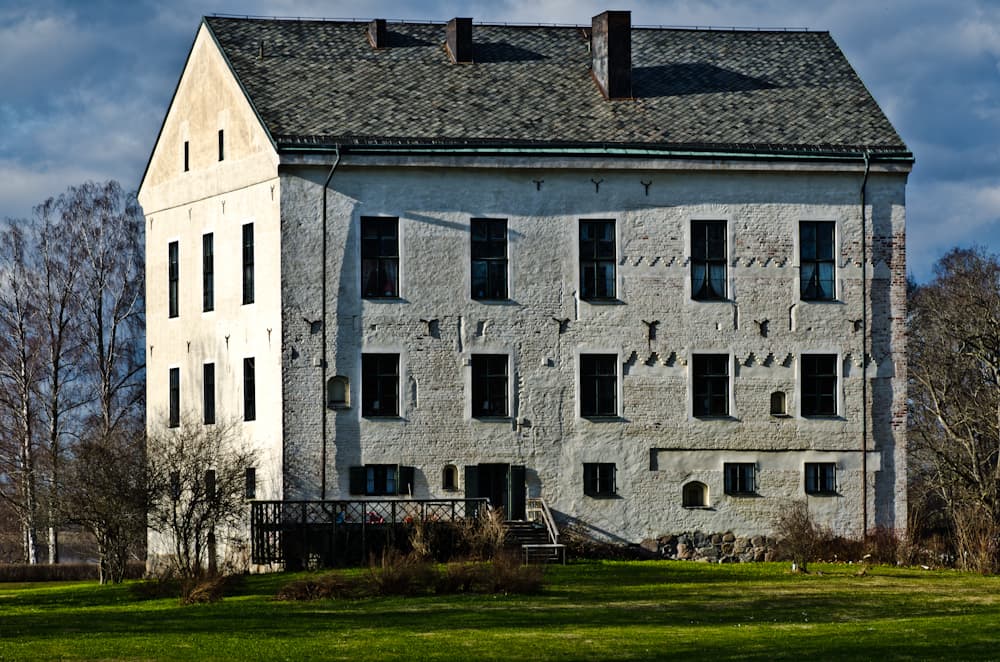
Göksholm Castle stands as a remarkable example of medieval architecture and continuous habitation, located in Stora Mellösa, within Örebro Municipality, Sweden. Positioned strategically on the southern shore of Lake Hjälmaren, it is recognized as the oldest privately owned building in Sweden that has been continuously inhabited since its construction. The castle's origins trace back to the 13th century, marking it as a significant relic of High Medieval fortification and residential architecture.
Medieval origins and architectural evolution
The earliest surviving sections of Göksholm date from the 13th century, initially constructed as a fortified castle centered around a large defensive tower. This tower served as a stronghold and residence, characteristic of hill castles of the period, designed to provide both protection and control over the surrounding landscape. Over the centuries, the castle underwent a series of expansions and reconstructions through six distinct building phases during the Middle Ages, reflecting evolving defensive needs and residential comforts.
The castle's layout was originally irregular, focused on fortification with thick stone walls and limited fenestration for defense. However, after a significant fire at the end of the 16th century, the castle was extensively rebuilt and modernized in line with contemporary architectural trends. This renovation introduced a more regularized floor plan, larger windows to allow more natural light, and decorative elements inspired by the Dutch Renaissance style. Despite these changes, the medieval core and foundational structures remain intact, preserving the castle's historical essence.
Renaissance enhancements and interior features
One of the castle's most notable interior features is a painted ceiling dating from the Renaissance renovation period. This ceiling consists of 121 cassettes, or decorative panels, which have been remarkably well preserved. The intricate artwork and craftsmanship reflect the aesthetic values of the Renaissance and provide insight into the cultural influences that shaped the castle's transformation from a purely defensive fortress to a stately residence.
17th-century modifications
During the 17th century, under the ownership of prominent figures such as Baron Knut Kurck and Baron Fleming, Göksholm Castle saw further enhancements. These included the addition of ornate portals and the construction of circular-patterned outer buildings, which contributed to the castle's architectural complexity and grandeur. These modifications reflected the period's shift towards more elaborate and comfortable noble residences, blending defensive features with aesthetic appeal.
19th and 20th-century restorations
In 1801, Lars Gustaf Tersmeden undertook restoration work on the castle's ceiling, ensuring the preservation of its Renaissance artwork. The 20th century brought additional changes, particularly in the 1950s, when some facade details were altered. These modifications were carried out with sensitivity to the castle's historical character, maintaining its status as a well-preserved monument of Swedish medieval and Renaissance architecture.
Historical significance and notable events
Göksholm Castle is historically significant not only for its architecture but also for its role in Swedish history. It is famously connected to the assassination of Engelbrekt Engelbrektsson in 1436. Engelbrektsson, a prominent leader of a popular uprising and the then rikshövitsman (leader of the government), was murdered on the castle's lands by Måns Bengtsson, the son and heir of the castle's owner at the time. This event marked a pivotal moment in Sweden's political history during the Middle Ages.
Architectural features and castle type
Classified as a hill castle, Göksholm is built on elevated terrain, providing natural defensive advantages. Its structure includes a large fortified tower, thick defensive walls, and later additions of residential wings and decorative elements. The castle's evolution from a purely military fortress to a noble residence is evident in its architectural layers, showcasing styles from High Medieval fortification to Dutch Renaissance influences.
Current status and visitor information
Today, Göksholm Castle remains a privately owned residence, maintaining its continuous habitation status. Its preservation allows for the study and appreciation of medieval and Renaissance architecture in Sweden. While it is not generally open to the public, its historical importance and architectural features make it a subject of interest for scholars and enthusiasts of Swedish heritage.
Frequently asked questions (FAQ)
- What is the historical significance of Göksholm Castle?
- Göksholm Castle is historically significant for being the site where Engelbrekt Engelbrektsson, a leader of a popular uprising and the government, was murdered in 1436. This event marked an important moment in Swedish medieval history.
- When was Göksholm Castle originally built?
- The oldest parts of Göksholm Castle date back to the 13th century, making it one of Sweden's oldest medieval castles.
- What architectural styles are present in Göksholm Castle?
- Göksholm Castle features architectural elements from the High Medieval period and later renovations in the Dutch Renaissance style, reflecting its evolution over centuries.
- Is Göksholm Castle open to the public?
- Göksholm Castle is privately owned and not generally open to the public, but it remains an important cultural and historical site in Sweden.
- Where is Göksholm Castle located?
- Göksholm Castle is located in Stora Mellösa, Örebro Municipality, on the southern shore of Lake Hjälmaren in Sweden.

Information
Current owner
Private owner
Loading map...
Visitor reviews
No reviews yet. Been here? Write the first review and help other travelers!
Write the first reviewVisited this castle? Share your experience
Your review helps other travelers and adds first-hand knowledge to our encyclopedia.