Glenbuchat Castle Ruins
Glenbuchat Castle is a notable example of a 16th-century Scottish Z-plan tower house located near Kildrummy in Aberdeenshire, Scotland. Built in 1590 for Sir John Gordon of Cairnbarrow to commemorate his marriage to Helen Carnegie, the castle reflects the architectural and social aspirations of Scottish nobility during the Renaissance period. Positioned strategically above the River Don, the castle's design combines residential comfort with defensive features typical of the era.
Historical background and ownership
Constructed during a time of relative peace and increasing stability in Scotland, Glenbuchat Castle was intended as a fortified residence rather than a purely military fortress. The Gordon family, prominent landowners in northeast Scotland, used the castle as a home for two branches of their lineage throughout the 16th and 17th centuries. The castle's founding is immortalized by a carved stone above the main entrance displaying the names of John Gordon and Helen Carnegie, alongside their family motto, “Nothing on earth remains but fame.”
In the early 18th century, ownership passed to John Gordon of Knockespock. The castle gained historical significance during the Jacobite uprising of 1715 when it hosted John Erskine, 23rd Earl of Mar, a key Jacobite leader. This association highlights Glenbuchat's role in the turbulent political landscape of early 18th-century Scotland. However, by 1738, the castle was no longer used as a residence, and the family's fortunes waned.
The castle's connection to the Jacobite cause led to its forfeiture in 1745, after which it fell into decline. Around 1840, the roof was deliberately removed, accelerating its deterioration into the roofless state seen today. In 1901, James William Barclay acquired the property and initiated restoration efforts. Later, in 1946, the castle was placed under state care, with Historic Scotland managing its preservation and the surrounding parkland.
Architectural features and layout
Z-plan design and defensive elements
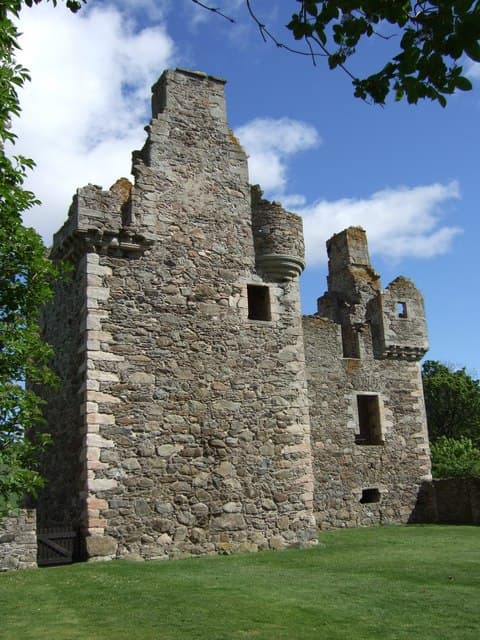
Glenbuchat Castle is a classic Z-plan tower house, a popular Scottish architectural style that emerged in the late 16th century. The layout consists of a rectangular main block with two round towers positioned diagonally at opposite corners. This configuration provided effective defensive coverage, allowing defenders to deliver flanking fire along the castle walls and protect the single entrance located in the re-entrant angle between the main block and one of the towers.
Masonry and internal structure
Constructed from robust local stone, the castle's walls are thick and designed for defense. The ground floor contains vaulted chambers originally used as kitchens and storage areas. Above these, the first floor housed a large central hall that served as the main living and gathering space. The two towers contain private chambers on their upper floors, accessed via spiral staircases that start at the first-floor level. These staircases are notable for their external supporting arches, which may indicate French architectural influence, possibly linked to Helen Carnegie's father's diplomatic role in France.
Interior modifications
During the early 18th century, the castle's interior was altered to improve lighting and functionality. The grand hall was subdivided into two smaller rooms with lowered ceilings. A large four-part window was inserted, marking a significant departure from the original defensive design toward greater comfort and domestic use.
Current condition and conservation
Today, Glenbuchat Castle stands as a roofless ruin, with significant masonry decay especially in the upper sections restricting access to certain areas. Despite this, many key architectural features remain visible, including the distinctive Z-plan layout, vaulted ground-floor rooms, and the commemorative stone above the entrance. The castle's condition reflects centuries of changing fortunes, deliberate dismantling, and ongoing conservation efforts.
The surrounding parkland, acquired by a local club and gifted to the state in the mid-20th century, helps preserve the castle's historic setting. Managed by Historic Scotland (now Historic Environment Scotland), Glenbuchat is protected as a site of cultural and architectural significance. Although closed for public entry in the mid-20th century due to safety concerns, plans have been made to improve access and visitor experience.
Cultural and architectural significance
Glenbuchat Castle exemplifies the transition in Scottish castle architecture during the Renaissance, blending defensive features with increasingly comfortable residential spaces. Its Z-plan design was influential in Scottish tower house construction, combining military practicality with aesthetic considerations.
The castle's association with the Gordon family and its role in the Jacobite uprisings provide valuable insights into the political and social history of northeast Scotland. The preservation of the carved stone with the founders' names and motto offers a tangible link to the personal histories behind the stone walls.
As a managed ruin, Glenbuchat continues to attract interest from historians, architects, and visitors keen to explore Scotland's rich heritage of fortified houses. Its enduring presence on the landscape above the River Don marks it as an important monument within the region.
Frequently asked questions (FAQ)
- How do I get to Glenbuchat Castle Ruins?
- Glenbuchat Castle Ruins is located near Kildrummy in the United Kingdom. You can reach the site by car, with the nearest major city being Aberdeen, approximately an hour away. There are also local bus services that connect to Kildrummy, but check the schedule for the most convenient options.
- What is the historical significance of Glenbuchat Castle?
- Glenbuchat Castle dates back to the 16th century and is a fine example of a Scottish Z-plan castle. It was originally built as a fortified residence and was associated with the powerful Gordon family. The ruins provide insight into the architectural style and historical context of that era.
- When was Glenbuchat Castle built?
- Construction of Glenbuchat Castle began in the early 16th century, around 1560. Its architectural features reflect the defensive needs of that time, as well as the wealth of the Gordon family. Over the centuries, it has undergone various changes, leading to its current ruinous state.
- Can I explore the castle grounds?
- Yes, visitors are welcome to explore the ruins and the surrounding grounds of Glenbuchat Castle. There are no entry fees, making it accessible for everyone. However, please respect the site and follow any posted guidelines to preserve its historical integrity.
- Why is Glenbuchat Castle a popular tourist attraction?
- Glenbuchat Castle is popular for its picturesque ruins set against the beautiful Scottish landscape. It offers a glimpse into Scotland's rich history and architectural heritage, attracting history enthusiasts and photographers alike. Additionally, its tranquil location makes it a perfect spot for a peaceful day out.
- Is it possible to visit Glenbuchat Castle year-round?
- Yes, Glenbuchat Castle Ruins are open to visitors year-round. However, the best time to visit is during the spring and summer months when the weather is more favorable, and the surrounding flora is in full bloom. Always check local weather conditions before planning your visit.
- What are the opening hours for Glenbuchat Castle?
- Glenbuchat Castle does not have official opening hours as it is an open ruin. Visitors can access the site at any time during daylight hours. It's recommended to visit during daylight for safety and to fully appreciate the landscape.
- Are there any nearby attractions to Glenbuchat Castle?
- Yes, nearby attractions include the beautiful Kildrummy Castle and the picturesque village of Kildrummy itself, which offers charming walks and local history. The area is rich in natural beauty, making it an excellent destination for hiking and outdoor activities. Don’t miss the chance to explore the stunning Scottish countryside while you're in the area.
- What are the ticket prices for visiting Glenbuchat Castle?
- Visiting Glenbuchat Castle Ruins is free of charge, making it an excellent option for budget-conscious travelers. There are no tickets required, allowing visitors to enjoy the site at their leisure. Donations to support preservation efforts are appreciated but not mandatory.
Photo gallery

Information
Website
Visit websiteSources & official resources
Verify the information above using these authoritative references.
Loading map...
Visitor reviews
No reviews yet. Been here? Write the first review and help other travelers!
Write the first reviewVisited this castle? Share your experience
Your review helps other travelers and adds first-hand knowledge to our encyclopedia.