Gilnockie Tower
Gilnockie Tower stands as a remarkable example of a 16th-century Scottish tower house, deeply rooted in the turbulent history of the Anglo-Scottish Borders. Located in the hamlet of The Hollows near Canonbie in southwest Scotland, this hill castle was originally constructed by the powerful Armstrong clan, a prominent Border family known for their influence and frequent involvement in the region's conflicts during the early modern period.
The tower's origins date back to around 1520, when Johnnie Armstrong, a notorious Border outlaw and the younger brother of Thomas Armstrong of Mangerton, established what was then known as Hollows Tower. This stronghold served as both a fortified residence and a defensive base for the Armstrongs in Dumfriesshire. Johnnie Armstrong's life and eventual tragic demise are central to Border history and folklore. In 1528, the tower was deliberately set ablaze by Sir Christopher Dacre, the English Warden of the Western Marches, as part of a campaign to suppress lawlessness in the borderlands. Subsequently, in 1530, Johnnie Armstrong and fifty of his followers were executed under orders from King James V of Scotland after being deceitfully invited to a hunting party, an event immortalized in the ballad bearing Armstrong's name.
Architectural features and defensive design
Gilnockie Tower is a stone-built tower house with a rectangular footprint measuring approximately 10 by 7.6 meters. The structure rises to four storeys plus an attic beneath distinctive crow-stepped gables, a hallmark of Scottish architecture during the early 1500s. The robust rubble masonry construction reflects its primary role as a fortified residence designed to withstand attacks.
The vaulted cellar in the basement features a notable set of gun loops oriented to the south, west, and north, indicating the tower was actively prepared for defense against invaders. The upper levels are accessed via a spiral staircase positioned in the south-west corner, a typical design choice in tower houses to maximize interior space while enhancing security.
The first floor houses the main hall, historically the central living and gathering area. Above it are two additional chambers, with attic space beneath the roof. At the top of the walls, corbel stones mark the former location of a parapet walk, a defensive walkway added during mid-16th-century repairs. This parapet walk was restored in the 21st century and fitted with a safety fence to preserve its historical function while ensuring visitor safety.
A distinctive architectural feature is the beacon stance corbelled out from the south gable at the tower's highest point. This projecting platform would have held a fire or beacon used to send signals across the border region, underscoring the tower’s strategic role in communication and defense during a period of frequent cross-border conflict.
Historical context and clan significance
Following its destruction in 1528, the Armstrongs swiftly rebuilt Gilnockie Tower, reaffirming its importance as a clan residence and stronghold. The tower endured further damage during English military raids in the 1540s, after which repairs included the addition of the parapet walk and the beacon stance, reflecting ongoing defensive needs in the volatile borderlands between England and Scotland.
Gilnockie Tower remained a significant symbol of the Armstrong clan’s power and resilience throughout the centuries. Its connection to Johnnie Armstrong and the dramatic events surrounding his execution have cemented the tower’s place in Scottish Border folklore and balladry.
Nearby historical sites
Approximately 500 meters southeast of Gilnockie Tower lies the site of Gilnockie Castle, near Gilnockie Bridge. While only earthworks remain today, it is believed this site may have been the location of an earlier tower destroyed during the 1528 conflicts with English forces, further illustrating the area's strategic importance.
Restoration and modern use
By the late 20th century, Gilnockie Tower had fallen into ruin, losing its roof and many internal features. In 1978, Major T.C.R. Armstrong-Wilson acquired the property and undertook a comprehensive restoration. This meticulous work included rebuilding the roof, reconstructing multiple floors, and installing traditional oak doors crafted in a style faithful to the tower’s historical character. Modern amenities such as electricity and running water were discreetly incorporated to support contemporary use without compromising authenticity.
The tower’s historical and cultural significance was formally recognized with its designation as a Category A listed building, ensuring its preservation as a structure of national importance. Further restoration efforts between 2015 and 2018 focused on restoring the tower’s 16th-century appearance while meeting modern safety standards, including the installation of a safety fence along the parapet walk.
Today, Gilnockie Tower functions as a cultural center and is home to the Clan Armstrong Museum. The museum houses a collection of artifacts related to the clan’s history and heritage and features a tribute to Neil Armstrong, the famed astronaut who shares the family name. This international recognition highlights the tower’s role as the ancestral home of the Armstrong family and a symbol of Scottish Border heritage.
Unique features and archaeological significance
Among the tower’s most intriguing elements is a large stone set into the wall near the basement entrance, carved with spiral patterns and a key-like symbol dating from the 2nd millennium BCE. This prehistoric artifact was repurposed during the tower’s construction, providing a tangible link between ancient and early modern periods. Such incorporation of ancient material is rare and adds to the tower’s archaeological interest.
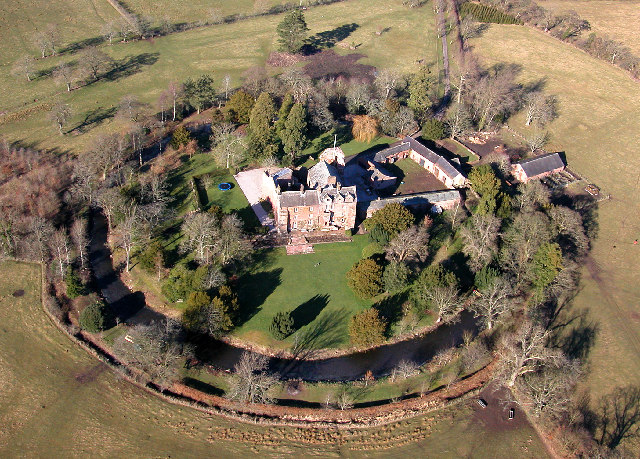
Situated on the west bank of the River Esk, Gilnockie Tower remains a prominent historical landmark within its landscape. Its combination of robust defensive architecture, rich clan history, and careful modern restoration make it an essential site for those interested in Scottish history, architecture, and Border culture.
Frequently asked questions (FAQ)
- How do I visit Gilnockie Tower?
- Gilnockie Tower is accessible by appointment only. Visitors should contact the current owner or the Clan Armstrong Museum to arrange a visit. Due to its private ownership and preservation efforts, visiting hours are limited and require prior booking.
- What is the historical significance of Gilnockie Tower?
- Gilnockie Tower was the ancestral home of the Armstrong clan and played a key role in the turbulent history of the Anglo-Scottish Borders during the early 16th century. It is closely associated with Johnnie Armstrong, a famous Border outlaw, and reflects the defensive architecture of the period.
- When was Gilnockie Tower built?
- The tower was originally constructed around 1520 by Johnnie Armstrong. It was rebuilt after being set ablaze in 1528 and underwent further repairs in the 1540s following military raids.
- Can I see the Clan Armstrong Museum at Gilnockie Tower?
- Yes, the tower houses the Clan Armstrong Museum, which features artifacts related to the clan's history and a tribute to Neil Armstrong. Museum visits are typically arranged alongside tours of the tower by appointment.
- Why is the beacon stance important?
- The beacon stance on the south gable was used historically to hold a fire or beacon for signaling across the Borders. This feature highlights the tower's strategic role in communication and defense during periods of conflict between England and Scotland.
Information
Opening hours
By appointment only
Ticket prices
Donation suggested
Current owner
Private owner
Website
Visit websiteSources & official resources
Verify the information above using these authoritative references.
Loading map...
Visitor reviews
No reviews yet. Been here? Write the first review and help other travelers!
Write the first reviewVisited this castle? Share your experience
Your review helps other travelers and adds first-hand knowledge to our encyclopedia.