Genhoes Castle
Genhoes Castle, also known locally as Kasteel Genhoes or Oud-Valkenburg, is a significant late medieval moated castle located west of the village of Schin op Geul in the Limburg province of the Netherlands. The castle stands within viewing distance of the nearby Schaloen Castle, contributing to the rich medieval heritage of the region.
The origins of Genhoes Castle date back to at least 1041, when it was first mentioned in historical records. At that time, it likely existed as a fortified tower house, a common form of early medieval defensive structure. Over the centuries, the castle underwent numerous modifications and expansions, reflecting the shifting political and military landscape of the region.
Early history and medieval development
By 1381, the castle was owned by Johan van Alden-Valkenborch. Before 1444, ownership passed to Jan 't Zievel, who bequeathed it to his son-in-law Hendrik van Ghoor. It was either Hendrik or his son Willem who likely constructed the present square tower and the west wing, key features that define the castle's late medieval character. The tower's walls are notably thick, measuring approximately 1.6 meters, indicative of the defensive priorities of the period.
Hendrik or Willem also built a gate tower, now lost, which stood at the site of the current gate arch leading to the bailey. The possibility exists that the castle suffered destruction during the Burgundian wars under Emperor Maximilian of Austria in the late 15th century, necessitating reconstruction efforts.
Family disputes and ownership changes
The castle's history from the late 15th century through the 17th century was marked by nearly 150 years of complex family disputes and legal battles. These conflicts culminated in the castle's transfer to the King of Spain as the lord of the Southern Netherlands in 1661, reflecting the broader geopolitical shifts in the region during the early modern period.
18th-century renovations and architectural evolution
In 1701, Genhoes Castle was acquired by Georg, Baron of Tunderfeld, a Latvian-born general-major who served Emperor Leopold I of Austria. His ownership marked a period of relative stability. Later, in 1749, the castle was sold to Leonard Thimus, a cloth manufacturer from Aachen, who made significant architectural contributions.
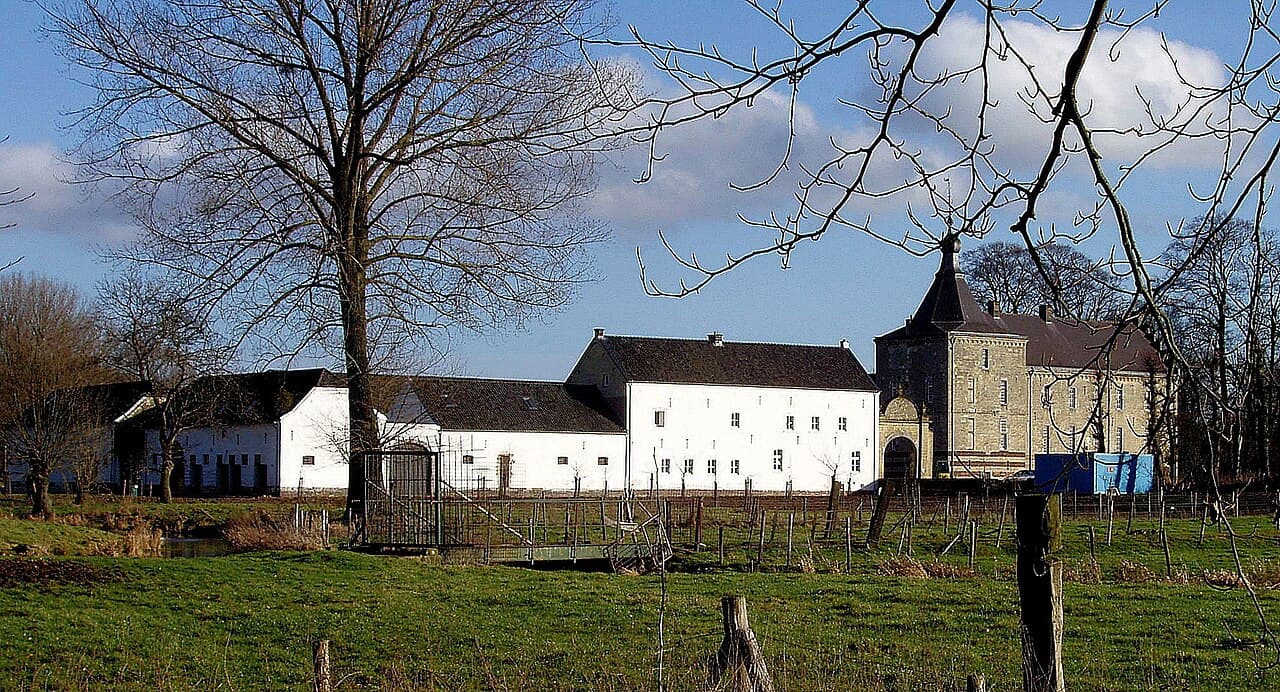
Thimus constructed the front wing and an arched bridge on medieval foundations, creating the distinctive L-shaped layout visible today. Beneath the castle's entrance was a prison that had fallen out of use by 1670. The castle's bailey was further developed into its current U-shaped form by Johann Friedrich von Pelser, Lord of Berensberg, Thimus's son-in-law.
Modern history and current status
Following the upheavals of the Napoleonic era, Oud-Valkenburg was definitively incorporated into the Kingdom of the Netherlands in 1814. During World War II, the castle was occupied by retreating German soldiers in 1944, a testament to its continued strategic importance.
Today, Genhoes Castle is owned by Natuurmonumenten, a Dutch association dedicated to nature conservation and environmental protection. The castle is currently used as a farm and rented out, remaining private property. Consequently, it is not open to the public for visits.
Architectural features and layout
Genhoes Castle is a classic example of a moated castle, with its defensive moat still preserved. Historically, the bailey was also surrounded by a moat, enhancing the castle's fortifications. The castle's core includes the robust square tower with thick walls, a testament to its defensive purpose during the late medieval period.
The gate arch to the bailey, which replaced the original gate tower, serves as the main entrance, leading visitors into the castle's courtyard area. The L-shaped design formed by the front wing and the west wing reflects the architectural evolution from a fortified tower house to a more complex residential and defensive structure.
Defensive elements
The castle's thick walls and moats were essential for protection against sieges and attacks common in the medieval and early modern periods. The presence of a prison beneath the entrance highlights the castle's role not only as a noble residence but also as a local center of authority and justice.
Cultural and historical significance
Genhoes Castle stands as a monument to the turbulent history of the Limburg region, reflecting the changing ownership, architectural styles, and political allegiances from the early medieval period through the modern era. Its connections to notable historical figures such as Emperor Maximilian of Austria and Emperor Leopold I of Austria underscore its importance in European history.
Although not accessible to the public, the castle's preservation by Natuurmonumenten ensures that this heritage site remains a vital part of the Netherlands' cultural landscape.
Frequently asked questions (FAQ)
- Can I visit Genhoes Castle?
- Genhoes Castle is private property and currently used as a farm, so it is not open to the public for visits.
- What is the historical significance of Genhoes Castle?
- Genhoes Castle reflects the turbulent history of the Limburg region, with origins dating back to 1041 and connections to notable historical figures and events.
- When was Genhoes Castle built?
- The castle was first mentioned in 1041, with the present square tower and west wing likely built in the 15th century.
- What are the main architectural features of Genhoes Castle?
- Key features include a thick-walled square tower, a moat, a gate arch leading to the bailey, and an L-shaped layout formed by the front and west wings.
- Who owns Genhoes Castle today?
- The castle is owned by Natuurmonumenten, a Dutch nature conservation association, and is used as a farm.
Photo gallery

Information
Current owner
Natuurmonumenten
Address
Oud Valkenburg 17-21, Netherlands
Loading map...
Visitor reviews
No reviews yet. Been here? Write the first review and help other travelers!
Write the first reviewVisited this castle? Share your experience
Your review helps other travelers and adds first-hand knowledge to our encyclopedia.