Garni Fortress — Armenia castle

Garni Fortress

Garni Fortress in Armenia
Early Medieval (5th–10th c.)
Well Preserved

Garni Fortress is a significant historical and architectural monument located near the village of Garni in Armenia. It represents a remarkable example of an early medieval bastioned fortress with origins tracing back to the 3rd century BC. The fortress stands as one of the few surviving structures from Armenia's ancient period, showcasing the strategic military architecture and cultural heritage of the region.

Historical context and significance

The site of Garni Fortress has been continuously important since antiquity, initially serving as a royal summer residence and a defensive stronghold. It is closely associated with the Kingdom of Armenia and its rulers during the Hellenistic and early medieval periods. The fortress's location near the Azat River gorge provided natural defenses and a commanding view of the surrounding landscape, making it a vital military and administrative center.

Garni Fortress is often linked to the reign of King Tiridates I of Armenia and other Armenian monarchs who fortified the region to protect against invasions by Roman, Parthian, and later Arab forces. The fortress played a crucial role in regional defense throughout the early medieval era, reflecting the turbulent history of Armenia as a crossroads between empires.

Architectural features and construction

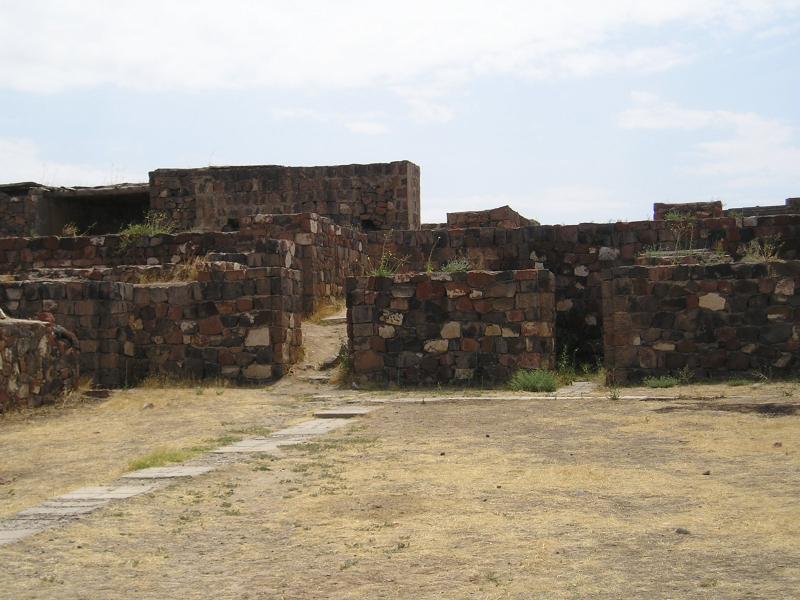
The fortress is characterized by its bastioned fortifications, which include thick defensive walls reinforced by towers and bastions designed to withstand sieges and artillery attacks. The walls are constructed from large basalt blocks, a common local building material, arranged to provide both strength and durability.

Key architectural elements include:

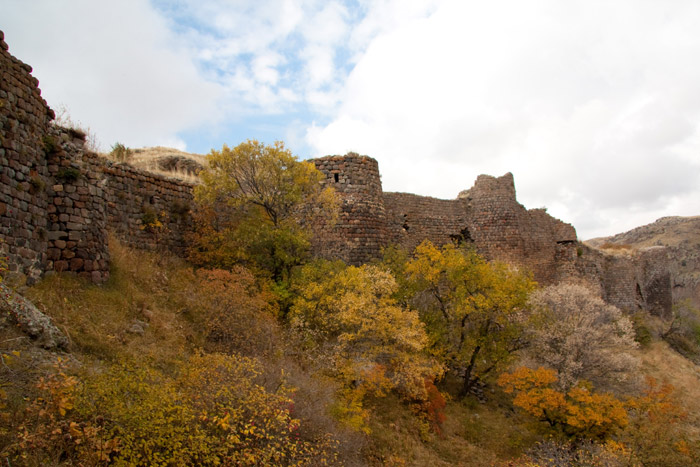
  • Bastions and towers: These project outward from the main walls, allowing defenders to cover adjacent walls with crossfire.
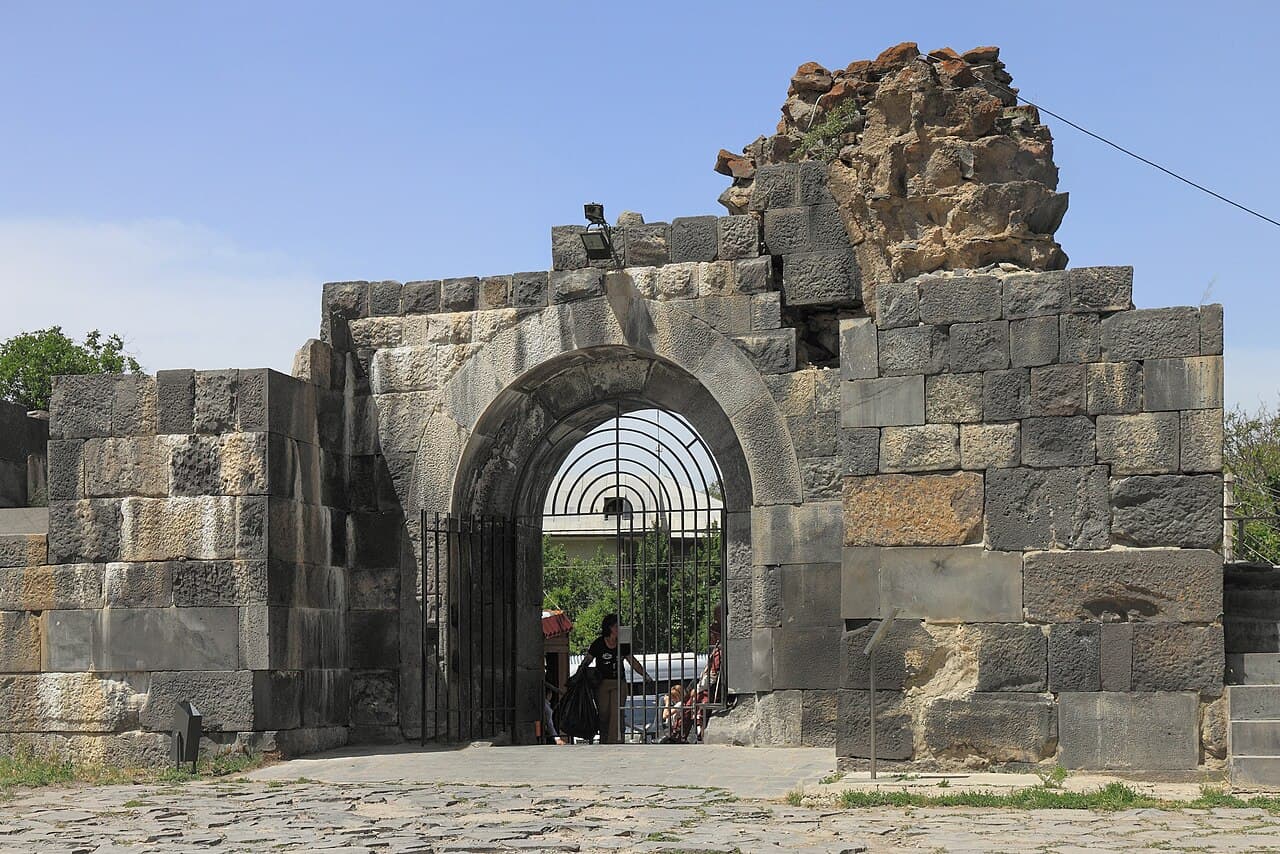
  • Gate complex: The entrance to the fortress is fortified with a gatehouse and defensive mechanisms to control access.
  • Inner courtyards and chambers: The interior includes spaces for troops, storage, and command functions, reflecting the fortress's military purpose.

The fortress's design integrates natural topography with man-made defenses, utilizing the steep cliffs and river gorge to enhance its defensive capabilities.

Archaeological and cultural importance

Garni Fortress is part of a larger archaeological complex that includes the nearby Garni Temple, a well-preserved Hellenistic pagan temple dating from the 1st century AD. Together, these sites illustrate the blend of Armenian, Hellenistic, and Roman influences in architecture and culture.

Excavations have revealed artifacts and structural remains that provide insight into the military technology and daily life during the fortress's active use. The site is protected as a cultural heritage monument and attracts scholars and tourists interested in Armenia's ancient history.

Preservation and current status

Today, Garni Fortress is classified as well preserved, with many of its walls and bastions remaining intact. Conservation efforts have focused on stabilizing the structure and facilitating visitor access while maintaining the site's historical integrity.

The fortress is accessible to the public and serves as a popular destination for those exploring Armenia's rich past. Its dramatic setting and robust architecture make it a notable example of early medieval military construction in the Caucasus region.

Visiting Garni Fortress

Visitors to Garni Fortress can explore the extensive fortifications and enjoy panoramic views of the Azat River gorge. The site is often combined with a visit to the nearby Garni Temple, providing a comprehensive experience of Armenia's ancient heritage.

The fortress is open year-round, with guided tours available to explain its historical and architectural significance. Visitors are advised to wear sturdy footwear due to uneven terrain and to respect preservation rules to protect this valuable cultural site.

Frequently asked questions (FAQ)

How do I get to Garni Fortress?
Garni Fortress is located approximately 28 kilometers east of Yerevan, Armenia's capital. You can reach it by car, taxi, or public transport; marshrutkas (minibuses) frequently run from Yerevan to Garni village, which is a short walk from the fortress.
What is the historical significance of Garni Fortress?
Garni Fortress is an ancient site dating back to the 1st century AD, making it one of the oldest structures in Armenia. It served as a royal summer residence and is notable for its Hellenistic temple, which is the only Greco-Roman colonnaded building in Armenia.
When was Garni Fortress built?
The current structures of Garni Fortress were built during the reign of King Tiridates I, around the 1st century AD. The site has been inhabited since ancient times, with archaeological evidence suggesting earlier settlements dating back to the 3rd millennium BC.
Can I enter Garni Fortress freely?
Yes, visitors can enter Garni Fortress, but there is a small entry fee to access the site. The ticket price helps maintain the fortress and its surrounding areas, ensuring a pleasant experience for all visitors.
Why is Garni Fortress a popular tourist destination?
Garni Fortress is a popular tourist destination due to its stunning architecture, rich history, and breathtaking views of the surrounding landscape. The unique blend of ancient Armenian and Hellenistic cultures, along with its scenic location, attracts history enthusiasts and nature lovers alike.
Is it possible to visit Garni Fortress year-round?
Yes, Garni Fortress is open to visitors year-round, but the best time to visit is during the spring and fall when the weather is mild and the scenery is particularly beautiful. Summer can be quite hot, while winter may bring snow, affecting accessibility.
What are the opening hours for Garni Fortress?
Garni Fortress is typically open daily from 10 AM to 6 PM, with extended hours during the summer months. It is advisable to check the official website or local resources for any seasonal changes or special events that may affect visiting hours.
Are there any nearby attractions to visit when I'm at Garni Fortress?
Yes, nearby attractions include the Garni Temple, the scenic Azat River Gorge, and the picturesque village of Garni itself. The Geghard Monastery, a UNESCO World Heritage site, is also just a short drive away and makes for an excellent addition to your visit.
What are the ticket prices for Garni Fortress?
The ticket price for Garni Fortress is quite affordable, usually around 1,000 AMD (approximately $2.50 USD) for adults. Discounts may be available for students and groups, so be sure to inquire at the ticket office upon arrival.

Photo gallery

Garni Fortress
Click to view

Photo by Marcin Konsek•CC BY-SA 4.0

1 photo • Click any image to view in full screen

Information

Bastioned Fortress

Loading map...

Visitor reviews

No reviews yet. Been here? Write the first review and help other travelers!

Write the first review

Visited this castle? Share your experience

Your review helps other travelers and adds first-hand knowledge to our encyclopedia.
Write a review

(5/5)

0/2000 characters

Your review will be visible after admin approval

Nearby castles

0.9 km
Kakavaberd — Armenia castle

Kakavaberd

, Armenia

Kakavaberd, also known as Geghi Berd, Keghi Berd, or Kegh, is a historic bastioned fortress perched on a ridge overlooking the Azat River gorge within the Khosrov Forest State Reserve in Ararat Province, Armenia. Situated at an altitude of 1,516 metres (4,974 feet), this fortress commands a strategic vantage point in a rugged natural landscape. Historical background and strategic importance The origins of Kakavaberd date back to the medieval period, with archaeological and historical evidence suggesting its construction during the High to Late Medieval era. The fortress was built to serve as a defensive stronghold controlling the vital mountain passes and protecting the surrounding region from invasions and raids. Its location overlooking the Azat River gorge allowed for surveillance of approaching enemies and control over trade routes. Throughout its history, Kakavaberd was a key military site in the defense systems of various Armenian principalities. It witnessed numerous conflicts and sieges, reflecting the turbulent history of the region marked by frequent invasions from neighboring powers. Architectural features and design Kakavaberd exemplifies the characteristics of a bastioned fortress, a type of fortification designed to provide enhanced defensive capabilities. The fortress incorporates thick stone walls reinforced with bastions—projecting structures that allowed defenders to cover adjacent walls with crossfire, eliminating blind spots. The fortress complex includes towers strategically placed along the curtain walls, which served as lookout points and platforms for archers. The main gatehouse was heavily fortified, often featuring a narrow entrance passage designed to slow down attackers. Inside the walls, there are remnants of living quarters, armories, and water cisterns that supported the garrison during prolonged sieges. The fortress's layout takes advantage of the natural topography, with steep cliffs providing natural defenses on certain sides. Location and natural environment Located within the protected area of the Khosrov Forest State Reserve, Kakavaberd is surrounded by a diverse ecosystem of forests, rocky outcrops, and river valleys. The Azat River gorge below the fortress adds to the natural defensive advantage and offers scenic views. The fortress's position in the Ararat Province places it within one of Armenia's historically significant regions, rich in cultural heritage and archaeological sites. The reserve itself is a habitat for rare flora and fauna, making Kakavaberd a point of interest not only for history enthusiasts but also for nature lovers. Current condition and preservation Today, Kakavaberd stands as partially preserved ruins. While much of the original structure has been affected by centuries of weathering and past conflicts, significant portions of the walls and bastions remain visible. Preservation efforts have focused on stabilizing the ruins to prevent further deterioration. Visitors to Kakavaberd can explore the remains of the fortress, gaining insight into medieval Armenian military architecture and the strategic importance of the site. The rugged terrain and limited access routes contribute to the fortress's secluded atmosphere. Visiting Kakavaberd Access to Kakavaberd requires a hike through the Khosrov Forest State Reserve, which is managed to protect the natural and historical heritage of the area. Visitors are advised to prepare for uneven terrain and to respect the conservation rules of the reserve. The site offers opportunities for hiking, photography, and historical exploration. Due to its location, Kakavaberd is best visited during the warmer months when weather conditions are favorable.

Details
16.6 km
Erebuni Fortress — Armenia castle

Erebuni Fortress

Yerevan, Armenia

Erebuni Fortress (Armenian: Էրեբունի ամրոց, romanized: Erebuni amrots') stands as one of the most significant archaeological sites in Armenia, representing an ancient fortified city established by the Urartian civilization in the 8th century BC. Located in what is now the capital city of Yerevan, the fortress sits at an elevation of approximately 1,017 metres (3,337 feet) above sea level. This strategic position provided commanding views over the surrounding landscape, crucial for defense and control of the region.Constructed during the reign of King Argishti I around 782 BC, Erebuni was part of a network of fortresses built to secure the northern borders of the Urartian kingdom. It served not only as a military bastion but also as a vital political, economic, and cultural center. The fortress's establishment marked a significant expansion of Urartian influence in the Armenian Highlands, underscoring its importance in the ancient Near East.Architectural features and layoutThe fortress was built using large basalt stones, typical of Urartian construction techniques, which contributed to its durability. The walls, originally up to 10 meters thick in places, enclosed a complex urban settlement featuring administrative buildings, temples, residential quarters, and storage facilities. The layout reflects advanced urban planning and defensive architecture for its time.The central citadel was the heart of the fortress, housing the royal palace and religious structures dedicated to the Urartian pantheon. Excavations have revealed remnants of altars and inscriptions, including cuneiform texts that provide valuable insights into the political and religious life of the kingdom.Defensive structuresErebuni's defensive system included massive walls reinforced with towers at intervals, designed to withstand sieges and attacks. The fortress featured a complex gate system, with narrow entrances and corridors to control access and enhance defense. The elevated position further augmented its defensive capabilities, allowing defenders to monitor approaching enemies from a distance.Historical significance and cultural legacyAs a major Urartian center, Erebuni Fortress played a crucial role in the administration and control of the kingdom's northern territories. It was a hub for trade and craftsmanship, evidenced by artifacts such as pottery, metalwork, and tools discovered on site. The fortress also served as a religious center, with temples dedicated to gods like Khaldi, the chief deity of Urartu.The name Yerevan is derived from "Erebuni," highlighting the fortress's enduring legacy in Armenian history and identity. The site represents the earliest known foundation of the modern Armenian capital, linking contemporary Yerevan directly to its ancient roots.Archaeological discoveriesExcavations at Erebuni have uncovered a wealth of artifacts, including wall paintings, inscriptions, and everyday objects that illuminate the daily life and beliefs of its inhabitants. The vibrant frescoes depict scenes of religious ceremonies, warriors, and mythological motifs, showcasing the artistic achievements of the Urartian culture.Inscriptions found at the site, primarily in cuneiform script, have been instrumental in understanding the political structure, military campaigns, and religious practices of the Urartian kingdom. These texts provide a rare glimpse into a civilization that flourished over 2,700 years ago.Preservation and current statusToday, Erebuni Fortress is classified as archaeological ruins and is partially preserved, with ongoing efforts to stabilize and conserve the site. It is managed as a museum and open to visitors, offering insight into Armenia's ancient history and the Urartian civilization.The fortress remains a prominent cultural landmark within Yerevan, attracting scholars, tourists, and locals interested in the origins of Armenian statehood and urban development. Its ruins provide a tangible connection to the past and a foundation for national heritage.

Early Medieval (5th–10th c.)
Details
20.4 km
Erivan Fortress — Armenia castle

Erivan Fortress

Yerevan, Armenia

Erivan Fortress, also known as Yerevan Fortress (Armenian: Երևանի բերդը; Persian: قلعه ایروان, Ghaleh-ye Iravân; Russian: Эриванская крепость), was a significant 16th-century bastioned fortress located in what is now the city of Yerevan, Armenia. Built during the Renaissance period, this fortress served as a crucial military stronghold and administrative center throughout various periods of regional conflict and control. The fortress was constructed primarily to defend the city and the surrounding region from invasions and raids. Its design incorporated bastioned fortifications, a style that emerged in response to the increasing use of artillery in warfare. The thick walls, angled bastions, and defensive towers allowed defenders to cover all approaches with overlapping fields of fire, making it a formidable obstacle for any attacking force. Historical context and strategic importance Erivan Fortress was strategically positioned on the banks of the Hrazdan River, providing natural defensive advantages. The fortress controlled key trade and military routes in the South Caucasus, making it a coveted asset for various empires and rulers, including Persian, Ottoman, and Russian forces. Its location allowed it to serve as a buffer zone and military outpost in the volatile frontier between empires. Throughout its history, the fortress witnessed numerous sieges and battles, reflecting the turbulent history of the region. It was repeatedly contested during the Ottoman-Persian wars and later during the Russian expansion into the Caucasus. The fortress's robust defenses and bastioned design helped it withstand several assaults, although it eventually lost military significance with the advent of modern warfare and changes in political control. Architectural features and design The bastioned fortress design of Erivan Fortress is characteristic of Renaissance military architecture, which emphasized angular bastions to eliminate blind spots and improve defensive coverage. The fortress walls were constructed from locally sourced stone and featured thick ramparts designed to absorb and deflect cannon fire. Key architectural elements included: Bastions: Projecting angular structures at the corners of the fortress walls, allowing defenders to fire along the adjacent walls and cover the surrounding area. Curtain walls: Thick and high walls connecting the bastions, forming a continuous defensive perimeter. Gates and entrances: Heavily fortified gates controlled access to the fortress, often protected by additional defensive structures such as barbicans or gatehouses. Internal buildings: The fortress contained barracks, armories, and administrative buildings necessary for sustaining a garrison and managing the city's defense. Adaptations and renovations Over the centuries, Erivan Fortress underwent several renovations and adaptations to meet evolving military needs. These included strengthening the walls, updating bastions, and modifying internal structures to accommodate changes in artillery technology and garrison requirements. Role in regional history Erivan Fortress played a central role in the defense of Yerevan and the surrounding region during the 16th to 19th centuries. It was a focal point in the conflicts between the Ottoman Empire and Safavid Persia, as well as during the Russian Empire's campaigns in the Caucasus. The fortress also served as an administrative center, housing governors and military commanders responsible for the region's security. Its presence influenced the development of Yerevan, shaping the city's growth around this military nucleus. Decline and current status With the progression of military technology and changes in political control, the fortress gradually lost its defensive importance. By the late 19th and early 20th centuries, much of the fortress was dismantled or fell into ruin as Yerevan expanded and modernized. Today, only remnants of the Erivan Fortress remain, serving as an archaeological site and a reminder of the city's historical military significance. These ruins provide valuable insights into the fortress's construction techniques, architectural style, and the turbulent history of the region. Visiting Erivan Fortress Visitors to Yerevan can explore the site of the former Erivan Fortress to appreciate its historical context and architectural legacy. Interpretive displays and archaeological findings help illustrate the fortress's role in the city's defense and development. The fortress's location near the Hrazdan River and central Yerevan makes it accessible for tourists interested in Armenian history and military architecture.

Renaissance (15th–17th c.)
Details