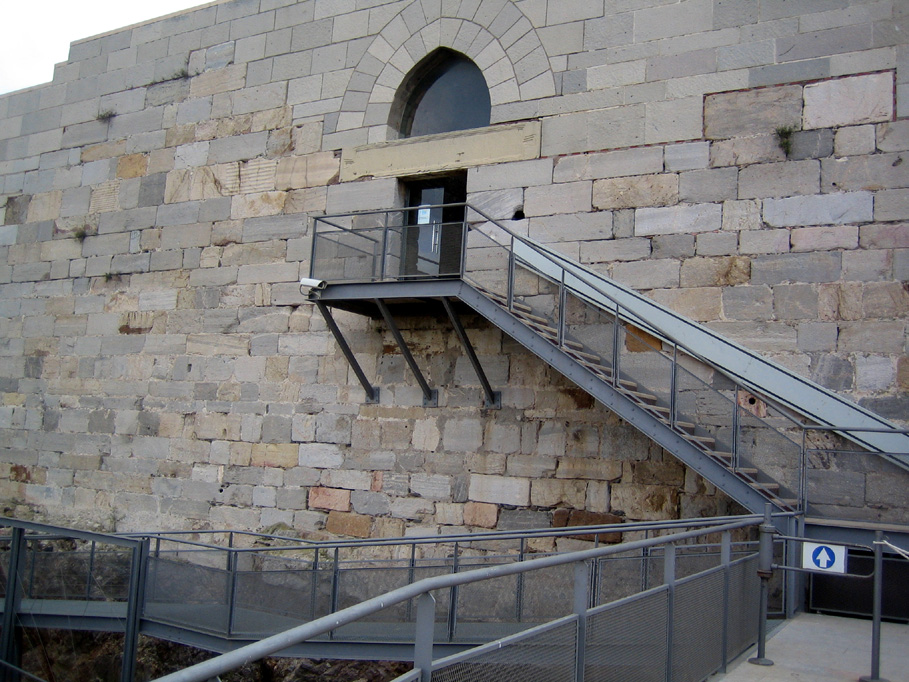
Galeras Fort
Galeras Fort, locally known as Fuerte de Galeras, stands prominently on a 219-meter-high mountain overlooking the historic city of Cartagena in the Region of Murcia, Spain. This fortress is a remarkable example of 18th-century military architecture, designed to protect one of Spain's most strategic naval bases. Its commanding position provided control over the harbor and the adjacent military shipyards, which have been vital to Spanish naval power since antiquity.
Historical background and strategic importance
The origins of Cartagena date back to the 3rd century BC when it was founded by the Carthaginian general Hasdrubal the Fair. Its natural harbor made it a coveted maritime stronghold throughout history. By the 16th century, Cartagena had become one of Spain's most important naval ports, necessitating extensive fortifications to defend against evolving military threats.
Although plans to fortify the Galeras hill were first proposed in the 16th century, the actual construction of Galeras Fort took place in the mid-18th century, between approximately 1750 and 1777. This period coincided with the reign of King Carlos III, under whose directive Cartagena was designated the capital of the Mediterranean Maritime Department, prompting a comprehensive modernization of the city's defenses.
The hill's strategic value was recognized even earlier by military engineer Vespasiano I Gonzaga, who suggested relocating the city to this elevated position to better withstand artillery advances. Although the relocation never occurred, the hill remained a key defensive site.
Construction and architectural design
The fort was primarily designed by Pedro Martín-Paredes Cermeño, a military engineer from Melilla, and constructed under the supervision of Croatian military engineer Mateo Wodopich (also known as Mateo Vodopich), a specialist in fortifications. The design reflects the principles of the Frenchified Spanish School of military architecture and embodies an eclectic form of Neoclassical style, which was prevalent in mid-18th-century military constructions.
Galeras Fort features a roughly quadrangular layout with five irregular bastions positioned at the corners and an additional bastion on the northeast side. The fort is surrounded by a deep moat and counterscarp, with a drawbridge providing controlled access. Thick, sloped curtain walls, especially on the southern side, were engineered to withstand naval artillery bombardments, highlighting the fort's role in coastal defense.
Within the fort, a large central courtyard connects various vaulted chambers and service rooms. The bastions are hollow and contain vaulted spaces designed to resist explosions, providing secure storage for munitions and shelter for personnel. A two-story building on the terrace once housed a semaphore station, enabling visual communication across distances.
Extending from the fort's southwest front are the Carlos III walls, a five-kilometer-long defensive barrier that encloses the military shipyard and much of the city, underscoring the fort's role as a critical citadel in Cartagena's defense system.
Military history and role in conflict
Galeras Fort played a significant role during several key conflicts in Spanish history. It was actively involved during the Peninsular War (1808–1814), when Spain resisted Napoleonic invasion forces. Later, the fort was a focal point during the Cantonal Revolution of 1873–74, a federalist uprising in which republican forces seized the garrison.
Traditional stories suggested that the rebels raised the Ottoman flag to deceive the defenders, but detailed historical research has shown that the flag flown was the red-yellow-purple tricolor associated with the federalists, reflecting their political stance.
Throughout the 20th century, the fort's military significance declined, transitioning to use as a military prison. Control of the site transferred from the Spanish Army to the Navy in 1987, and it remains under the jurisdiction of the Spanish Armed Forces.
Current status and accessibility
Today, Galeras Fort remains military property and is closed to the public. The site is reportedly used for telecommunications and as a lighthouse, maintaining its strategic importance in a modern context. While the mountain itself is accessible to visitors, the fortifications are within a restricted military zone, limiting direct exploration.
Despite restricted access, the fort's impressive Neoclassical bastions, moat, and defensive walls remain visible, offering a glimpse into the sophisticated military engineering of the 18th century. Its preservation provides valuable insight into Spain's naval defense heritage and the evolution of coastal fortifications.
Architectural significance and legacy
Galeras Fort exemplifies the adaptation of classical military engineering principles to the challenges posed by artillery and naval warfare in the 18th century. Its design incorporates advanced features such as angled bastions for overlapping fields of fire, bomb-proof vaulted chambers, and robust curtain walls angled to deflect cannonballs.
The fort's integration into the larger defensive network of Cartagena, including neighboring Atalaya Fort and the extensive Carlos III walls, illustrates a comprehensive approach to coastal defense. This network protected one of Spain's most vital naval arsenals, which continues to serve as a major military port today.
As a testament to its historical and architectural importance, Galeras Fort remains a significant landmark in the military history of Spain, reflecting centuries of strategic evolution from ancient times through the modern era.
Frequently asked questions (FAQ)
- How do I visit Galeras Fort?
- Galeras Fort is currently a military property and is not open to the public. However, the mountain on which it stands is accessible, allowing visitors to view the fortifications from a distance.
- What is the historical significance of Galeras Fort?
- Galeras Fort was built in the 18th century to protect the naval arsenal of Cartagena. It played key roles in the Peninsular War and the Cantonal Revolution, reflecting its strategic military importance.
- What architectural style characterizes Galeras Fort?
- The fort is designed in an eclectic Neoclassical style influenced by the Frenchified Spanish School of military engineering, featuring bastions, a moat, and bomb-proof vaulted chambers.
- When was Galeras Fort constructed?
- Construction of Galeras Fort took place between the mid-18th century and 1777, under the direction of military engineers Pedro Martín-Paredes Cermeño and Mateo Wodopich.
- Is Galeras Fort accessible to visitors?
- No, the fort is still used by the military and is closed to the public. Visitors can access the surrounding mountain area but not the fort itself.
Information
Current owner
Spanish Armed Forces
Address
Pasaje Galeras, Cartagena, Murcia, Spain
Loading map...
Visitor reviews
No reviews yet. Been here? Write the first review and help other travelers!
Write the first reviewVisited this castle? Share your experience
Your review helps other travelers and adds first-hand knowledge to our encyclopedia.