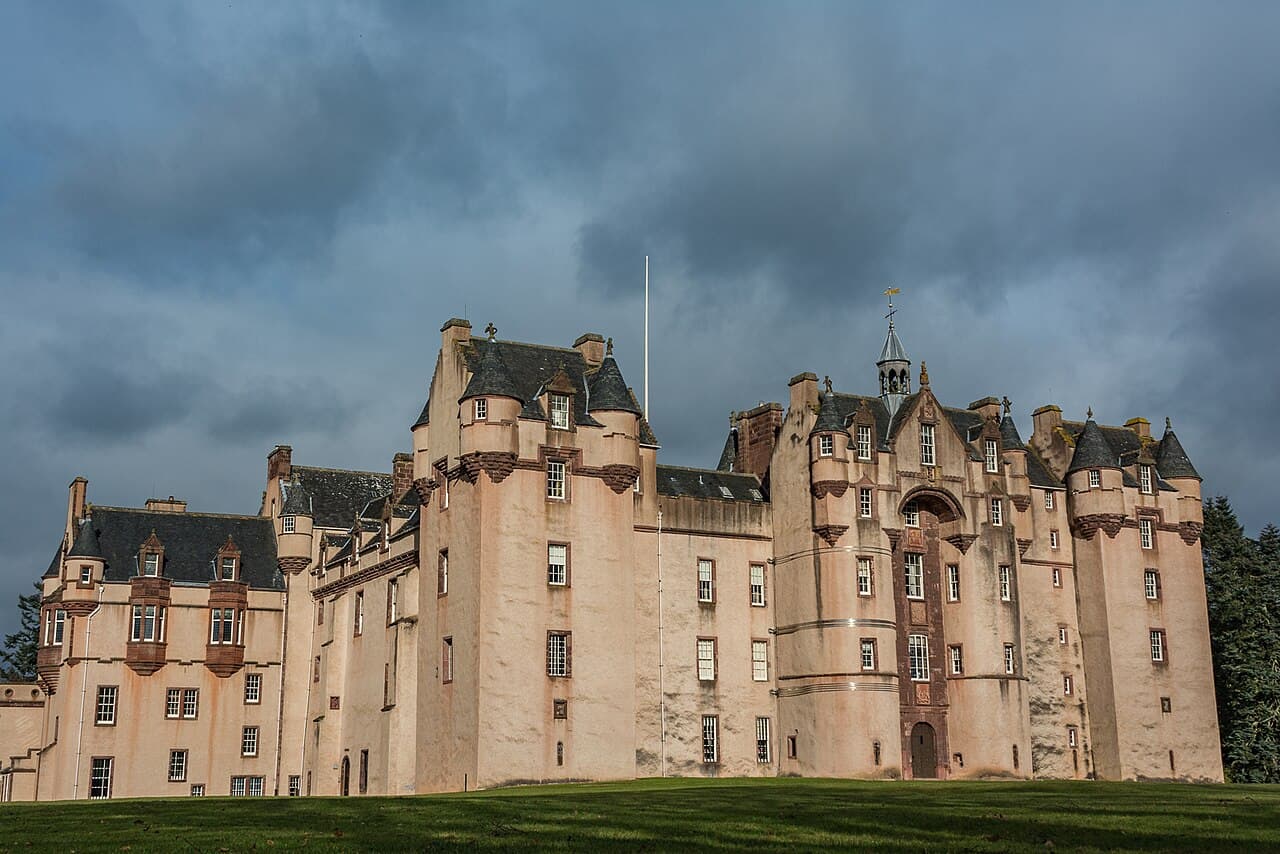
Fyvie Castle
Fyvie Castle stands as a remarkable example of a Scottish hill castle with origins tracing back to the 13th century. Situated in the village of Fyvie in Scotland, this castle embodies centuries of architectural evolution, royal history, and cultural significance. Its earliest parts are believed to have been constructed around 1211, possibly under the reign of King William the Lion, marking Fyvie as a notable medieval stronghold in northeast Scotland.
The castle's historical prominence is underscored by its role as a royal residence, most notably as the childhood home of Charles I, who lived here for four years. Fyvie also hosted an open-air court presided over by the legendary Robert the Bruce, cementing its place in Scotland's medieval judicial and political landscape. Over the centuries, Fyvie Castle transitioned from royal possession to private ownership, passing through the hands of five prominent families: the Prestons, Meldrums, Setons, Gordons, and Forbes-Leiths. Each family left its architectural mark by adding distinctive towers and features that contribute to the castle's unique composite structure.
Medieval origins and royal connections
The foundation of Fyvie Castle in the early 13th century places it squarely within the high medieval period of Scottish history. The initial construction likely served both defensive and residential purposes, typical of castles built to assert royal authority and control over strategic territories. The association with William the Lion suggests that Fyvie was an important royal asset during his reign, reflecting the king's efforts to consolidate power in Scotland.
Fyvie's role as a royal residence is further highlighted by its connection to Charles I, who spent part of his childhood within its walls. This royal occupancy underscores the castle's significance beyond military defense, serving also as a domestic and administrative center. The open-air court held by Robert the Bruce at Fyvie adds a layer of judicial importance, illustrating the castle's function as a venue for governance and legal proceedings during a turbulent era of Scottish history.
Architectural evolution through successive families
Following the Battle of Otterburn around 1390, Fyvie Castle ceased to be a royal stronghold and entered a new phase under private ownership. The castle's architecture reflects this transition, with each successive family contributing to its expansion and stylistic development.
The preston tower
The oldest surviving tower, known as the Preston Tower, dates from approximately 1390 to 1433. Positioned on the far right when facing the main facade, this tower exemplifies medieval defensive architecture with its robust stone construction and strategic placement. It serves as a tangible link to the castle's late medieval past and the Preston family's tenure.
The seton tower and internal features
The Seton Tower, erected in 1599 by Alexander Seton, marks a significant architectural addition that also serves as the castle's main entrance. Seton's influence extended inside the castle, where he commissioned the impressive great wheel staircase. This spiral staircase, designed like the spokes of a wheel, is a distinctive feature facilitating movement between floors and exemplifies late Renaissance architectural innovation within a medieval context.
Later additions: gordon and leith towers
The Gordon Tower, built in 1778, reflects the architectural tastes of the late 18th century, while the Leith Tower, constructed in 1890, showcases Victorian-era influences. These towers expanded the castle's footprint and introduced new stylistic elements, blending with the older medieval structures to create a layered architectural narrative.
Interior collections and historic artifacts
Inside Fyvie Castle, visitors can explore a rich collection of arms and armour that highlight the martial heritage of its past occupants. The castle also houses an impressive array of portraits by renowned artists such as Henry Raeburn, Pompeo Batoni, and Thomas Gainsborough, reflecting the cultural patronage and status of the families who lived here.
The castle's interior features, including the great wheel staircase and various chambers, provide insight into the domestic and defensive functions of a Scottish castle evolving over several centuries. These elements, combined with the castle's architectural diversity, make Fyvie a valuable study in the adaptation of medieval fortifications to changing residential needs.
Landscaped grounds and estate development
The castle is set within extensive grounds that include walled gardens and the adjacent Fyvie Lake. The eastern walled garden remains cultivated today with traditional Scottish fruits, while historical records indicate the presence of additional walled gardens to the west and south, emphasizing the estate's long-standing agricultural and aesthetic management.
Landscaping efforts in the 18th and 19th centuries, particularly under the ownership of Colonel William Gordon and later Alexander Leith, introduced Victorian influences that reshaped the parkland and gardens. These enhancements reflect broader trends in estate design during those periods and contribute to the castle's picturesque setting.
Historical events and military significance
Fyvie Castle was the site of a notable military engagement on October 28, 1644, when Manus O'Cahan and the Marquis of Montrose successfully defended the castle against the Covenant Army. This skirmish is recognized as part of Scotland's military heritage and adds to the castle's historical importance beyond its residential and administrative roles.
Legends, hauntings, and cultural impact
Like many Scottish castles, Fyvie is steeped in legend and reputed to be haunted. A famous story recounts the discovery in 1920 of a woman's skeleton hidden behind a bedroom wall during renovation work. After the remains were buried in the local cemetery, strange noises and unexplained phenomena plagued the castle, prompting the Laird to have the skeleton reinterred within the wall, after which the disturbances ceased.
Local lore also speaks of a secret room in the castle's south-west corner that must remain sealed to avoid disaster. Additionally, the castle is associated with three "weeping stones," historic boundary markers surrounded by curses. Only one stone remains visible today, preserved within the castle, while the others are lost, adding to the site's aura of mystery and folklore.
Fyvie Castle's rich history, architectural complexity, and enduring legends have made it a subject of interest in heritage programs and paranormal studies, further enhancing its cultural significance in Scotland.
Public access and preservation
Today, Fyvie Castle is managed by the National Trust for Scotland, which acquired the property in 1984. The castle is open to the public during the summer months, offering visitors the opportunity to explore its historic interiors, extensive grounds, and learn about its multifaceted past. Preservation efforts ensure that Fyvie Castle remains a well-preserved example of Scottish medieval and post-medieval architecture, maintaining its status as a treasured heritage site.
Frequently asked questions (FAQ)
- How do I get to Fyvie Castle?
- Fyvie Castle is located in Fyvie, Aberdeenshire, Scotland. It is accessible by car, with ample parking available on site. Public transport options include buses that connect to nearby towns, making it convenient for visitors traveling from larger cities.
- What is the historical significance of Fyvie Castle?
- Fyvie Castle has a rich history dating back to the 13th century and has been home to several noble families, including the Setons and the Gordons. It is renowned for its stunning architecture and beautiful grounds, showcasing the evolution of Scottish castle design over the centuries. The castle is also associated with various legends and tales, adding to its historical allure.
- When was Fyvie Castle built?
- Fyvie Castle was originally constructed in the late 13th century, with significant renovations and expansions occurring in the 16th and 17th centuries. Its present form reflects a blend of medieval and Renaissance styles, making it a fascinating example of historical architecture. The castle's long history is evident in its impressive structure and design.
- Can I take guided tours of Fyvie Castle?
- Yes, guided tours are available at Fyvie Castle, providing visitors with in-depth insights into its history and architecture. These tours are led by knowledgeable guides who share captivating stories and details about the castle's past. Self-guided tours are also an option for those who prefer to explore at their own pace.
- Why is Fyvie Castle a popular tourist attraction?
- Fyvie Castle attracts visitors due to its stunning architecture, rich history, and beautiful gardens. The picturesque setting and well-preserved interiors offer a glimpse into Scotland's past, making it a favorite among history enthusiasts and families alike. Additionally, the castle hosts various events and activities throughout the year, enhancing its appeal.
- Is it possible to host events at Fyvie Castle?
- Yes, Fyvie Castle is available for private events, including weddings and corporate gatherings. The castle's enchanting setting and historic ambiance provide a unique backdrop for special occasions. Interested parties can contact the castle's management for more information on booking and available services.
- What are the opening hours for Fyvie Castle?
- Fyvie Castle is generally open to visitors from April to October, with varying hours depending on the season. It’s best to check the official website for the most current opening times and any seasonal changes. During the winter months, the castle may have limited access or be closed for maintenance.
- What are the ticket prices for visiting Fyvie Castle?
- Ticket prices for Fyvie Castle vary based on age and the type of tour chosen. Discounts may be available for children, seniors, and families, making it more accessible to visitors. It's advisable to purchase tickets in advance, especially during peak tourist season, to ensure availability.
- When is the best time to visit Fyvie Castle?
- The best time to visit Fyvie Castle is during the spring and summer months, when the gardens are in full bloom and the weather is generally mild. This period also coincides with special events and activities hosted at the castle. Autumn can also be a beautiful time to visit for those who enjoy the changing foliage.
- Are there any nearby attractions to visit?
- Yes, there are several nearby attractions, including the picturesque village of Fyvie and the scenic Aberdeenshire countryside. Visitors can explore local walking trails, historic sites, and other castles in the area, such as Castle Fraser and Haddo House. These attractions make for a delightful day trip to complement a visit to Fyvie Castle.
Photo gallery

Information
Website
Visit websiteSources & official resources
Verify the information above using these authoritative references.
Loading map...
Visitor reviews
No reviews yet. Been here? Write the first review and help other travelers!
Write the first reviewVisited this castle? Share your experience
Your review helps other travelers and adds first-hand knowledge to our encyclopedia.


