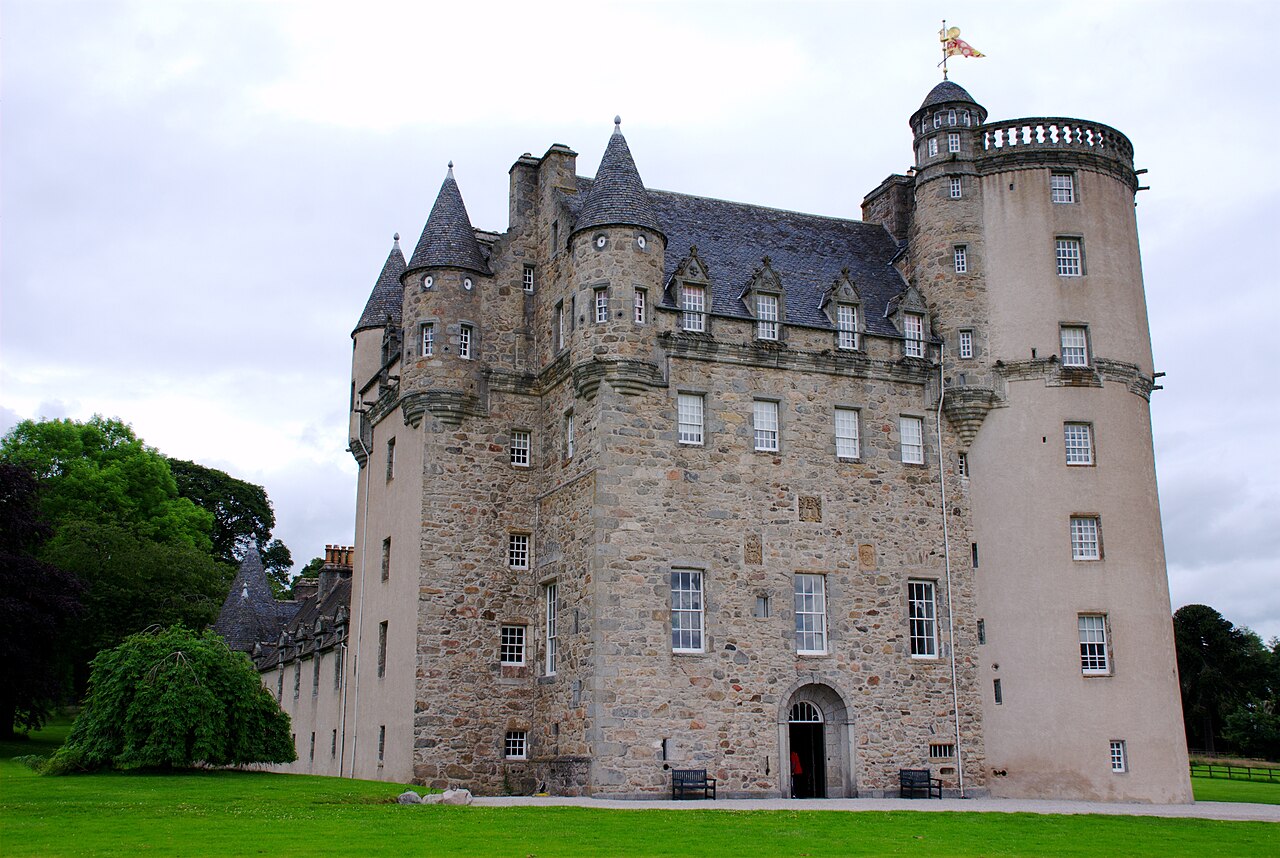
Fraser Castle
Fraser Castle, located in Aberdeenshire, Scotland, stands as one of the most impressive examples of a Z-plan castle in the country, embodying the architectural and historical richness of the Renaissance period in Scotland. Its origins trace back to the early 15th century, with archaeological evidence suggesting a square tower from around 1400 or 1500 formed the nucleus of the current structure. Originally known as Muchall-in-Mar, the castle's evolution reflects the fortunes and ambitions of the Fraser family over several centuries.
The castle's initial construction began in 1575 under the direction of Michael Fraser, who sought to transform the modest tower house into a grand residence befitting the family's rising status. This ambitious expansion introduced the distinctive Z-plan layout, characterized by a rectangular main block flanked by two towers at opposite corners: the square Michael Tower to the northwest and a large circular tower to the southeast. This design not only enhanced the castle's defensive capabilities but also its aesthetic grandeur, combining practical fortification with Renaissance elegance.
Origins and early construction
The Fraser family's association with the land began in the mid-15th century when James II granted the lands of Muchall and Stoneywood to Thomas Fraser in 1454. It is likely that Thomas Fraser quickly established a stronghold by constructing a three-story rectangular tower house, which remains the core of the present castle. This early structure served as a symbol of the Fraser family's authority and control over the barony.
Expansion under Michael Fraser
By the late 16th century, the original tower was deemed insufficient for the family's prestige. Michael Fraser initiated significant upgrades starting around 1575, commissioning the master mason Thomas Leiper to add the northwest square tower. Inspired by contemporary Aberdeenshire castles and influenced by his mason, Michael expanded the plans to include a large circular tower at the southeast corner, completing the iconic Z-plan configuration. This layout was a popular Scottish castle design of the time, blending residential comfort with defensive features.
The exterior was adorned with decorative motifs, including a series of Catholic symbols, a bold statement in post-Reformation Scotland that reflected the Fraser family's religious allegiance and regional influence. The construction of these towers was incomplete at Michael's death in 1588, but his son Andrew Fraser continued the work, finishing the expansions by 1618 with the help of master mason John Bell. Bell left a unique coded signature beneath the large coat of arms on the north wall, a testament to the craftsmanship involved.
The castle in the 17th century: political turmoil and further development
The Fraser family's fortunes peaked under Andrew Fraser, 1st Lord Fraser, who oversaw the addition of two northward wings enclosing a courtyard by 1630. This development gave the castle much of its present form. However, the turbulent political climate of 17th-century Scotland soon brought hardship. The 2nd Lord Fraser, also Andrew, was a fervent Covenanter opposing King Charles I's religious reforms, leading to direct involvement in conflicts such as the sacking of the Episcopal Palace of Aberdeen.
In retaliation, Royalist forces attacked Castle Fraser, destroying estate farms and crops. The situation worsened in 1644 when James Graham, Marquis of Montrose, leading Royalist troops, captured and sacked the castle. These events marked a period of decline for the Fraser estate, with subsequent generations struggling to restore its former glory.
Later ownership and architectural modifications
By the late 17th century, financial difficulties forced the 4th Lord Fraser to transfer ownership of the castle to John Erskine, Earl of Mar, though the family retained residence rights. This arrangement entangled the Frasers in the political upheavals surrounding the 1707 Act of Union and the 1715 Jacobite uprising. The death of Charles Fraser in 1716 without heirs ended the direct Fraser lineage at the castle, passing the estate through complex inheritance to Miss Elyza Fraser in 1787.
Elyza Fraser initiated a new phase of modernization, overseeing classical-style renovations including a new south entrance and sash windows. She also reshaped the grounds, removing older formal gardens in favor of a more naturalistic landscape and commissioning the construction of an octagonal stable block. The castle interiors were extensively remodeled between 1820 and 1850 by architects John Smith and William Burn, incorporating Regency style with Tudor detailing, particularly evident in the fine library.
20th-century restoration and present-day status
The castle eventually fell into disuse before being purchased in 1921 by the 1st Viscount Cowdray, who initiated restoration efforts for his son Clive Pearson. Restoration continued under Pearson's daughter, Lavinia Smiley, and her husband, Major Michael Smiley, culminating in the 1976 gift of the castle and surrounding land to the National Trust for Scotland. The Trust expanded the estate in 1993, preserving the castle within a substantial historic landscape.
Today, visitors to Castle Fraser can explore the well-preserved interiors that showcase a blend of medieval, Renaissance, and Regency elements. The castle retains original furnishings, portraits, and collections that narrate its rich history. Key features include the vaulted great hall, the Michael Tower kitchen, the grand dining room, and the intimate bedrooms in the round tower, such as the green room and pink room. The castle's rooftop offers panoramic views of the estate and surrounding countryside.
The estate encompasses over 1.2 square kilometers of landscaped grounds, woodlands, farmland, and a 19th-century walled kitchen garden. Visitors can enjoy extensive walks and explore the historic gardens and stable block. Castle Fraser is open to the public from Easter to October, with year-round access to the grounds and gardens. It also serves as a venue for weddings, conferences, and special events, maintaining its role as a vibrant part of Scotland's cultural heritage.
Architectural significance of the Z-plan design
The Z-plan configuration of Castle Fraser is a hallmark of Scottish Renaissance castle architecture, combining defensive features with residential comfort. The placement of the two towers at diagonally opposite corners allowed for effective crossfire defense and created a visually striking silhouette. The combination of the square and round towers provided varied interior spaces, from the utilitarian kitchen in the Michael Tower to the more luxurious living quarters in the round tower.
Decorative elements such as carved stonework, heraldic panels, and the incorporation of Catholic iconography distinguish Castle Fraser from many contemporaneous Scottish castles, reflecting the family's religious convictions and social aspirations during a period of significant religious conflict.
Interior layout and features
The castle's interior is arranged around a central great hall, a vaulted stone chamber that served as the social and administrative heart of the estate. From here, visitors can access the kitchen, dining room, private chambers, and the chapel, a vaulted room whose original function may have been for storing valuable documents and relics.
The library, redesigned in the early 19th century, exemplifies Regency style with Tudor influences, featuring elegant woodwork and a collection of Fraser family portraits and artifacts. The upper floors of the towers contain bedrooms and living rooms that reflect the tastes and personalities of various owners, including rooms dedicated to Lavinia and Major Smiley, showcasing the castle's continuous occupation and adaptation over centuries.
Historical legacy and cultural importance
Fraser Castle stands as a testament to the resilience and adaptability of Scottish noble families through centuries of political upheaval, religious conflict, and social change. Its preservation and restoration by the National Trust for Scotland ensure that this architectural gem remains accessible to the public, offering insights into Scotland's Renaissance architecture and the complex history of the Fraser family.
The castle's combination of medieval fortification, Renaissance design, and 19th-century modernization makes it a unique cultural landmark. It provides valuable educational opportunities and a tangible connection to Scotland's past, attracting historians, architects, and tourists alike.
Frequently asked questions (FAQ)
- How do I get to Fraser Castle?
- Fraser Castle is located in Aberdeenshire, easily accessible by car and public transport. If you're driving, take the A96 road and follow signs to the castle. Public transport options include local buses that connect to nearby towns.
- What is the historical significance of Fraser Castle?
- Fraser Castle is a remarkable example of Scottish baronial architecture, dating back to the 16th century. It has been home to the Fraser family for centuries and played a key role in the region's history, including its involvement in various historical conflicts.
- When was Fraser Castle built?
- Fraser Castle was constructed in the late 16th century, with significant renovations made in the 18th and 19th centuries. Its design reflects the evolving architectural styles of the time, showcasing both defensive and residential features.
- Can I take guided tours of Fraser Castle?
- Yes, guided tours are available at Fraser Castle, providing visitors with insights into its rich history and architecture. Tours typically last about an hour and are led by knowledgeable guides who share fascinating stories about the castle and its inhabitants.
- Why is Fraser Castle a popular tourist destination?
- Fraser Castle attracts visitors due to its stunning architecture, beautiful gardens, and rich history. The picturesque surroundings and the castle's connection to Scottish heritage make it an ideal destination for history enthusiasts and families alike.
- Is it possible to host events at Fraser Castle?
- Yes, Fraser Castle offers options for hosting events, including weddings and private functions. The castle’s enchanting setting provides a unique backdrop for special occasions, and the staff can assist with planning details to ensure a memorable experience.
- What are the opening hours for Fraser Castle?
- Fraser Castle is typically open to visitors from April to October, with varying hours depending on the season. It's recommended to check the official website for the most current opening times before planning your visit.
- What are the ticket prices for Fraser Castle?
- Ticket prices for Fraser Castle vary based on age and whether you are a family or individual visitor. Children often enjoy discounted rates, and there are sometimes special rates for groups, so it's best to check the official website for the latest pricing details.
- What is the best time to visit Fraser Castle?
- The best time to visit Fraser Castle is during the spring and summer months when the gardens are in full bloom and the weather is generally pleasant. Visiting during special events or festivals can also enhance your experience and offer unique activities.
- Are there any nearby attractions to visit when at Fraser Castle?
- Yes, there are several attractions near Fraser Castle, including the beautiful Cairngorms National Park and charming towns like Huntly and Alford. Visitors can also explore other historical sites and enjoy outdoor activities in the surrounding area.
Information
Website
Visit websiteSources & official resources
Verify the information above using these authoritative references.
Loading map...
Visitor reviews
No reviews yet. Been here? Write the first review and help other travelers!
Write the first reviewVisited this castle? Share your experience
Your review helps other travelers and adds first-hand knowledge to our encyclopedia.