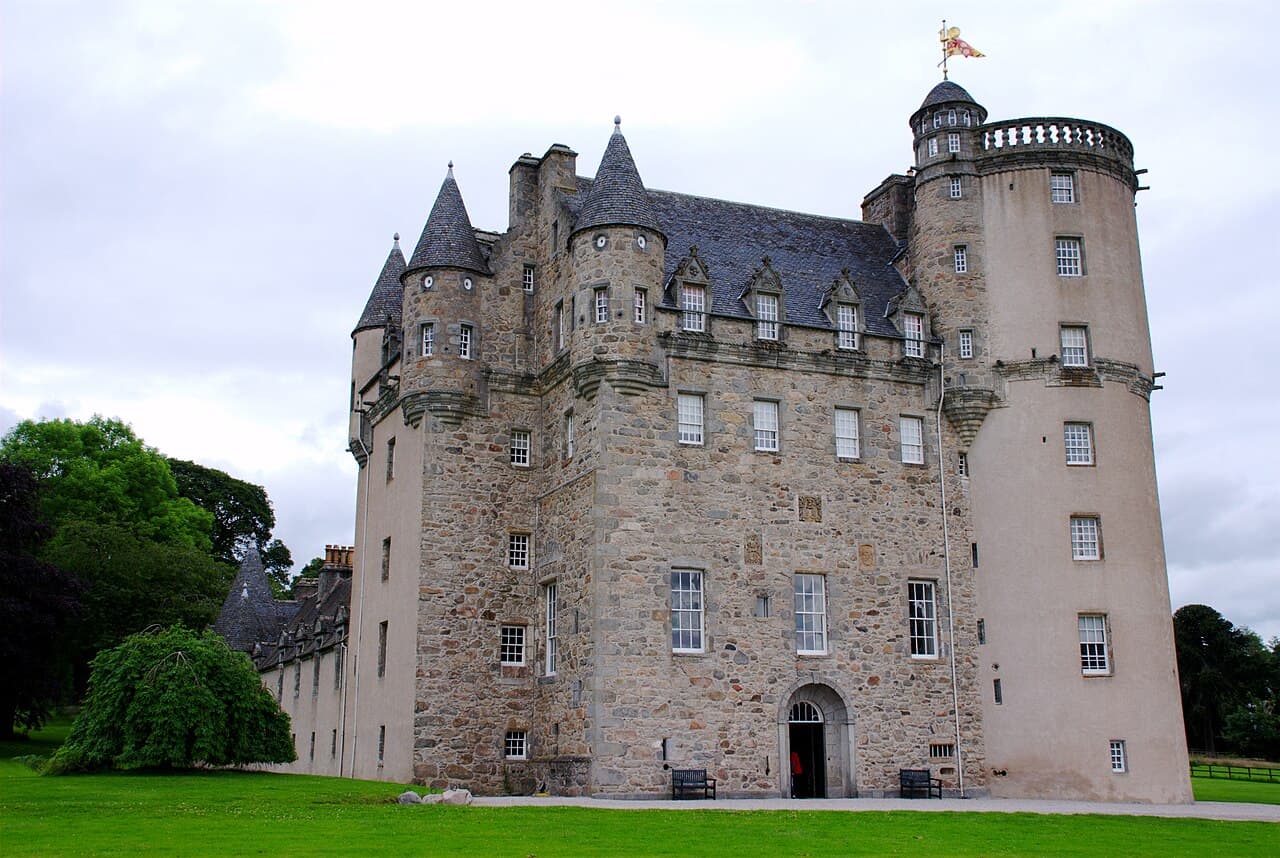
Castle Fraser
Castle Fraser stands as one of Scotland's most magnificent Z-plan castles and is among the grandest of the renowned "Castles of Mar". Located near Kemnay in Scotland, this castle is a splendid example of Renaissance architecture combined with medieval fortification elements. Its impressive design and rich history make it a significant cultural landmark, surrounded by over 300 acres of beautifully landscaped grounds, woodlands, and farmland.
The castle's origins date back to the mid-15th century, with archaeological evidence revealing an earlier square tower from around 1400 to 1500 incorporated into the current structure. This early tower formed the nucleus of what would become a sprawling fortress, reflecting the evolution of Scottish castle architecture through the centuries.
Historical development and ownership
The estate was initially granted by King James II of Scotland in 1454 to Thomas Fraser, who established the original three-story rectangular tower house that remains the core of the castle today. This early medieval structure was typical of Scottish noble residences of the period, designed for both defense and domestic living.
In 1575, Michael Fraser, the sixth Laird of Fraser, dramatically expanded the castle, commissioning architect Thomas Leiper to add a large square tower on the southwest corner, known as Michael’s Tower, and a round tower on the southeast corner. These additions created the castle's distinctive Z-plan layout, a design characterized by a central block flanked by towers at diagonally opposite corners, allowing for improved defense and aesthetic grandeur.
The castle continued to evolve under Michael's son, Andrew Fraser, the first Lord Fraser, who by 1618 had added two northward wings enclosing a courtyard, significantly expanding the castle's footprint and enhancing its residential comfort and defensive capabilities.
The 17th century brought turbulent times for the Fraser family and Castle Fraser. Andrew Fraser, the second Lord Fraser, supported the Covenanters against King Charles I, leading to military attacks that partially damaged the castle. Financial strains and political upheaval caused the estate to change hands in 1674 when Charles Fraser sold it to John Erskine, Earl of Mar. Despite this, Charles Fraser continued to reside at the castle under agreements reflecting the complex loyalties of the time.
In 1787, the castle returned to the Fraser family through Miss Elyza Fraser, who undertook modernization efforts including a new southern entrance. Her nephew, Charles Fraser, further enhanced the interiors from 1814, commissioning architect John Smith to design a Regency-style library completed in 1830, blending Tudor revival elements with contemporary tastes.
The castle experienced decline in the early 20th century until Viscount Cowdray purchased and restored it in 1921. Eventually, the property was donated to the National Trust for Scotland in 1976, ensuring its preservation as a Category A listed building and securing its place within Scotland’s Inventory of Gardens and Designed Landscapes.
Architectural features and layout
The z-plan design and towers
Castle Fraser exemplifies the classic Z-plan castle, combining a central rectangular tower house with two projecting towers at opposite corners. The original tower, dating from the mid-15th century, forms the heart of the complex. The southwest corner features Michael’s Tower, a large square tower constructed with finely worked granite, attributed to masons John Bell and Thomas Leiper. John Bell’s contribution is immortalized by a stone panel inscribed "I Bel" on the castle’s north side.
The southeast corner is marked by a tall round tower, rising four stories above the main block, providing both defensive vantage points and elegant living quarters. During the early 1600s, the castle was heightened with a corbelled fourth floor adorned with imitation cannon openings, enhancing its military appearance and status.
Courtyard and northern wings
Andrew Fraser’s early 17th-century additions include two northward wings that enclose a spacious courtyard. These wings contain rooms with vaulted timber ceilings and large windows overlooking the gardens, reflecting a transition toward comfort and style in castle living. The courtyard is secured by two small gate lodges connected by an archway dating to the 1820s, blending functionality with architectural charm.
Interior design and renovations
The 19th century saw significant interior enhancements under Charles Fraser, guided by architects John Smith and William Burn. Smith’s Regency-style library, completed in 1830, is notable for its Tudor revival details and sash windows that flood the room with natural light. Though some Gothic revival elements proposed by Burn were not fully realized, a Gothic-style pipe organ was once installed, adding to the castle’s eclectic stylistic layers.
Much of the castle’s original furniture, portraits, and collections have been preserved, maintaining the atmosphere of a lived-in noble residence and offering visitors a glimpse into the Fraser family’s history and lifestyle.
Estate buildings and landscape
Stable block and ancillary structures
The estate includes an octagonal stable block built in 1794 by John Paterson, featuring granite cherry-cocking masonry. This stable complex forms a quadrangle with circular corner towers and an eastern gateway. Inside, a former threshing barn contains a grain-drying oven and remnants of a 19th-century hydraulic system powered by a waterwheel, illustrating the estate’s agricultural heritage.
Additional estate buildings include two gate lodges: one with an L-shaped plan and rounded western end from the 1820s, and another from 1892 with a T-shaped layout and stepped gables. Tudor-style cottages constructed from pink granite complement the estate’s architectural ensemble.
Gardens and grounds
The castle is set within approximately 300 acres of woodland, farmland, and landscaped parkland, largely shaped in the late 18th century by Elyza Fraser. Tree-lined avenues lead visitors through the estate to a walled kitchen garden enclosed by red brick walls up to 3.6 meters high. This garden is divided into four sections by central paths and includes two greenhouses and a restored 17th-century stone sundial, reflecting the estate’s horticultural sophistication.
Archaeological significance and prehistoric context
Archaeological investigations have uncovered parts of an earlier square tower dating from around 1400 to 1500 integrated into the castle’s foundations, underscoring the site’s long-standing occupation and strategic importance.
Nearby prehistoric monuments enrich the historical landscape. Approximately 200 meters southeast of the castle stand two monoliths about two meters tall. Beyond these lies a cromlech—a circular stone structure roughly 20 meters in diameter composed of standing stones arranged around a central cairn—indicating ancient ritual or burial practices predating the castle by millennia.
These prehistoric features add a profound dimension to Castle Fraser’s heritage, linking the site not only to medieval and Renaissance history but also to Scotland’s deep prehistoric past.
Visiting castle fraser today
Today, Castle Fraser is managed by the National Trust for Scotland and is open to the public. Visitors can explore the richly furnished interiors, extensive grounds, and historic gardens. The castle’s well-preserved architecture and layered history offer a compelling experience for those interested in Scottish heritage, Renaissance architecture, and noble family histories.
The estate’s combination of medieval fortification, Renaissance grandeur, and 19th-century enhancements makes it a unique example of Scottish castle evolution. Its setting amidst expansive parkland and proximity to ancient monuments further enhance its appeal as a cultural and historical destination.
Frequently asked questions (FAQ)
- What are the opening hours for Castle Fraser?
- Castle Fraser is typically open to visitors from April to October, with hours varying by day. During peak season, the castle opens from 10 AM to 5 PM, while in the shoulder months, hours may be reduced. It’s advisable to check the official website for any seasonal changes or special events.
- What is the historical significance of Castle Fraser?
- Castle Fraser is one of the finest examples of Scottish baronial architecture and dates back to the 16th century. It has a rich history associated with the Fraser family, who played a significant role in Scottish history. The castle is also known for its unique architectural features, including its distinctive round towers and intricate stone carvings.
- Can I access Castle Fraser with mobility aids?
- Yes, Castle Fraser is committed to accessibility and provides facilities for visitors with mobility aids. However, some areas of the castle may have limited access due to the historic nature of the building. It’s recommended to contact the visitor center in advance for specific accessibility information.
- When is the best time to visit Castle Fraser?
- The best time to visit Castle Fraser is during the spring and summer months when the gardens are in full bloom and the weather is most pleasant. Additionally, many special events and guided tours are offered during this time, enhancing the visitor experience. Autumn also provides a beautiful backdrop with stunning foliage.
- Is it possible to take guided tours of Castle Fraser?
- Yes, guided tours are available at Castle Fraser, providing visitors with in-depth information about its history and architecture. These tours are often led by knowledgeable staff who can share fascinating stories and facts about the castle. It’s advisable to check in advance for tour schedules and availability.
- What are the ticket prices for visiting Castle Fraser?
- Ticket prices for Castle Fraser are generally affordable, with discounts available for children, families, and seniors. Admission fees help support the conservation of the castle and its grounds. Always check the official website for the most current pricing and any special promotions.
- Are there any nearby attractions to visit when at Castle Fraser?
- Yes, there are several nearby attractions that complement a visit to Castle Fraser, including beautiful gardens, nature trails, and other historical sites. The surrounding Aberdeenshire area is rich in natural beauty and offers a variety of outdoor activities. Visitors can explore local villages and enjoy the scenic countryside as well.
Photo gallery

Photo by Karora•Public domain
Information
Website
Visit websiteSources & official resources
Verify the information above using these authoritative references.
Loading map...
Visitor reviews
No reviews yet. Been here? Write the first review and help other travelers!
Write the first reviewVisited this castle? Share your experience
Your review helps other travelers and adds first-hand knowledge to our encyclopedia.



