Frankenberg Castle
Frankenberg Castle, located in the historic city of Aachen, Germany, is a remarkable example of a high medieval hill castle that has witnessed centuries of European history. Constructed in the 13th century, this castle originally served as the seat of a Vogt, a local administrator overseeing the surrounding region under the Holy Roman Empire. Its strategic position on a natural rocky outcrop allowed it to be fortified as a water castle, surrounded by a moat that enhanced its defensive capabilities.
The castle's architecture and history reflect the complex socio-political landscape of medieval Germany, particularly within the Duchy of Jülich-Cleves-Berg. Over the centuries, Frankenberg Castle has undergone numerous transformations, from its initial construction through periods of destruction, neglect, and restoration. Today, it stands as a restored monument that encapsulates the spirit of medieval chivalry, religious conflicts, and Renaissance humanism.
Historical significance and ownership
Frankenberg Castle's origins are closely tied to the noble von Merode family, specifically Arnold I von Merode, who is believed to have been instrumental in its construction. The castle was first documented in 1352, although its construction dates back to the 13th century. It was initially built as a fortified residence outside the old fortifications of Aachen, serving as an administrative center with imperial immediacy over the lands surrounding the Burtscheid Abbey.
Throughout its history, the castle experienced periods of conflict and ownership changes. In 1391, it was briefly seized by robber barons from Schönforst Castle but was reclaimed by the von Merode family by 1449. The castle suffered partial destruction in the 16th century during the Spanish-Dutch conflicts, particularly under the tenure of Adam III von Merode-Frankenberg, who fought alongside the Dutch against Spanish forces. Following his death without male heirs, the castle passed to Johann von Merode-Houffalize as a fief under the Duchy of Jülich-Cleves-Berg.
The castle's decline began in the 18th century when the last male heir of the Merode-Houffalize line died in 1728, leading to its abandonment and gradual ruin. The French Constitution of 1793 ended its status as a fief, and by the early 19th century, the property was sold to Friedrich Joseph Freiherr von Coels von der Brügghen, who initiated extensive renovations between 1834 and 1838, incorporating contemporary architectural elements of the period.
Architectural features and construction history
Original medieval structure
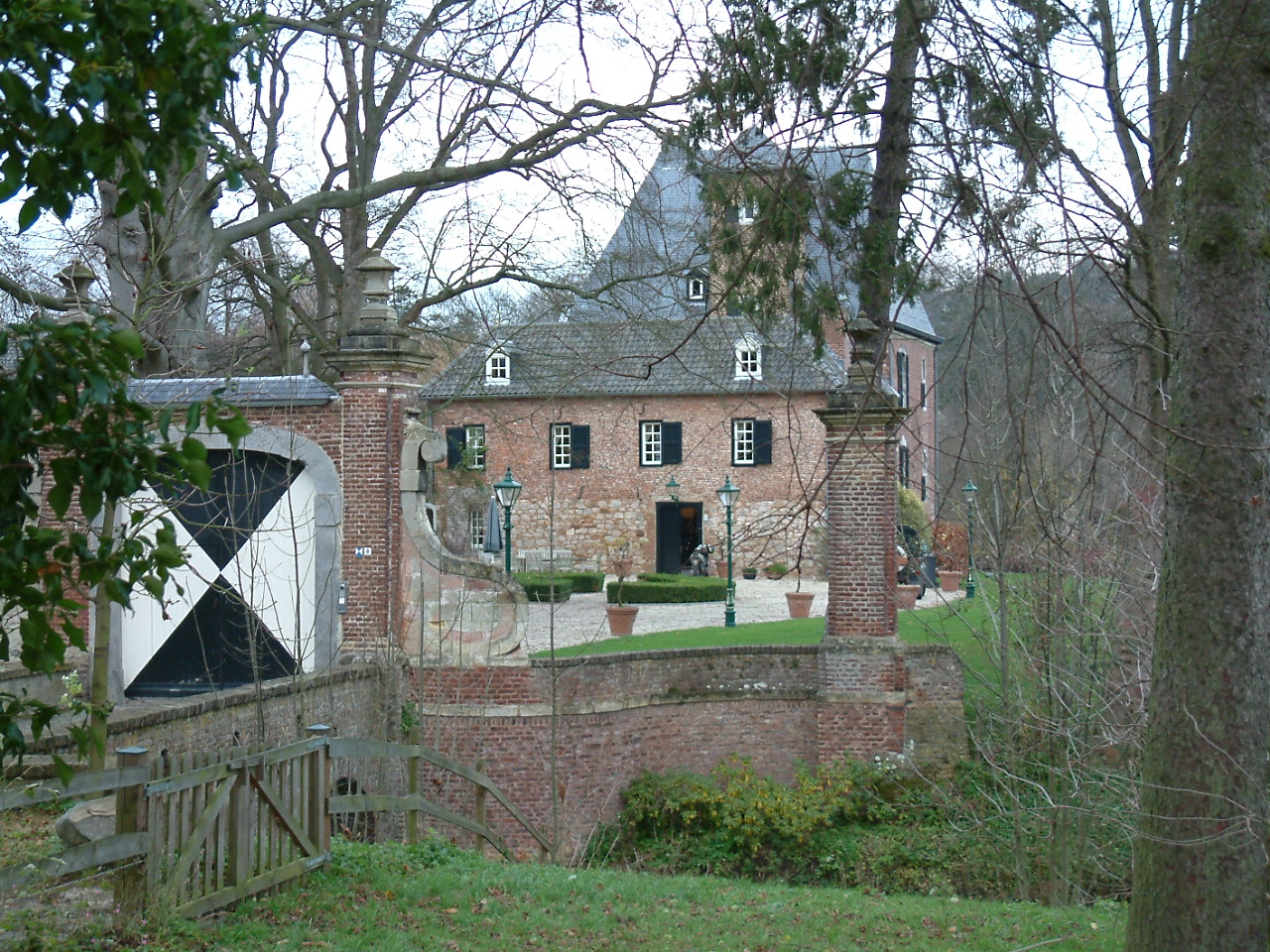
The castle was originally designed with a broad forecastle, a farmyard, and a main castle completely surrounded by water, characteristic of a water castle designed for defense and administration. The main building followed a three-cornered plan situated on a rocky outcrop, with robust stone foundations and brick masonry on upper floors.
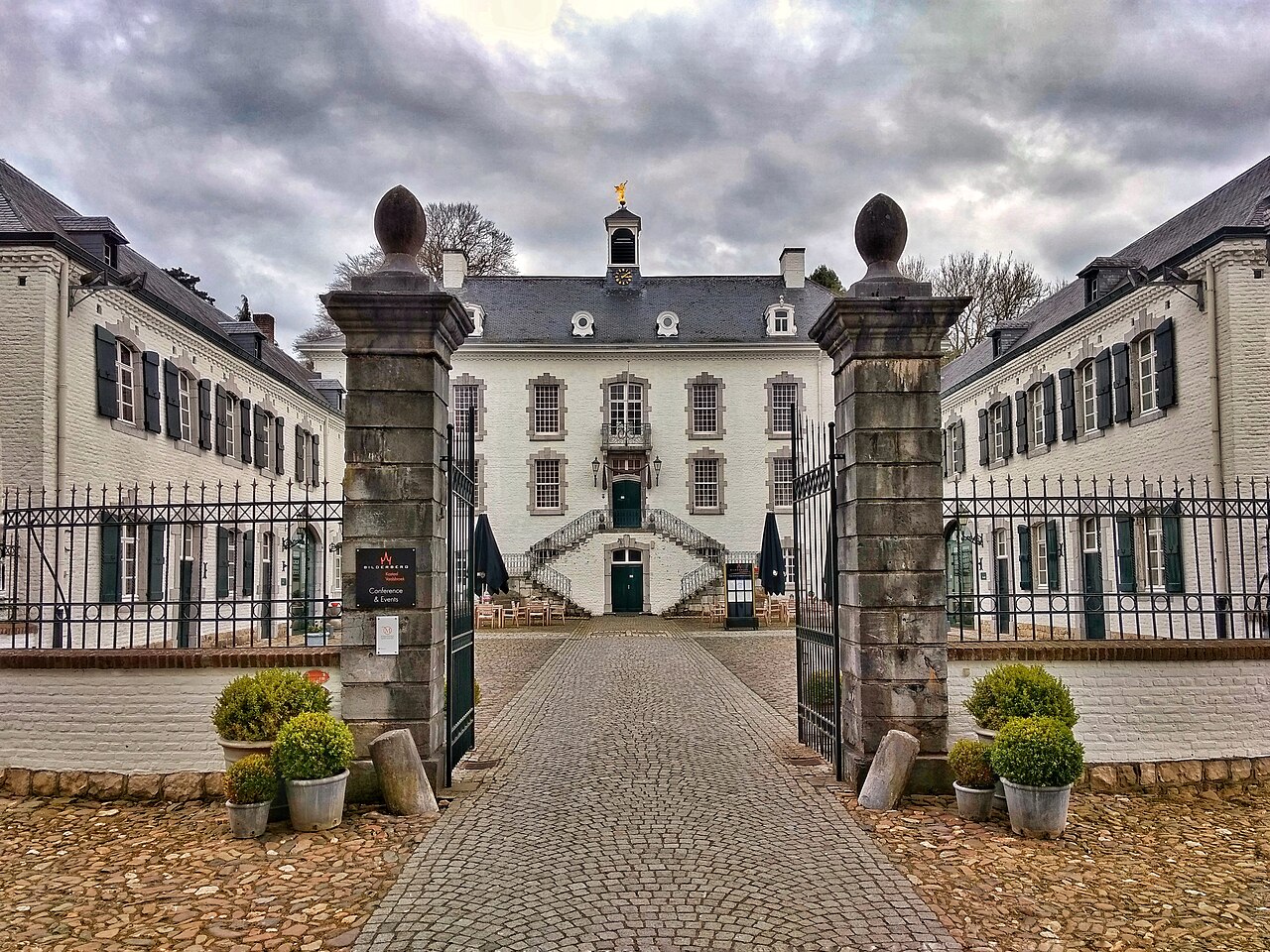
The residential building on the east side features a decorative façade with rough stone blocks on the lower levels and brick on the upper floors. Light-colored stone highlights the corners, window, and doorjambs, while a staircase leads to the raised ground floor, which contains embedded embrasures for defense. A distinctive bretèche above the main door and curved corbels under the eaves add to the medieval character.
Towers and defensive elements
The castle includes several towers of varying shapes and heights. The northwest corner connects to a prominent five-story, eight-cornered tower topped with merlons, combining rough stone and brick construction. This tower features a small balcony supported by corbels and stone cornices marking floor transitions.
On the southwest corner stands a four-story, horseshoe-shaped tower made entirely of rough natural stones with narrow embrasures, emphasizing the castle’s defensive purpose. The castle's main yard was historically enclosed by battlements and a wall-walk, which were reconstructed during 19th-century renovations and partially restored to earlier forms during the 20th-century reconstruction.
Renovations and modernizations
By the early 17th century, the castle had fallen into disrepair, with collapsed walls, missing roofs, and unsafe interiors. Reconstruction efforts began in 1637 under Johan Dietrich von Merode-Houffalize and were completed in 1661 by his son Franz-Ignaz, restoring the castle’s habitability in a château style while preserving much of its medieval character.
The 19th-century renovations added new architectural elements popular at the time, such as merloned roofs on towers and enclosing the main yard with massive battlements. However, some of these gothic revival details were later removed during the 1971 restoration to return the castle closer to its original medieval appearance.
Cultural and historical legacy
Frankenberg Castle holds a significant place in the history of Aachen and the broader region. It was the residence of notable figures such as Edmund von Merode and Adam III von Merode-Frankenberg, linking it to important historical events including the Spanish-Dutch wars and the religious conflicts of the 16th and 17th centuries.
From 1961 until 2010, the castle housed a museum dedicated to the history of Aachen, showcasing artifacts from the Stone Age through the Roman period to the Industrial Revolution. After World War II damage and a period of disuse, it was restored and repurposed as a cultural center, preserving its heritage and making it accessible to the public.
The castle’s name derives from the concept of a "Franke," a type of castle that originally did not owe fealty to any higher lord, reflecting its early independent status before becoming a fief. Its location in the Frankenberg district of Aachen situates it within a rich historical and cultural landscape.
Visiting information and accessibility
Today, Frankenberg Castle is a well-preserved historical site open to visitors interested in medieval architecture, history, and culture. Its proximity to Aachen’s city center makes it accessible for day trips. The castle’s grounds and buildings offer a glimpse into medieval defensive architecture, noble residence life, and the complex history of the Rhineland.
Visitors can explore the castle’s towers, courtyard, and restored residential buildings, experiencing the blend of medieval and 19th-century architectural styles. The site occasionally hosts cultural events and exhibitions that celebrate its heritage.
Architectural style and classification
Frankenberg Castle is classified as a hill castle due to its elevated position on a rocky outcrop. Its architectural style is primarily Gothic, reflecting its medieval origins, with later additions and restorations incorporating elements of château-style and 19th-century gothic revival features that were subsequently moderated to preserve historical authenticity.
The castle’s construction and renovations demonstrate the evolution of castle architecture from purely defensive fortifications to more residential and representational functions, mirroring broader European trends from the high medieval period through the early modern era.
Frequently asked questions (FAQ)
- How do I get to Frankenberg Castle in Aachen?
- Frankenberg Castle is located in the Frankenberg district of Aachen, easily accessible by local public transport and car. It is a short distance from Aachen city center, with parking available nearby.
- What is the historical significance of Frankenberg Castle?
- Frankenberg Castle was a key administrative seat in the Holy Roman Empire, associated with the von Merode family and significant events like the Spanish-Dutch conflicts and religious wars of the 16th and 17th centuries.
- Can I tour the interior of Frankenberg Castle?
- Yes, visitors can explore the castle's restored residential buildings, towers, and courtyard. Guided tours may be available seasonally, providing insights into its medieval architecture and history.
- When was Frankenberg Castle built?
- Frankenberg Castle was constructed in the 13th century, with documented mentions starting in the mid-14th century.
- Is Frankenberg Castle wheelchair accessible?
- Due to its medieval architecture and historic structure, accessibility is limited. Visitors with mobility challenges should inquire in advance about accommodations.
Information
Opening hours
Varies seasonally, typically 10:00-17:00, Tuesday to Sunday
Ticket prices
Moderate entrance fee
Current owner
Municipality of Aachen
Loading map...
Visitor reviews
No reviews yet. Been here? Write the first review and help other travelers!
Write the first reviewVisited this castle? Share your experience
Your review helps other travelers and adds first-hand knowledge to our encyclopedia.