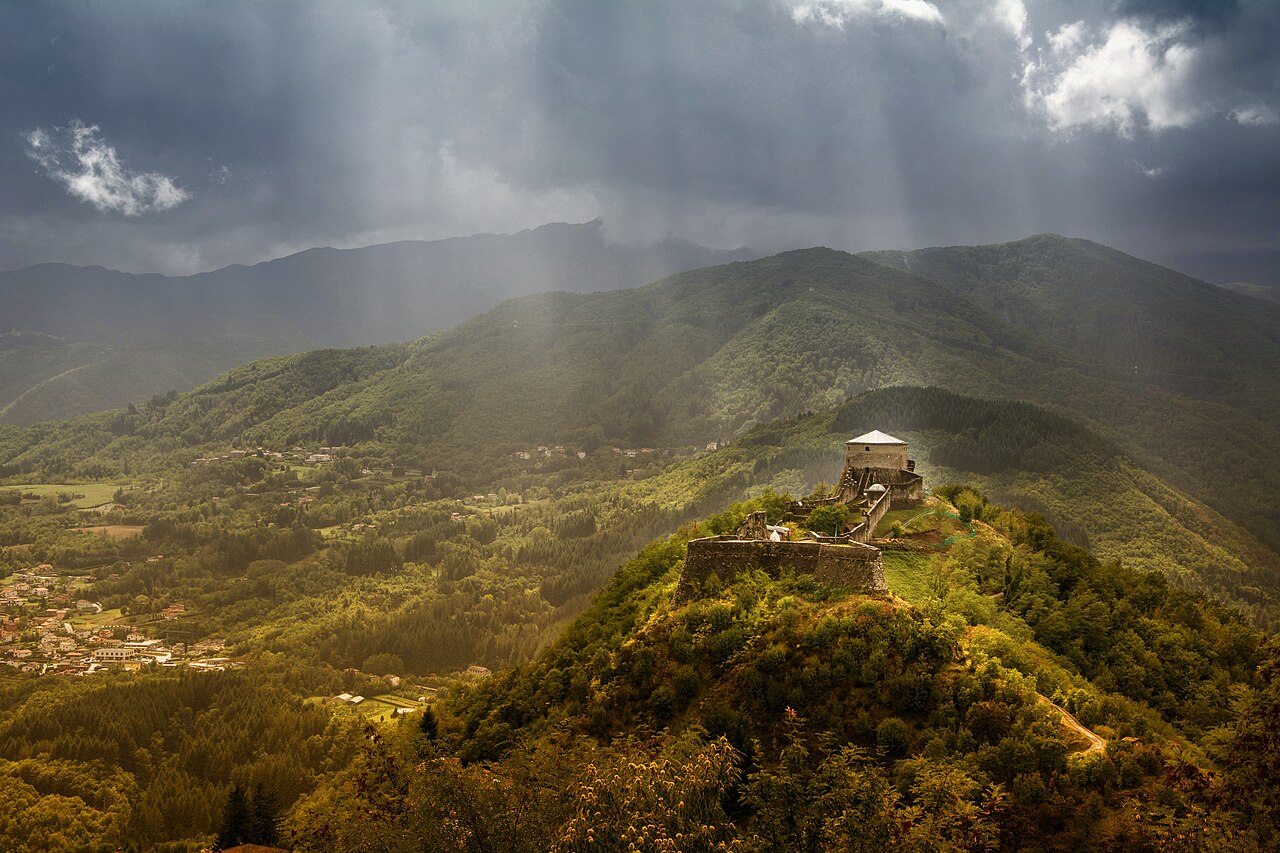
Fortress Rocca

Medieval Fortress Rocca in Coreglia Antelminelli, Italy
Coreglia Antelminelli, Italy

The medieval fortress Rocca in Coreglia Antelminelli, nestled in the Tuscany region of Italy, stands as a remarkable example of a bastioned fortress from the early medieval period. Perched atop a natural buttress overlooking the steep valleys formed by the rivers Ania and Segone in the Apennines mountains, this castle combines strategic military architecture with breathtaking natural surroundings. Today, it offers a unique opportunity to experience living within fortified walls that once played a pivotal role in regional conflicts during the Middle Ages.

Historical significance and military role

Dating back to the 11th century, the Rocca fortress was constructed during a turbulent era marked by the struggle between the papal and imperial factions in Italy. Its commanding position allowed occupants to monitor extensive stretches of the surrounding valleys, making it a vital military asset. The fortress was frequently contested by local powers, particularly during the conflicts involving the city of Lucca and the municipalities of the Serchio Valley.

The guelphs and ghibellines conflict

In 1316, the fortress became a stronghold for the Guelphs, supporters of the Pope, during their struggle against the Ghibellines, who backed the Holy Roman Emperor. The Ghibelline forces were led locally by the formidable condottiero Castruccio Castracani. After a prolonged siege, Castracani successfully captured the fortress, recognizing its strategic importance. He subsequently reinforced the castle's fortifications and established a permanent garrison to secure his control over the region.

Francesco castracani and military campaigns

In the first half of the 14th century, Francesco Castracani, a relative or successor of Castruccio, used the Rocca as a base for military operations. His raids targeted the nearby town of Barga, located across the valley. The fortress's defensive capabilities and elevated vantage point made it an ideal location for organizing troops and planning campaigns during this period of regional instability.

Architectural features and fortifications

The Rocca exemplifies the characteristics of a bastioned fortress, a design that evolved to adapt to the changing nature of warfare, particularly with the introduction of artillery. The fortress's walls are reinforced with bastions—projecting angular structures that allowed defenders to cover adjacent walls with crossfire, minimizing blind spots and enhancing the defense against attackers.

Strategic location and natural defenses

Situated on a prominent buttress, the fortress benefits from natural steep slopes on several sides, which act as formidable barriers against assault. The proximity to the rivers Ania and Segone not only provided natural moats but also ensured access to water supplies during sieges. The elevated position offers panoramic views of the valleys, enabling early detection of approaching enemies.

Structural elements and layout

The fortress's layout includes thick stone walls, defensive towers, and a gatehouse controlling access to the interior. The bastions are strategically placed to cover the main approaches, while internal courtyards allowed for troop assembly and logistics. Although modified over centuries, the core medieval defensive elements remain prominent, reflecting the military engineering of the time.

Modern use and preservation

Today, the Rocca fortress has been transformed into a unique vacation home, allowing visitors to immerse themselves in a living piece of history. Its preservation offers insight into medieval military architecture and the region's turbulent past. The castle's adaptation respects its historical fabric while providing modern comforts, making it a rare example of a fortified structure still in active residential use.

Cultural and tourism impact

As a heritage site in the Tuscany region, the Rocca contributes to local tourism by attracting visitors interested in medieval history, architecture, and scenic mountain landscapes. Its location in the Apennines makes it a perfect destination for those seeking both cultural enrichment and natural beauty.

Visitor experience and accessibility

Guests staying at the fortress can explore the surrounding valleys and nearby historical towns such as Barga and Lucca. The castle's elevated position and preserved fortifications offer a tangible connection to the past, complemented by modern amenities that ensure a comfortable stay.

Frequently asked questions (FAQ)

How do I get to You Can Stay in an Medieval Fortress in the Italian Mountains?
The fortress is located in Coreglia Antelminelli, which is accessible by car and public transportation from major cities like Lucca and Pisa. It is advisable to use GPS for directions, as the roads can be narrow and winding. Parking is available near the entrance of the fortress.
What is the historical significance of this castle?
This medieval fortress dates back to the 11th century and is a remarkable example of the defensive architecture of the time. It played a crucial role in the region's history, providing protection against invasions and serving as a stronghold for local nobility. Today, it stands as a testament to the medieval era and attracts history enthusiasts.
When was the castle last renovated?
The castle underwent significant restoration in the early 2000s to preserve its historical features while making it accessible to visitors. These renovations have helped to maintain the authenticity of the structure while providing modern amenities for guests. Regular maintenance ensures that the castle remains in good condition for future generations.
Can I stay overnight in the castle?
Yes, visitors can enjoy an overnight stay in the castle, which offers unique accommodations that blend medieval charm with modern comfort. Rooms are equipped with essential amenities while maintaining the historical ambiance. Reservations are recommended, especially during peak tourist seasons.
Why is the castle a popular destination for tourists?
The castle's stunning mountain setting, rich history, and unique accommodations make it a sought-after destination for travelers looking for an authentic experience. Visitors can explore the castle's architecture, learn about its history, and enjoy breathtaking views of the surrounding landscape. Nearby hiking trails and local attractions further enhance the appeal.
Is it possible to schedule guided tours of the castle?
Yes, guided tours are available and can be arranged in advance. These tours provide in-depth insights into the castle's history, architecture, and significance in the region. Guides are knowledgeable and can answer any questions you may have during your visit.
What are the opening hours for the castle?
The castle is generally open to visitors from 10 AM to 6 PM, but hours may vary depending on the season. It is advisable to check the official website or contact the castle administration for the most current information. Special extended hours may be offered during holidays and peak tourist seasons.
What is the ticket price for visiting the castle?
Ticket prices for visiting the castle typically range from €5 to €10 for adults, with discounts available for children and seniors. Group rates may also be available for larger parties. It is recommended to purchase tickets online in advance, especially during the busy summer months.
What nearby attractions can I visit while in Coreglia Antelminelli?
In addition to the castle, visitors can explore the charming village of Coreglia Antelminelli, known for its picturesque streets and local artisan shops. The surrounding mountains offer numerous hiking trails and outdoor activities. Nearby towns like Bagni di Lucca and Lucca are also worth visiting for their historical sites and vibrant culture.

Information

Bastioned Fortress

Loading map...

Visitor reviews

No reviews yet. Been here? Write the first review and help other travelers!

Write the first review

Visited this castle? Share your experience

Your review helps other travelers and adds first-hand knowledge to our encyclopedia.

Write a review

(5/5)

0/2000 characters

Your review will be visible after admin approval

Nearby castles

10.5 km

Rocca Ariostesca

Castelnuovo di Garfagnana, Italy

The Rocca Ariostesca stands as a prominent medieval fortress in Castelnuovo di Garfagnana, Italy, embodying centuries of military, political, and cultural history. Its origins trace back to a modest military outpost in the 10th century, which evolved into a significant defensive complex through the 12th century under local rulers. This fortress played a crucial role in controlling the strategic Garfagnana valley, adapting through various historical phases to meet changing military and civic needs. The fortress’s development reflects the broader medieval landscape of Italy, where fortified structures served as centers of power, administration, and protection. Its location on a hill provided natural defensive advantages, typical of a hill castle, allowing surveillance over the surrounding territory and control of key routes. Over time, the Rocca Ariostesca became integrated into the fabric of the town, symbolizing the intersection of military strength and civic life. Historical evolution and architectural transformations Early beginnings and medieval expansion The initial military presence on the site during the 10th century laid the groundwork for the fortress’s later development. By the 12th century, the structure began to take on the characteristics of a medieval fortress, with stone walls and defensive features designed to protect the settlement and assert local authority. Throughout the 13th century, the Rocca underwent several modifications to enhance its defensive capabilities. This period saw the reinforcement of walls and the possible addition of towers or battlements, reflecting the turbulent political climate of the time. Castruccio castracani and the 14th-century fortification A pivotal moment in the Rocca’s history occurred in the early 14th century under Castruccio Castracani, a renowned condottiere and ruler of Lucca. Castracani expanded the town’s defensive walls, incorporating the Rocca more fully into the fortified perimeter of Castelnuovo di Garfagnana. This integration underscored the fortress’s strategic importance in controlling the Garfagnana region and protecting against external threats. The 15th-century central tower and civic functions In the early 15th century, Paolo Guinigi, lord of Lucca, commissioned the construction of a large central tower within the Rocca. This tower was notable for its civic clock, a rare feature that emphasized the fortress’s role beyond military defense, extending into municipal administration and public life. The tower later served as a prison, reflecting its function in law enforcement and governance. Its commanding position overlooking the central square made it a focal point of town life. Cultural significance and notable figures Connection to the este family and ludovico ariosto The name Rocca Ariostesca derives from the association with the Este family and the celebrated poet Ludovico Ariosto, who governed Garfagnana from 1522 to 1525. Ariosto’s tenure marked a cultural flourishing, blending political authority with literary prestige. His governance contributed to the Rocca’s identity as a center of both power and culture. Fulvio testi and the continuation of literary governance Following Ariosto, the poet and diplomat Fulvio Testi also served as governor, continuing the tradition of literary figures overseeing the region. This unusual combination of artistic and political leadership highlights the Rocca’s unique place in Renaissance cultural history. Later modifications and urban integration In 1675, significant architectural changes were made to the fortress, including the addition of a terrace facing the main square, Umberto I. This terrace enhanced the fortress’s interaction with the public space, signaling a shift from purely defensive functions to more civic and ceremonial roles. Alongside the terrace, a monumental arch was constructed to provide access to the town center, blending military architecture with urban design. Damage, restoration, and current use The Rocca Ariostesca suffered damage during World War II, reflecting the ongoing vulnerability of historic structures in times of conflict. Subsequent restoration efforts aimed to preserve its medieval character and structural integrity, allowing it to continue as a significant historical monument. Today, the fortress serves as a cultural hub, housing an archaeological museum that displays artifacts spanning from prehistoric times to the Ligurian-Apuan and Etruscan periods. This museum underscores the long human presence in the Garfagnana region and the Rocca’s role as a custodian of local heritage. Architectural features and interior spaces The central tower and defensive layout The fortress’s layout is typical of medieval military architecture, dominated by the imposing central tower built in the early 15th century. This tower’s stone construction and strategic placement overlooking the town square exemplify its dual role as a lookout and symbol of authority. The inclusion of the civic clock further distinguished it as a landmark of timekeeping and governance. Terrace and monumental arch The 1675 terrace facing Umberto I square represents a notable architectural adaptation, transforming the fortress’s interface with the town. The adjacent monumental arch serves as a ceremonial gateway, linking the defensive structure with the urban environment and reflecting evolving civic priorities. Interior halls and decorative elements Historically, the Rocca contained richly furnished interiors, including the "Sala dei Principi" or Hall of Princes, which was adorned with tapestries and decorations befitting noble or administrative functions. Although these interior elements have not survived, their documented existence indicates the fortress’s role as a seat of power and culture. Archaeological museum and heritage preservation The archaeological museum within the Rocca offers visitors a comprehensive view of the region’s ancient past. Exhibits include artifacts from the Ligurian-Apuan and Etruscan cultures, shedding light on the prehistoric and early historic inhabitants of the Garfagnana valley. This collection enriches the fortress’s significance beyond its medieval origins, connecting it to broader narratives of human settlement and cultural development in Tuscany. By preserving and showcasing these artifacts, the Rocca Ariostesca serves as a vital center for cultural education and historical research, attracting scholars and tourists alike. Its dual function as a fortress and museum exemplifies the adaptive reuse of historic sites to maintain relevance in the modern era.

High Medieval (11th–13th c.)
Details
20 km
Verrucole Castle — Italy castle

Verrucole Castle

San Romano in Garfagnana, Italy

Verrucole Castle is a remarkable example of a Renaissance military fortress perched on a basaltic hill in the municipality of San Romano in Garfagnana, Italy. Its history spans over a millennium, beginning with the fortified settlement established by the Gherardinghi family in the late 10th century. The castle's name derives from the local term “verruca,” meaning a high, rugged hill, reflecting the imposing natural terrain upon which it was constructed. This strategic location provided a commanding view over the surrounding valley and was a key factor in its military significance throughout the Middle Ages and Renaissance. The castle's origins trace back to around the year 991, when the Gherardinghi counts built the initial defensive core. In the 12th century, the castle became a focal point in regional conflicts, notably during the alliance of the Gherardinghi with other noble families and the maritime republic of Pisa against the Republic of Lucca. The ensuing siege by Lucca led to the castle's capture, although imperial intervention by Emperor Frederick I Barbarossa in 1185 reaffirmed the Gherardinghi's possession. However, by the end of the 13th century, the castle passed under Lucca's control and was administered by the Guidiccioni family. Historical developments under notable families Ghibelline and Este influence In the 14th century, the fortress was held by the Ghibelline marquis and mercenary leader Spinetta Malaspina from 1328 to 1345. Later, the Este family of Ferrara acquired the castle in 1446, marking a significant phase of restoration and military enhancement. The Este dukes, particularly Marquis Leonello d'Este around 1450 and Alfonso II d'Este circa 1564, undertook major renovations that transformed Verrucole into a formidable Renaissance fortress. These works included the addition of two bastions, reflecting advances in fortification techniques designed to counter artillery and gunpowder weapons. Military and cultural significance For over four centuries, Verrucole served as a military stronghold under the Este dukes of Modena and Reggio. Its strategic position allowed control over the Garfagnana valley, a vital corridor in northern Tuscany. Between 1522 and 1525, the renowned poet and court official Ludovico Ariosto governed the area, overseeing military presidia including Verrucole Castle. The fortress also witnessed episodes such as the imprisonment of Captain Francesco Accorsini by the Inquisition in the 17th century, illustrating its continued role in regional power dynamics. Architectural features and layout Fortress structure and defensive elements The castle's layout is dominated by two main strongholds positioned at opposite ends of the hill: the Rocca Tonda (round tower) and the Rocca Quadra (square tower). The Rocca Tonda is a polygonal tower notable for its surviving Ghibelline merlons, the distinctive swallowtail-shaped crenellations emblematic of medieval fortifications associated with the Ghibelline faction. Excavations have revealed a cylindrical tower integrated within this bastion, underscoring the complexity of its defensive design. The Rocca Quadra, located near the northeast bastion, includes remnants of a semicircular tower and a small building facing north. Historically, each stronghold was managed by a pair of castellans, each commanding guard corps responsible for patrolling and defending their respective sectors. The main entrance, known as Porta Piana, retains key defensive features such as a guardhouse and machicolations – openings in the battlements used to repel attackers with projectiles or boiling substances. Defensive walls and artillery adaptations Visitors can observe extensive crenellated curtain walls, casemates (vaulted chambers for shelter or artillery), and cannon embrasures designed for early gunpowder weaponry. The two prominent 16th-century bastions face the Pania di Corfino massif, enhancing the fortress's defensive perimeter. Near the entrance to one casemate lie the remains of a powder magazine and guard quarters, structures that have been carefully restored and now serve as museum spaces illustrating the castle's military functions. Additional features and restoration efforts Chapel, sally port, and commander’s garden Ascending toward the Rocca Tonda, a small chapel once served the spiritual needs of the military personnel stationed at the fortress. Adjacent to this tower is a narrow sally port, a hidden emergency exit incorporated into the walls next to a stone staircase, reflecting sophisticated siege defense strategies. North of the sally port lay the commander's garden, historically containing service buildings and a cistern vital for collecting rainwater, ensuring water supply during prolonged sieges. A gunpowder tower once stood west of the garden but was destroyed by lightning in 1683, a reminder of the hazards faced by such fortifications. Modern restoration and public access Between 1994 and 2000, extensive restoration stabilized the fortress's stonework, cleared overgrowth, and uncovered significant archaeological remains. Excavations around the Rocca Tonda recovered the chapel and reinforced walls to preserve the integrity of the structure. The powder magazine and guardhouse were adapted to serve as interpretative centers, enabling visitors to understand the castle's military heritage through thoughtfully curated exhibits. These restoration efforts culminated in the fortress's public opening in 2012, followed by improvements to access infrastructure in 2019, commemorating the 530th anniversary of construction activities under Ercole I d’Este. Today, Verrucole Castle stands as a well-preserved testament to the evolution of military architecture from medieval origins through Renaissance innovation, offering visitors a vivid glimpse into the region's complex history and strategic importance. Archaeological significance and historical layers Archaeological studies have revealed that beneath the Renaissance fortress lie traces of earlier settlements, including a Bronze Age village and medieval habitation layers. This deep historical context enriches the understanding of Verrucole as a site continuously occupied and adapted over centuries. The castle's stone construction, typical of local materials, exemplifies the practical and aesthetic considerations of fortification design in the Garfagnana region. Overall, Verrucole Castle offers a comprehensive narrative of military, political, and cultural developments in northern Tuscany. Its architectural features, historical associations with prominent families and figures, and ongoing preservation efforts make it a significant heritage site for scholars and visitors alike.

Renaissance (15th–17th c.)
Details
26.8 km

Castello di Sestola

Italy, Italy

Castello di Sestola stands prominently in the town of Sestola, Emilia-Romagna, Italy, occupying a commanding hilltop position that has been significant since ancient times. Archaeological evidence points to human presence here dating back to the Bronze Age, highlighting the strategic importance of this rocky outcrop overlooking the surrounding valleys and passes. The earliest documented fortification on the site, known as Castrum Sextulae, is recorded in 753 AD when King Astolfo of the Lombards granted the lands to Abbot Anselmo, founder of the Abbey of Nonantola, marking the fortress's early medieval prominence. Throughout the Middle Ages, particularly from the 13th century onward, the castle was a focal point of conflict between the powerful city-states of Modena and Bologna. Control shifted several times until the fortress was firmly incorporated into the holdings of the Este family following the submissions of Obizzo II in 1288 and Obizzo III in 1336. From 1337, it functioned as the residence of the Governor of Frignano, an Este-appointed official responsible for regional administration and defense. Renaissance transformation and military architecture The castle underwent a significant transformation in the 16th century to adapt to changes in military technology and warfare. After papal forces briefly seized Sestola in 1521, the fortress returned to Este control following the death of Pope Leo X. The original medieval structures suffered damage during ongoing conflicts, prompting Duke Alfonso II d’Este to order their demolition. In their place, a new fortress designed to withstand firearms and artillery was commissioned. The architect Marco Antonio Pasi oversaw construction beginning in 1563, a project that extended nearly two decades. This hill castle exemplifies 16th-century military architecture adapted for the Renaissance period, featuring robust stone walls, angled bastions, and a layout optimized for defense against cannon fire. The fortress integrates naturally with the rocky terrain, utilizing the natural elevation to command views over the southern approaches to the Frignano area and the valleys below. Later uses and social functions Following its decline as a military stronghold, the Castello di Sestola was repurposed for various civic and social uses. In 1816, it was converted into a penitentiary, a role it fulfilled until 1866. During the 1820s, a pine forest was planted nearby under the orders of Francesco IV, enhancing the site's landscape. Later in the 19th century, parts of the fortress housed a military meteorological observatory, leveraging its strategic location between the plains and the summit observatory on Monte Cimone. The castle also served humanitarian functions, with adjacent buildings accommodating children from the Umberto I Institute for rachitic children. In the 20th century, it was adapted as an elementary school with boarding facilities, managed by the Associazione Nazionale Enti Assistenziali (ANEA). These varied uses reflect the castle’s continuous adaptation to the community's evolving needs. Architectural features and current cultural role The fortress’s most striking architectural feature is its tower, which rises prominently above the complex. The tower includes a panoramic terrace offering a 360-degree view of the surrounding landscape, with informational panels that help visitors appreciate the territory’s geography and history. The tower’s ground floor hosts a small rotating exhibition called “Un angolo d’arte,” showcasing contemporary artworks and linking the historical site with modern cultural expressions. Within the castle, several museums occupy former functional spaces, each illustrating different facets of local history and culture. The Museum of Mechanical Musical Instruments is housed in what was once the Governor’s apartment. It features a collection of approximately 120 pieces dating from the 1600s to the present, highlighting the region’s rich tradition of musical craftsmanship. The Museum of Mountain Civilization occupies the former stables and archive buildings. It exhibits tools, clothing, and artifacts related to the daily life and work of mountain inhabitants, providing insight into the cultural heritage of this challenging environment. Additionally, the permanent exhibition “Stanza dei ricordi” is dedicated to Teresina Burchi Reiter, a renowned local soprano, preserving her costumes, documents, and photographs. Preserved prison elements and religious art The castle’s period as a penitentiary is still visible through preserved inscriptions, plaques, columns, and other artifacts. Notably, frescoes devoted to Saint John the Baptist were transferred from the nearby church of Roncoscaglia and are preserved within the fortress. These artworks represent valuable examples of religious art integrated into the castle’s historical narrative. Historical significance and heritage preservation Castello di Sestola embodies a layered history spanning from the Bronze Age through the Early Medieval period and into the Renaissance and modern eras. Its evolution from a Lombard fortification to a contested medieval stronghold, then a Renaissance fortress designed for artillery defense, reflects broader shifts in military technology and regional power dynamics. Today, the castle is a well-preserved example of hill castle architecture adapted over centuries for diverse functions. It serves as a cultural hub, hosting museums, exhibitions, and educational activities that celebrate the local history and arts. The site’s integration of natural landscape, military architecture, and cultural heritage makes it a significant landmark in Emilia-Romagna and an important destination for visitors interested in Italian history and architecture.

Details