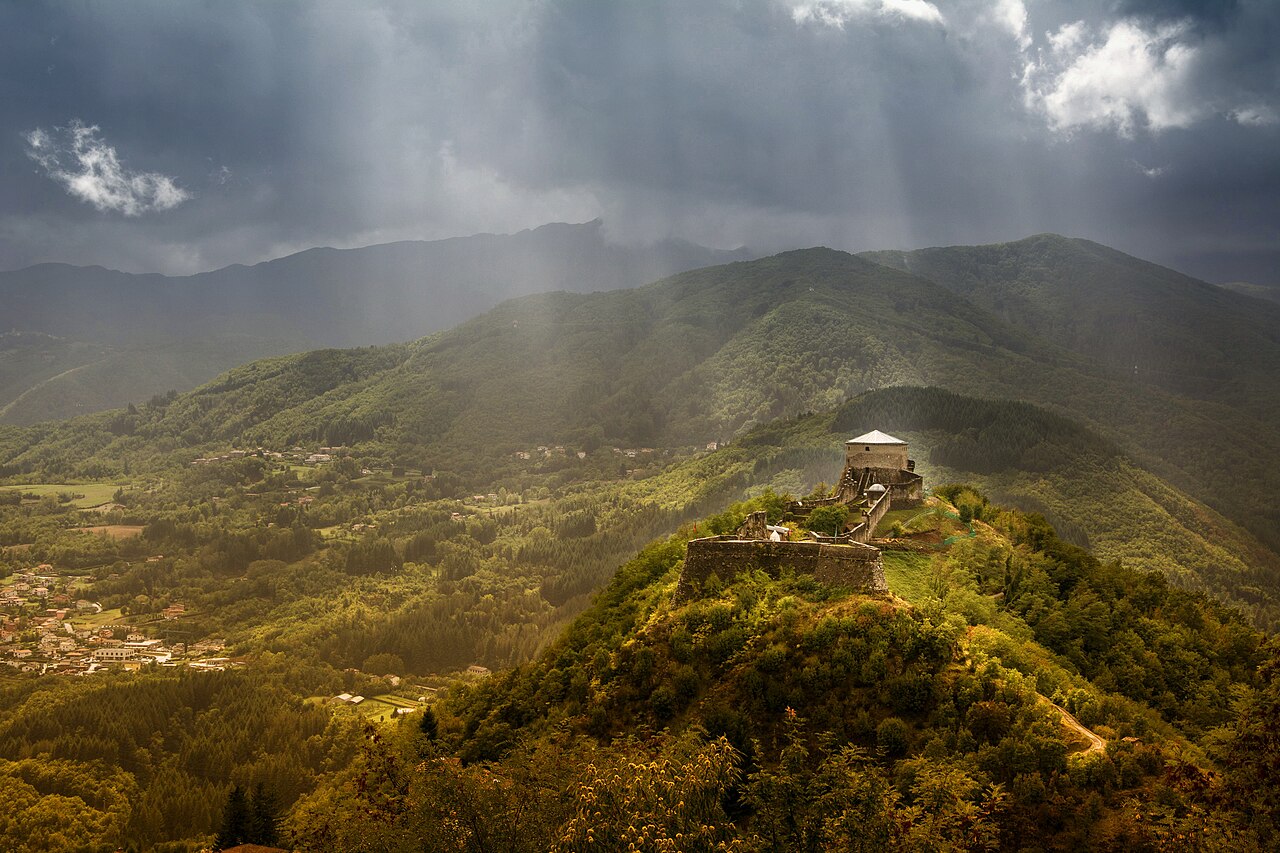
Rocca Ariostesca
The Rocca Ariostesca stands as a prominent medieval fortress in Castelnuovo di Garfagnana, Italy, embodying centuries of military, political, and cultural history. Its origins trace back to a modest military outpost in the 10th century, which evolved into a significant defensive complex through the 12th century under local rulers. This fortress played a crucial role in controlling the strategic Garfagnana valley, adapting through various historical phases to meet changing military and civic needs.
The fortress’s development reflects the broader medieval landscape of Italy, where fortified structures served as centers of power, administration, and protection. Its location on a hill provided natural defensive advantages, typical of a hill castle, allowing surveillance over the surrounding territory and control of key routes. Over time, the Rocca Ariostesca became integrated into the fabric of the town, symbolizing the intersection of military strength and civic life.
Historical evolution and architectural transformations
Early beginnings and medieval expansion
The initial military presence on the site during the 10th century laid the groundwork for the fortress’s later development. By the 12th century, the structure began to take on the characteristics of a medieval fortress, with stone walls and defensive features designed to protect the settlement and assert local authority.
Throughout the 13th century, the Rocca underwent several modifications to enhance its defensive capabilities. This period saw the reinforcement of walls and the possible addition of towers or battlements, reflecting the turbulent political climate of the time.
Castruccio castracani and the 14th-century fortification
A pivotal moment in the Rocca’s history occurred in the early 14th century under Castruccio Castracani, a renowned condottiere and ruler of Lucca. Castracani expanded the town’s defensive walls, incorporating the Rocca more fully into the fortified perimeter of Castelnuovo di Garfagnana. This integration underscored the fortress’s strategic importance in controlling the Garfagnana region and protecting against external threats.
The 15th-century central tower and civic functions
In the early 15th century, Paolo Guinigi, lord of Lucca, commissioned the construction of a large central tower within the Rocca. This tower was notable for its civic clock, a rare feature that emphasized the fortress’s role beyond military defense, extending into municipal administration and public life. The tower later served as a prison, reflecting its function in law enforcement and governance. Its commanding position overlooking the central square made it a focal point of town life.
Cultural significance and notable figures
Connection to the este family and ludovico ariosto
The name Rocca Ariostesca derives from the association with the Este family and the celebrated poet Ludovico Ariosto, who governed Garfagnana from 1522 to 1525. Ariosto’s tenure marked a cultural flourishing, blending political authority with literary prestige. His governance contributed to the Rocca’s identity as a center of both power and culture.
Fulvio testi and the continuation of literary governance
Following Ariosto, the poet and diplomat Fulvio Testi also served as governor, continuing the tradition of literary figures overseeing the region. This unusual combination of artistic and political leadership highlights the Rocca’s unique place in Renaissance cultural history.
Later modifications and urban integration
In 1675, significant architectural changes were made to the fortress, including the addition of a terrace facing the main square, Umberto I. This terrace enhanced the fortress’s interaction with the public space, signaling a shift from purely defensive functions to more civic and ceremonial roles. Alongside the terrace, a monumental arch was constructed to provide access to the town center, blending military architecture with urban design.
Damage, restoration, and current use
The Rocca Ariostesca suffered damage during World War II, reflecting the ongoing vulnerability of historic structures in times of conflict. Subsequent restoration efforts aimed to preserve its medieval character and structural integrity, allowing it to continue as a significant historical monument.
Today, the fortress serves as a cultural hub, housing an archaeological museum that displays artifacts spanning from prehistoric times to the Ligurian-Apuan and Etruscan periods. This museum underscores the long human presence in the Garfagnana region and the Rocca’s role as a custodian of local heritage.
Architectural features and interior spaces
The central tower and defensive layout
The fortress’s layout is typical of medieval military architecture, dominated by the imposing central tower built in the early 15th century. This tower’s stone construction and strategic placement overlooking the town square exemplify its dual role as a lookout and symbol of authority. The inclusion of the civic clock further distinguished it as a landmark of timekeeping and governance.
Terrace and monumental arch
The 1675 terrace facing Umberto I square represents a notable architectural adaptation, transforming the fortress’s interface with the town. The adjacent monumental arch serves as a ceremonial gateway, linking the defensive structure with the urban environment and reflecting evolving civic priorities.
Interior halls and decorative elements
Historically, the Rocca contained richly furnished interiors, including the "Sala dei Principi" or Hall of Princes, which was adorned with tapestries and decorations befitting noble or administrative functions. Although these interior elements have not survived, their documented existence indicates the fortress’s role as a seat of power and culture.
Archaeological museum and heritage preservation
The archaeological museum within the Rocca offers visitors a comprehensive view of the region’s ancient past. Exhibits include artifacts from the Ligurian-Apuan and Etruscan cultures, shedding light on the prehistoric and early historic inhabitants of the Garfagnana valley. This collection enriches the fortress’s significance beyond its medieval origins, connecting it to broader narratives of human settlement and cultural development in Tuscany.
By preserving and showcasing these artifacts, the Rocca Ariostesca serves as a vital center for cultural education and historical research, attracting scholars and tourists alike. Its dual function as a fortress and museum exemplifies the adaptive reuse of historic sites to maintain relevance in the modern era.
Frequently asked questions (FAQ)
- How do I get to Rocca Ariostesca?
- You can reach Rocca Ariostesca by car or public transport. The castle is located in Castelnuovo di Garfagnana, which is accessible via the SS12 road. There are also train services to nearby towns, with local buses connecting to the castle.
- What is the historical significance of Rocca Ariostesca?
- Rocca Ariostesca dates back to the 14th century and played a crucial role in the defense of the region during the medieval period. It was named after the famous poet Ludovico Ariosto, who was associated with the area. The castle reflects the rich history of the Garfagnana valley and the strategic importance of its location.
- When was Rocca Ariostesca last renovated?
- The castle has undergone several renovations, with significant restoration work completed in the 20th century to preserve its structure. The most recent restoration efforts focused on enhancing visitor access and showcasing its architectural features. These renovations ensure that visitors can appreciate the castle's historical significance while enjoying modern amenities.
- Can I access Rocca Ariostesca with a wheelchair?
- Yes, Rocca Ariostesca has made efforts to improve accessibility for all visitors. However, due to its historical nature, some areas may still present challenges. It's recommended to check in advance for specific accessibility options and facilities available during your visit.
- Why is Rocca Ariostesca a popular tourist attraction?
- Rocca Ariostesca attracts visitors due to its stunning architecture, rich history, and breathtaking views of the surrounding mountains. The castle often hosts cultural events, exhibitions, and guided tours that provide insight into its past. Its picturesque setting and unique features make it a must-visit location in the Garfagnana region.
- Is it possible to take guided tours of Rocca Ariostesca?
- Yes, guided tours are available at Rocca Ariostesca, providing an in-depth look at its history and architecture. These tours are led by knowledgeable guides who share fascinating stories and facts about the castle. It's advisable to check the schedule and book in advance, especially during peak tourist seasons.
- What are the opening hours for Rocca Ariostesca?
- Rocca Ariostesca is typically open to visitors from 9 AM to 6 PM, though hours may vary by season. It's best to check the official website or contact the castle directly for the most accurate and up-to-date information. Keep in mind that the castle may close on certain holidays.
- What are the ticket prices for visiting Rocca Ariostesca?
- Ticket prices for Rocca Ariostesca are generally affordable, with discounts available for students, seniors, and children. Adult tickets typically cost around €5, while reduced rates may be offered for larger groups. It's recommended to check the official website for current pricing and any special offers.
- What are some nearby attractions to Rocca Ariostesca?
- In addition to Rocca Ariostesca, the area boasts other attractions such as the beautiful Parco dell'Orecchiella and the historic town of Castelnuovo di Garfagnana. Visitors can also explore local hiking trails and enjoy the scenic beauty of the Apuan Alps. Nearby churches and museums offer additional opportunities to experience the rich cultural heritage of the region.
Information
Website
Visit websiteSources & official resources
Verify the information above using these authoritative references.
Loading map...
Visitor reviews
No reviews yet. Been here? Write the first review and help other travelers!
Write the first reviewVisited this castle? Share your experience
Your review helps other travelers and adds first-hand knowledge to our encyclopedia.