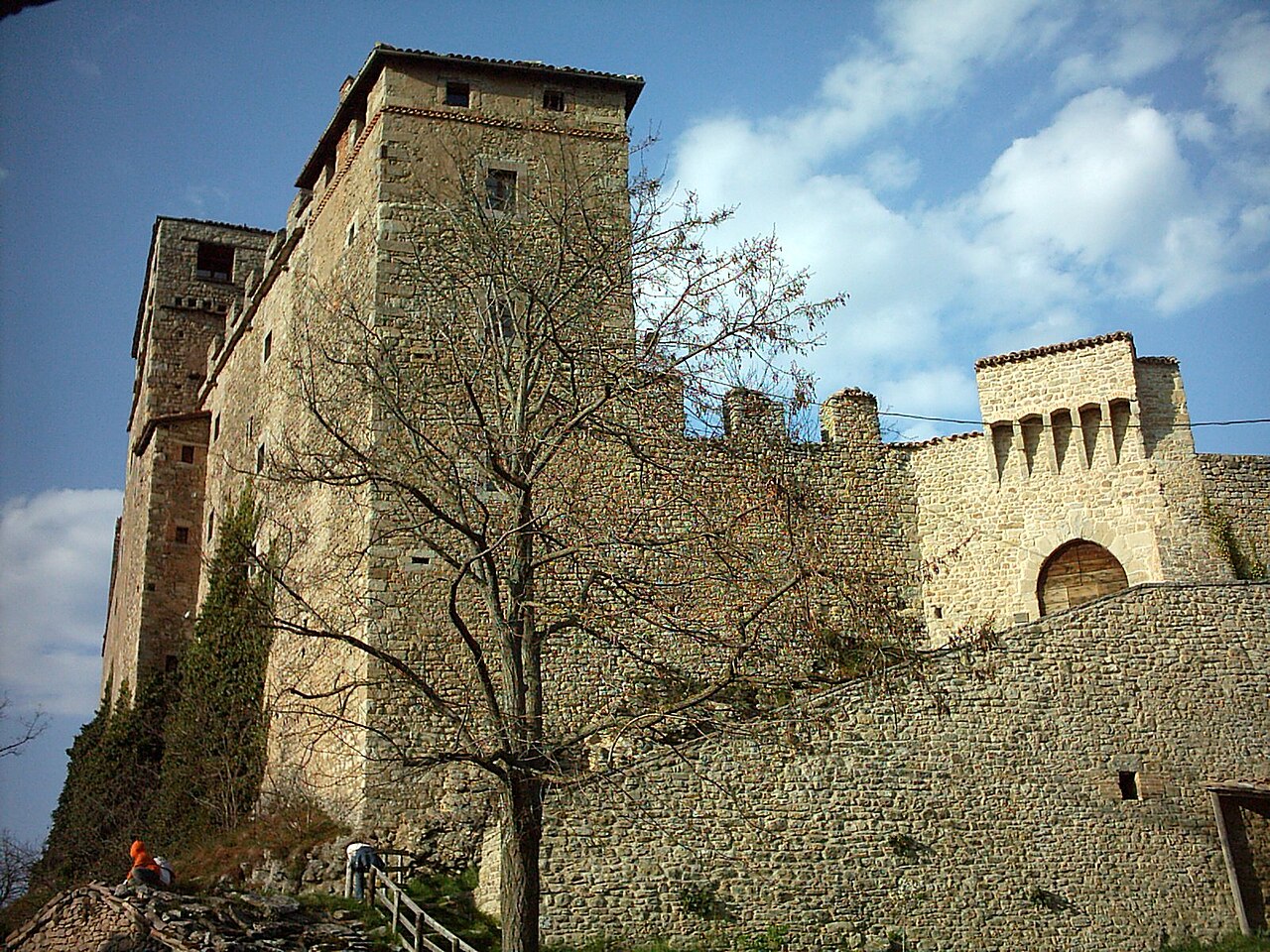
Castello di Sestola stands prominently in the town of Sestola, Emilia-Romagna, Italy, occupying a commanding hilltop position that has been significant since ancient times. Archaeological evidence points to human presence here dating back to the Bronze Age, highlighting the strategic importance of this rocky outcrop overlooking the surrounding valleys and passes. The earliest documented fortification on the site, known as Castrum Sextulae, is recorded in 753 AD when King Astolfo of the Lombards granted the lands to Abbot Anselmo, founder of the Abbey of Nonantola, marking the fortress's early medieval prominence.
Throughout the Middle Ages, particularly from the 13th century onward, the castle was a focal point of conflict between the powerful city-states of Modena and Bologna. Control shifted several times until the fortress was firmly incorporated into the holdings of the Este family following the submissions of Obizzo II in 1288 and Obizzo III in 1336. From 1337, it functioned as the residence of the Governor of Frignano, an Este-appointed official responsible for regional administration and defense.
Renaissance transformation and military architecture
The castle underwent a significant transformation in the 16th century to adapt to changes in military technology and warfare. After papal forces briefly seized Sestola in 1521, the fortress returned to Este control following the death of Pope Leo X. The original medieval structures suffered damage during ongoing conflicts, prompting Duke Alfonso II d’Este to order their demolition. In their place, a new fortress designed to withstand firearms and artillery was commissioned. The architect Marco Antonio Pasi oversaw construction beginning in 1563, a project that extended nearly two decades.
This hill castle exemplifies 16th-century military architecture adapted for the Renaissance period, featuring robust stone walls, angled bastions, and a layout optimized for defense against cannon fire. The fortress integrates naturally with the rocky terrain, utilizing the natural elevation to command views over the southern approaches to the Frignano area and the valleys below.
Later uses and social functions
Following its decline as a military stronghold, the Castello di Sestola was repurposed for various civic and social uses. In 1816, it was converted into a penitentiary, a role it fulfilled until 1866. During the 1820s, a pine forest was planted nearby under the orders of Francesco IV, enhancing the site's landscape. Later in the 19th century, parts of the fortress housed a military meteorological observatory, leveraging its strategic location between the plains and the summit observatory on Monte Cimone.
The castle also served humanitarian functions, with adjacent buildings accommodating children from the Umberto I Institute for rachitic children. In the 20th century, it was adapted as an elementary school with boarding facilities, managed by the Associazione Nazionale Enti Assistenziali (ANEA). These varied uses reflect the castle’s continuous adaptation to the community's evolving needs.
Architectural features and current cultural role
The fortress’s most striking architectural feature is its tower, which rises prominently above the complex. The tower includes a panoramic terrace offering a 360-degree view of the surrounding landscape, with informational panels that help visitors appreciate the territory’s geography and history. The tower’s ground floor hosts a small rotating exhibition called “Un angolo d’arte,” showcasing contemporary artworks and linking the historical site with modern cultural expressions.
Within the castle, several museums occupy former functional spaces, each illustrating different facets of local history and culture. The Museum of Mechanical Musical Instruments is housed in what was once the Governor’s apartment. It features a collection of approximately 120 pieces dating from the 1600s to the present, highlighting the region’s rich tradition of musical craftsmanship.
The Museum of Mountain Civilization occupies the former stables and archive buildings. It exhibits tools, clothing, and artifacts related to the daily life and work of mountain inhabitants, providing insight into the cultural heritage of this challenging environment. Additionally, the permanent exhibition “Stanza dei ricordi” is dedicated to Teresina Burchi Reiter, a renowned local soprano, preserving her costumes, documents, and photographs.
Preserved prison elements and religious art
The castle’s period as a penitentiary is still visible through preserved inscriptions, plaques, columns, and other artifacts. Notably, frescoes devoted to Saint John the Baptist were transferred from the nearby church of Roncoscaglia and are preserved within the fortress. These artworks represent valuable examples of religious art integrated into the castle’s historical narrative.
Historical significance and heritage preservation
Castello di Sestola embodies a layered history spanning from the Bronze Age through the Early Medieval period and into the Renaissance and modern eras. Its evolution from a Lombard fortification to a contested medieval stronghold, then a Renaissance fortress designed for artillery defense, reflects broader shifts in military technology and regional power dynamics.
Today, the castle is a well-preserved example of hill castle architecture adapted over centuries for diverse functions. It serves as a cultural hub, hosting museums, exhibitions, and educational activities that celebrate the local history and arts. The site’s integration of natural landscape, military architecture, and cultural heritage makes it a significant landmark in Emilia-Romagna and an important destination for visitors interested in Italian history and architecture.
Frequently asked questions (FAQ)
- How do I get to Castello di Sestola?
- You can reach Castello di Sestola by car or public transportation from nearby cities like Modena or Bologna. The castle is situated in the Appennino Modenese region, and parking is available nearby for visitors. If you're using public transport, check the local bus schedules for the best routes.
- What is the historical significance of Castello di Sestola?
- Castello di Sestola dates back to the 13th century and played a vital role in the defense of the Modena area during the Middle Ages. It served as a strategic stronghold for various noble families over the centuries, reflecting the turbulent history of the region. Today, it stands as a monument to the medieval past and the architectural styles of that era.
- When was Castello di Sestola built?
- Construction of Castello di Sestola began in the early 13th century, specifically around 1200. Over the centuries, it underwent several modifications and expansions, showcasing various architectural influences. The castle remains one of the best-preserved examples of medieval fortifications in Italy.
- Can I visit Castello di Sestola with children?
- Yes, Castello di Sestola is a family-friendly destination with plenty of space for children to explore. The castle often hosts educational activities and guided tours that are suitable for all ages. However, it's advisable to supervise younger children, especially around the castle's steep staircases and towers.
- Why is Castello di Sestola a popular tourist attraction?
- Castello di Sestola attracts visitors due to its rich history, stunning views of the surrounding landscape, and well-preserved architecture. The castle offers a unique glimpse into medieval life and is a great spot for photography enthusiasts. Additionally, its location near the Apennine mountains makes it an ideal starting point for outdoor activities.
- Is it possible to attend events at Castello di Sestola?
- Yes, Castello di Sestola hosts various cultural events, including historical reenactments, art exhibitions, and concerts throughout the year. These events provide a great opportunity to experience the castle's history in a lively and engaging way. Be sure to check the official website for the latest updates on event schedules.
- What are the opening hours for Castello di Sestola?
- Castello di Sestola is typically open from 9 AM to 6 PM during the high season, which runs from April to October. In the low season, the hours may vary, so it's recommended to check ahead for specific opening times. Guided tours are usually available, providing a deeper understanding of the castle's history.
- Are there any nearby attractions to visit?
- Yes, visitors to Castello di Sestola can explore several nearby attractions, including the picturesque town of Sestola and the stunning natural landscapes of the Appennino Modenese. Outdoor enthusiasts can enjoy hiking, skiing, and various nature trails in the vicinity. Other historical sites and local eateries can also enhance your visit.
- What are the ticket prices for visiting Castello di Sestola?
- Ticket prices for Castello di Sestola typically range from €5 to €10, depending on age and whether you opt for a guided tour. Discounts may be available for children, students, and seniors, so be sure to inquire when purchasing your ticket. Special rates may also apply during events or exhibitions.
Information
Website
Visit websiteSources & official resources
Verify the information above using these authoritative references.
Loading map...
Visitor reviews
No reviews yet. Been here? Write the first review and help other travelers!
Write the first reviewVisited this castle? Share your experience
Your review helps other travelers and adds first-hand knowledge to our encyclopedia.