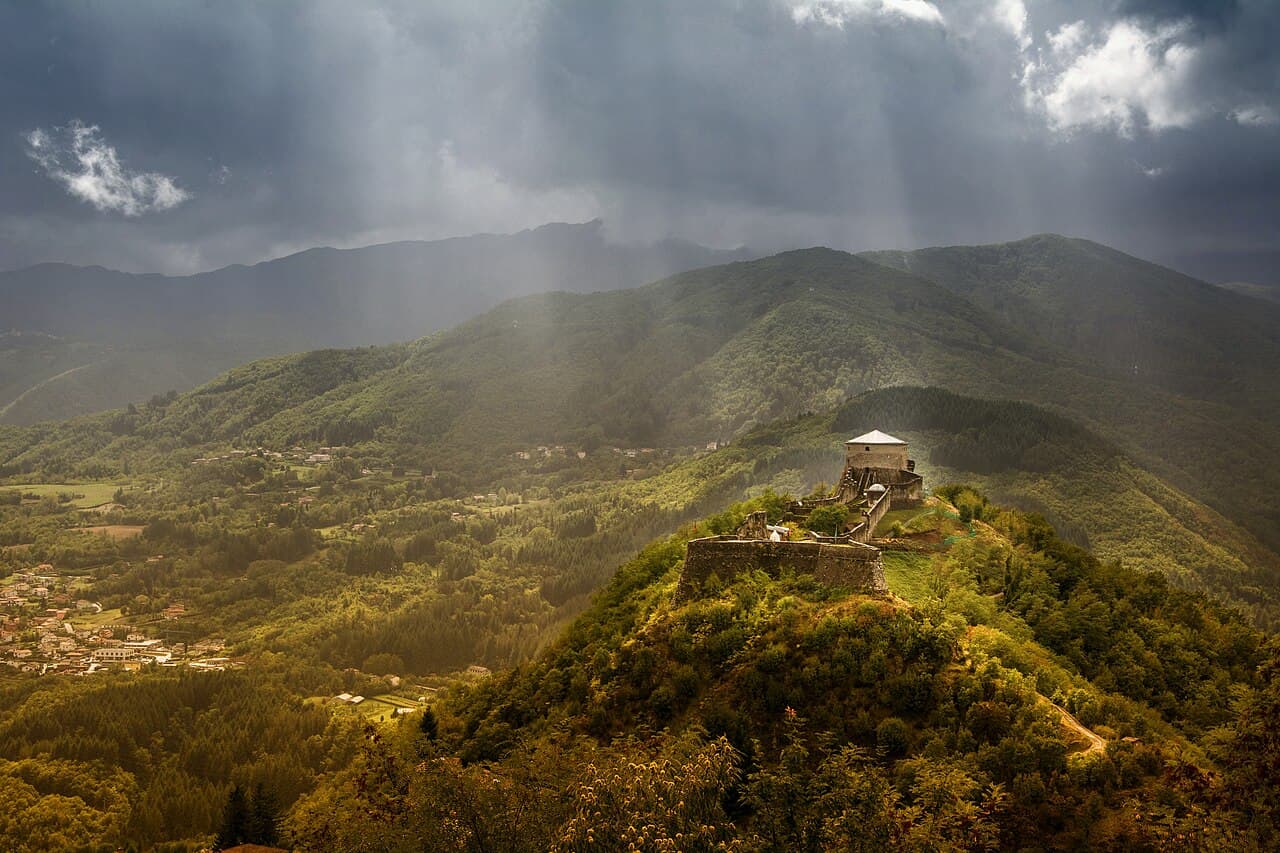
Verrucole Castle
Verrucole Castle is a remarkable example of a Renaissance military fortress perched on a basaltic hill in the municipality of San Romano in Garfagnana, Italy. Its history spans over a millennium, beginning with the fortified settlement established by the Gherardinghi family in the late 10th century. The castle's name derives from the local term “verruca,” meaning a high, rugged hill, reflecting the imposing natural terrain upon which it was constructed. This strategic location provided a commanding view over the surrounding valley and was a key factor in its military significance throughout the Middle Ages and Renaissance.
The castle's origins trace back to around the year 991, when the Gherardinghi counts built the initial defensive core. In the 12th century, the castle became a focal point in regional conflicts, notably during the alliance of the Gherardinghi with other noble families and the maritime republic of Pisa against the Republic of Lucca. The ensuing siege by Lucca led to the castle's capture, although imperial intervention by Emperor Frederick I Barbarossa in 1185 reaffirmed the Gherardinghi's possession. However, by the end of the 13th century, the castle passed under Lucca's control and was administered by the Guidiccioni family.
Historical developments under notable families
Ghibelline and Este influence
In the 14th century, the fortress was held by the Ghibelline marquis and mercenary leader Spinetta Malaspina from 1328 to 1345. Later, the Este family of Ferrara acquired the castle in 1446, marking a significant phase of restoration and military enhancement. The Este dukes, particularly Marquis Leonello d'Este around 1450 and Alfonso II d'Este circa 1564, undertook major renovations that transformed Verrucole into a formidable Renaissance fortress. These works included the addition of two bastions, reflecting advances in fortification techniques designed to counter artillery and gunpowder weapons.
Military and cultural significance
For over four centuries, Verrucole served as a military stronghold under the Este dukes of Modena and Reggio. Its strategic position allowed control over the Garfagnana valley, a vital corridor in northern Tuscany. Between 1522 and 1525, the renowned poet and court official Ludovico Ariosto governed the area, overseeing military presidia including Verrucole Castle. The fortress also witnessed episodes such as the imprisonment of Captain Francesco Accorsini by the Inquisition in the 17th century, illustrating its continued role in regional power dynamics.
Architectural features and layout
Fortress structure and defensive elements
The castle's layout is dominated by two main strongholds positioned at opposite ends of the hill: the Rocca Tonda (round tower) and the Rocca Quadra (square tower). The Rocca Tonda is a polygonal tower notable for its surviving Ghibelline merlons, the distinctive swallowtail-shaped crenellations emblematic of medieval fortifications associated with the Ghibelline faction. Excavations have revealed a cylindrical tower integrated within this bastion, underscoring the complexity of its defensive design.
The Rocca Quadra, located near the northeast bastion, includes remnants of a semicircular tower and a small building facing north. Historically, each stronghold was managed by a pair of castellans, each commanding guard corps responsible for patrolling and defending their respective sectors. The main entrance, known as Porta Piana, retains key defensive features such as a guardhouse and machicolations – openings in the battlements used to repel attackers with projectiles or boiling substances.
Defensive walls and artillery adaptations
Visitors can observe extensive crenellated curtain walls, casemates (vaulted chambers for shelter or artillery), and cannon embrasures designed for early gunpowder weaponry. The two prominent 16th-century bastions face the Pania di Corfino massif, enhancing the fortress's defensive perimeter. Near the entrance to one casemate lie the remains of a powder magazine and guard quarters, structures that have been carefully restored and now serve as museum spaces illustrating the castle's military functions.
Additional features and restoration efforts
Chapel, sally port, and commander’s garden
Ascending toward the Rocca Tonda, a small chapel once served the spiritual needs of the military personnel stationed at the fortress. Adjacent to this tower is a narrow sally port, a hidden emergency exit incorporated into the walls next to a stone staircase, reflecting sophisticated siege defense strategies.
North of the sally port lay the commander's garden, historically containing service buildings and a cistern vital for collecting rainwater, ensuring water supply during prolonged sieges. A gunpowder tower once stood west of the garden but was destroyed by lightning in 1683, a reminder of the hazards faced by such fortifications.
Modern restoration and public access
Between 1994 and 2000, extensive restoration stabilized the fortress's stonework, cleared overgrowth, and uncovered significant archaeological remains. Excavations around the Rocca Tonda recovered the chapel and reinforced walls to preserve the integrity of the structure. The powder magazine and guardhouse were adapted to serve as interpretative centers, enabling visitors to understand the castle's military heritage through thoughtfully curated exhibits.
These restoration efforts culminated in the fortress's public opening in 2012, followed by improvements to access infrastructure in 2019, commemorating the 530th anniversary of construction activities under Ercole I d’Este. Today, Verrucole Castle stands as a well-preserved testament to the evolution of military architecture from medieval origins through Renaissance innovation, offering visitors a vivid glimpse into the region's complex history and strategic importance.
Archaeological significance and historical layers
Archaeological studies have revealed that beneath the Renaissance fortress lie traces of earlier settlements, including a Bronze Age village and medieval habitation layers. This deep historical context enriches the understanding of Verrucole as a site continuously occupied and adapted over centuries. The castle's stone construction, typical of local materials, exemplifies the practical and aesthetic considerations of fortification design in the Garfagnana region.
Overall, Verrucole Castle offers a comprehensive narrative of military, political, and cultural developments in northern Tuscany. Its architectural features, historical associations with prominent families and figures, and ongoing preservation efforts make it a significant heritage site for scholars and visitors alike.
Frequently asked questions (FAQ)
- What is the historical significance of Verrucole Castle?
- Verrucole Castle, dating back to the 11th century, played a crucial role in the defense of the Garfagnana region. It served as a strategic military outpost and has witnessed many historical events, including battles and territorial disputes.
- When was Verrucole Castle built?
- The construction of Verrucole Castle began in the early 11th century, making it one of the oldest fortifications in the area. Over the centuries, it has undergone various renovations and expansions, reflecting the architectural styles of different periods.
- How do I get to Verrucole Castle?
- Verrucole Castle is located near San Romano in Garfagnana, Italy. It is accessible by car, and visitors can find parking nearby. There are also walking trails that lead up to the castle, offering beautiful views of the surrounding landscape.
- What are the opening hours for Verrucole Castle?
- Verrucole Castle is typically open to visitors from April to October, with varying hours depending on the day of the week. It is advisable to check the official website or contact local tourist information for the most accurate and updated opening times.
- Can I visit Verrucole Castle year-round?
- While the castle is open to visitors mainly during the spring and summer months, it may have limited access during the winter. However, the surrounding area is beautiful year-round, and some outdoor activities can still be enjoyed in the vicinity.
- Is it possible to take guided tours of the castle?
- Yes, guided tours of Verrucole Castle are available and highly recommended. These tours provide insights into the castle's history, architecture, and significance, enhancing your visit and understanding of the site.
- What is the ticket price for visiting Verrucole Castle?
- The ticket prices for Verrucole Castle are generally modest, with discounts available for children and students. It's best to check the official website for the latest pricing and any special promotions.
- When is the best time to visit Verrucole Castle?
- The best time to visit Verrucole Castle is during the spring and early autumn when the weather is pleasant and the surrounding nature is in full bloom. These seasons also tend to have fewer tourists, allowing for a more peaceful experience.
- Are there any nearby attractions to visit alongside Verrucole Castle?
- Yes, nearby attractions include the picturesque village of San Romano, the natural beauty of the Garfagnana valley, and other historical sites such as the Rocca di Lucchio. Exploring these areas can enrich your visit to Verrucole Castle.
Photo gallery

Information
Website
Visit websiteSources & official resources
Verify the information above using these authoritative references.
Loading map...
Visitor reviews
No reviews yet. Been here? Write the first review and help other travelers!
Write the first reviewVisited this castle? Share your experience
Your review helps other travelers and adds first-hand knowledge to our encyclopedia.


