Fort York
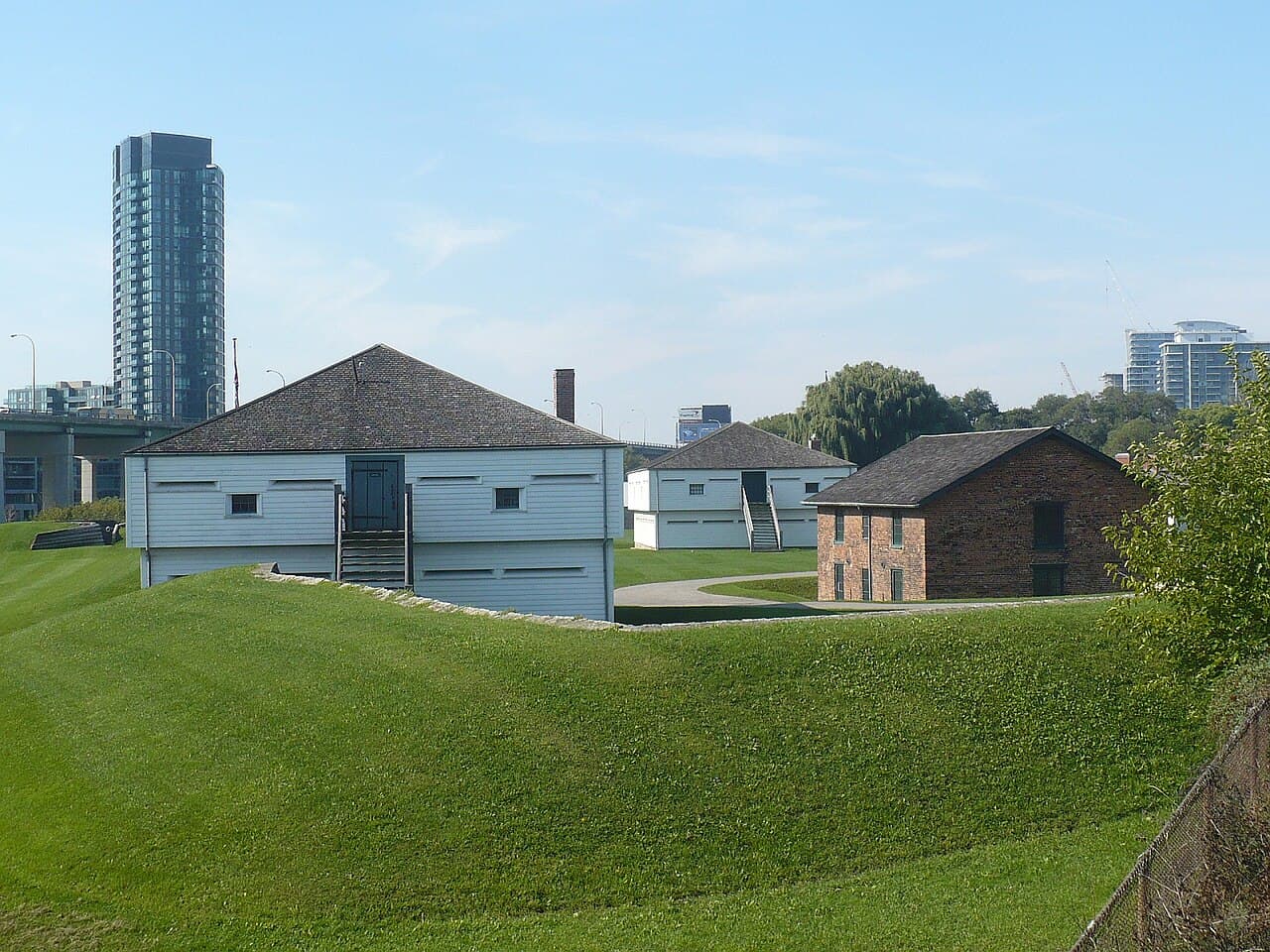
Fort York stands as a significant bastioned fortress located in the Fort York neighbourhood of Toronto, Ontario, Canada. Constructed in the 18th century, it played a crucial role in defending the entrance to Toronto Harbour during the early 19th century. The fort is characterized by its stone-lined earthwork walls and encompasses eight historic buildings, including two prominent blockhouses. Today, Fort York forms the core of the Fort York National Historic Site, a 16.6-hectare (41-acre) area that also includes the Garrison Common, military cemeteries, and a modern visitor centre.
Early history and strategic importance
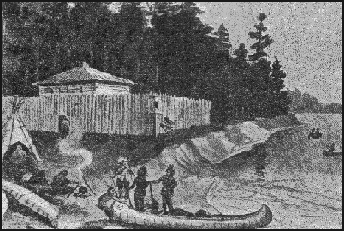
The origins of Fort York trace back to 1793 when John Graves Simcoe, the first Lieutenant Governor of Upper Canada, established a garrison to protect the growing settlement that would become Toronto. Rising anglo-american tensions in the late 18th century led to the fort being expanded and officially designated as a British Army post in 1798. This fortification was essential for controlling access to the vital harbour and guarding against potential American incursions during a period of geopolitical uncertainty.
The war of 1812 and the battle of york
During the War of 1812, Fort York was a focal point of military conflict. In April 1813, American forces launched an attack that resulted in the destruction of the original fort during the Battle of York. The battle was a significant event, involving naval and land forces, and it underscored the vulnerability of the settlement. Following this, reconstruction efforts began later in 1813, rebuilding the fort over the remains of the original structure. The reconstruction was completed by 1815, resulting in a stronger and more defensible fortification.
After its rebuilding, Fort York served as a military hospital for the remainder of the war, providing care for wounded soldiers. Despite this, the fort briefly engaged in combat again in August 1814 during an encounter with an American naval vessel, demonstrating its continued strategic importance.
Post-war use and military significance
Following the War of 1812, Fort York remained an active military site. Although a new fortification, known as New Fort York, was constructed to the west in the 1840s, the original fort continued to be used by both the British Army and the Canadian militia. In 1870, ownership of the property was formally transferred to the Canadian militia, marking a transition in military stewardship.
Despite the municipal government assuming ownership in 1909, the fort was sporadically used by the Canadian military up until the end of the Second World War. This prolonged military presence highlights the fort's enduring role in Canada's defence infrastructure over more than a century.
Preservation and public heritage site
Fort York was designated a National Historic Site of Canada in 1923, recognizing its historical and cultural significance. In 1934, the fort underwent restoration to return it to its early 19th-century configuration, emphasizing its appearance and function during the War of 1812 era. Since then, it has operated as a museum dedicated to the war and to illustrating military life in 19th-century Canada.
The site offers visitors a comprehensive experience with access to the preserved earthwork walls, original blockhouses, and other historic buildings. The visitor centre provides educational exhibits and programming, making Fort York a key destination for those interested in Canadian military history and colonial-era fortifications.
Architectural features and layout
Fort York's design reflects the bastioned fortress style typical of the post-Renaissance military architecture, incorporating angled bastions for defensive coverage and earthwork walls reinforced with stone. The fort's layout includes multiple buildings serving various military functions, such as barracks, officers' quarters, and storage facilities. The two blockhouses are notable for their robust timber construction and strategic placement, providing elevated firing positions and observation points.
The fort's fortifications were designed to withstand artillery fire and provide overlapping fields of fire to repel attackers, demonstrating advanced military engineering for the period. The surrounding Garrison Common historically served as a parade ground and training area for troops stationed at the fort.
Cultural impact and modern role
Beyond its military significance, Fort York holds cultural importance as a symbol of early Canadian resilience and colonial history. The site hosts numerous public events, reenactments, and educational programs that engage the community and visitors alike. It also serves as a reminder of the complex history between British, Canadian, and American forces in the early 19th century.
Today, Fort York is managed as a heritage site that balances preservation with public accessibility, offering insights into military architecture, historical conflicts, and the evolution of Toronto from a frontier settlement to a major urban centre.
Frequently asked questions (FAQ)
- How do I get to Fort York?
- Fort York is easily accessible by public transit, with several bus and streetcar routes that stop nearby. If you are driving, there is parking available at the site, but be sure to check for any fees or restrictions.
- What is the historical significance of Fort York?
- Fort York was established in 1793 and played a crucial role in the defense of Toronto during the War of 1812. It is one of the oldest military sites in Canada and offers insight into the military history and early settlement of the region.
- When was Fort York built?
- Construction of Fort York began in 1793, with the fortifications evolving over the years to accommodate changing military needs. The site has been preserved and restored to reflect its historical significance and architectural features.
- Can I take a guided tour of Fort York?
- Yes, guided tours of Fort York are available and are highly recommended for a deeper understanding of its history and architecture. Tours typically cover key structures, artifacts, and the fort's role in Canadian history.
- Why is Fort York considered an important architectural site?
- Fort York features a variety of historical buildings and structures, many of which are original to the site or have been meticulously restored. The architectural design reflects the military styles of the late 18th and early 19th centuries, showcasing the evolution of military architecture in Canada.
- Is it possible to visit Fort York year-round?
- Fort York is open year-round, although hours of operation may vary seasonally. It is advisable to check the official website for the latest information on opening hours and any special events that may be occurring during your visit.
- What are the ticket prices for Fort York?
- Admission prices for Fort York are generally reasonable, with discounts available for seniors, students, and children. Check the official website for the most current pricing and any special offers or family packages that might be available.
- When is the best time to visit Fort York?
- The best time to visit Fort York is during the warmer months from May to September when the weather is pleasant, and many outdoor activities and events take place. However, visiting during the shoulder seasons of spring and fall can also provide a quieter experience with fewer crowds.
- What nearby attractions can I visit after Fort York?
- After visiting Fort York, you can explore the beautiful waterfront area, including the Toronto Islands, or visit the nearby Art Gallery of Ontario and the Royal Ontario Museum. The vibrant Distillery District is also a short distance away, offering unique shops and restaurants.
Photo gallery

Information
Loading map...
Visitor reviews
No reviews yet. Been here? Write the first review and help other travelers!
Write the first reviewVisited this castle? Share your experience
Your review helps other travelers and adds first-hand knowledge to our encyclopedia.