Fort Rouillé
Fort Rouillé was a French bastioned fortress and trading post established in 1751 in what is now Toronto, Ontario, Canada. It was built to expand French influence and trade networks with the indigenous peoples of the region during the post-Renaissance period. The fort was named after Antoine Louis Rouillé, the Secretary of State for the Navy under King Louis XV, reflecting its strategic importance to French colonial ambitions in North America.
Historical context and construction
The establishment of Fort Rouillé followed the success of a smaller trading post called Fort Toronto, constructed in 1750 by the French to facilitate fur trade and solidify alliances with local indigenous groups. Recognizing the need for a more fortified presence to protect French interests against British expansion and indigenous alliances, the French authorities commissioned the construction of Fort Rouillé on the shores of Lake Ontario.
The fort was designed as a bastioned fortress, a style common in European military architecture of the 17th and 18th centuries. This design incorporated angled bastions at the corners of the fort's walls, allowing defenders to cover all approaches with overlapping fields of fire. The fort's layout included defensive walls, bastions, a central courtyard, storage facilities for trade goods, barracks for soldiers, and a trading house.
Architectural features and layout
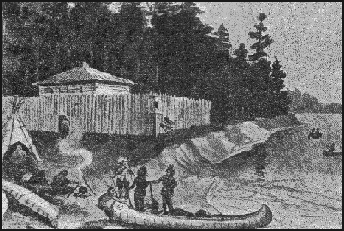
Fort Rouillé's bastioned design was adapted to the site's geography near the lake, providing strategic control over the waterfront and trade routes. The fort's walls were constructed from timber and earthworks, materials readily available in the region, reinforced to withstand attacks and the harsh Canadian climate.
The bastions projected outward from the main walls, enabling defenders to fire along the walls and prevent attackers from approaching unseen. Inside the fort, the courtyard served as a hub for trading activities and military operations. The fort included storage buildings for furs and trade goods, soldiers' quarters, and facilities for the French garrison stationed there.
Role during the French and Indian War
Fort Rouillé played a significant role during the French and Indian War (1754–1763), part of the larger Seven Years' War between France and Britain. The fort served as a strategic trading post and military outpost, helping the French maintain alliances with indigenous nations and control over the western approaches to the Great Lakes.
However, following the French defeat at Fort Niagara in July 1759, the French garrison at Fort Rouillé evacuated and deliberately destroyed the fort to prevent its capture by advancing British forces. This scorched earth tactic was common in the conflict to deny resources to the enemy.
Legacy and archaeological significance
After the war, the remains of Fort Rouillé were dismantled, and the site underwent significant changes during the 19th and 20th centuries as Toronto developed. Today, the original fort no longer stands, but its location is preserved within Exhibition Place, a public park and event venue.
An obelisk monument marks the site, and the outline of the fort is delineated in concrete on the ground, providing visitors with a tangible connection to this important chapter of Canadian and French colonial history. Archaeological investigations have helped uncover details about the fort's layout and construction, contributing to the understanding of French military architecture and colonial trade practices in North America.
Visiting Fort Rouillé today
Visitors to the site can explore the monument and interpretive displays that explain the fort's historical significance. The location within Exhibition Place makes it accessible for those interested in early Canadian history, French colonial endeavors, and military architecture.
While no original structures remain, the site offers educational opportunities about the French presence in the Great Lakes region and the complex interactions between European powers and indigenous peoples during the 18th century.
Frequently asked questions (FAQ)
- When was Fort Rouillé built and by whom?
- Fort Rouillé was built in 1751 by the French as a bastioned fortress and trading post to strengthen their presence in the Toronto area.
- What was the purpose of Fort Rouillé?
- The fort served as a trading post with local indigenous peoples and as a military outpost during the French and Indian War.
- Why was Fort Rouillé destroyed?
- The French garrison evacuated and burned Fort Rouillé in 1759 after their defeat at Fort Niagara to prevent the British from capturing it.
- Can visitors see any remains of Fort Rouillé today?
- No original structures remain, but the site is marked by an obelisk monument and a concrete outline within Exhibition Place in Toronto.
- What architectural style characterizes Fort Rouillé?
- Fort Rouillé was designed as a bastioned fortress, featuring angled bastions for defense, typical of 18th-century European military architecture.
Photo gallery

Photo by Unknown authorUnknown author•Public domain
Information
Current owner
Municipality
Loading map...
Visitor reviews
No reviews yet. Been here? Write the first review and help other travelers!
Write the first reviewVisited this castle? Share your experience
Your review helps other travelers and adds first-hand knowledge to our encyclopedia.