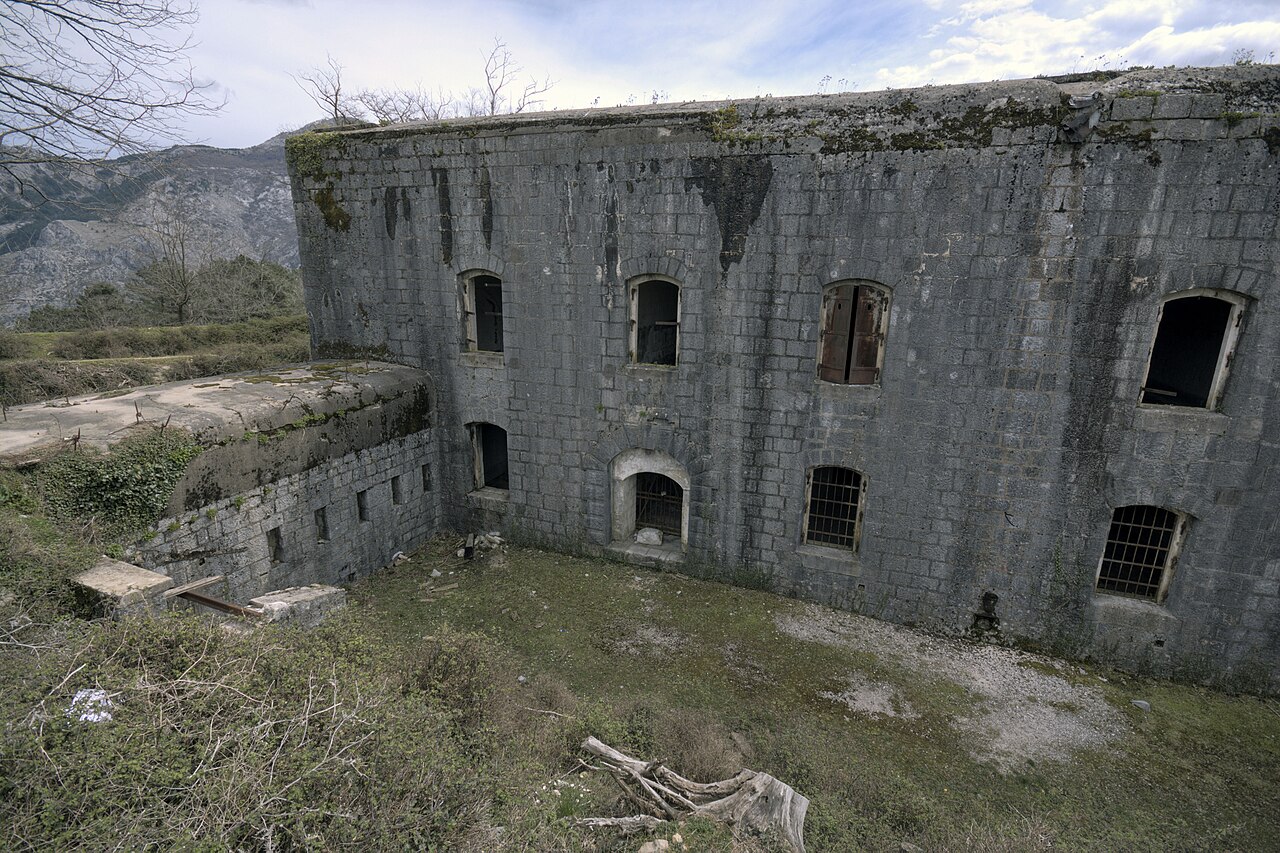
Fort Traste
Fort Trašte is a significant example of early 20th-century military architecture constructed by the Austro-Hungarian Empire near Tivat, Montenegro. Erected between 1907 and 1909, this modern coastal fortress was strategically positioned on a hill overlooking the Bay of Trašte to the southwest and the expansive Tivatsko polje plain to the northeast. Its primary purpose was to defend the bay and surrounding coastline against potential amphibious assaults, reflecting the military concerns of the Austro-Hungarian naval command during this period.
Strategic location and design
The fort's location on elevated terrain provided commanding views over the bay and adjacent lands, enabling early detection of enemy ships or landing parties. This vantage point was crucial for controlling access to the bay, an important maritime route in the Adriatic Sea. The design incorporates elements typical of early 20th-century coastal fortifications, including thick reinforced concrete walls and rotating gun cupolas that allowed for 360-degree coverage and rapid targeting of hostile vessels.
Architectural features
Fort Trašte's architecture is characterized by its robust concrete construction, a departure from traditional stone masonry, reflecting advances in military engineering and the increasing use of reinforced concrete for defensive structures. The rotating gun turrets housed heavy artillery pieces, protected by armored steel cupolas that could rotate to cover multiple firing angles. These turrets were designed to withstand bombardment while providing effective offensive capabilities.
The fort also included underground passages and ammunition storage areas designed to protect munitions and personnel from enemy fire and aerial attacks. Its layout was compact yet functional, optimized for rapid deployment of artillery and efficient defense coordination.
Historical context and military role
Constructed during a period of intense naval competition in the Adriatic region, Fort Trašte was part of a network of Austro-Hungarian fortifications aimed at securing key coastal points. The empire sought to protect its maritime interests and maintain control over strategic ports and bays against rival powers.
During World War I, the fort came under bombardment but remarkably sustained only minor damage, demonstrating the effectiveness of its design and construction. However, the dissolution of the Austro-Hungarian Empire in 1918 led to the fort's abandonment, as the new political landscape rendered many such military installations obsolete.
Current condition and preservation
Today, Fort Trašte remains largely derelict but is in fairly good condition externally. The rotating gun cupolas still survive, offering a tangible link to the fort's military past. Despite its abandonment, the structure's durable construction has allowed it to withstand over a century of exposure to the elements.
The site is accessible to visitors interested in military history and Austro-Hungarian fortifications, though it lacks extensive modern restoration or visitor facilities. Its rugged state provides an authentic glimpse into early 20th-century coastal defense architecture.
Significance and legacy
Fort Trašte serves as a prominent reminder of the Austro-Hungarian Empire's strategic military efforts in the Adriatic Sea region. Its construction reflects the technological advancements in fortress design during the modern period, particularly the transition to reinforced concrete and mechanized artillery defenses.
The fort's preservation offers valuable insights into the military history of Montenegro and the broader geopolitical dynamics of the early 1900s. It remains an important cultural and historical landmark for the town of Tivat and the surrounding Bay of Kotor area.
Frequently asked questions (FAQ)
- What is the historical significance of Fort Traste?
- Fort Traste, built in the 19th century, served as a crucial defensive structure during the Austro-Hungarian Empire's rule over the region. Its strategic location offered protection against naval threats and played a vital role in the maritime history of Tivat. Today, it stands as a testament to Montenegro's rich military heritage.
- When is the best time to visit Fort Traste?
- The best time to visit Fort Traste is during the spring and early fall months, from April to June and September to October. During these periods, the weather is pleasantly warm, making it ideal for exploring the castle and its surroundings. Additionally, these months tend to be less crowded than the peak summer season.
- Can I access Fort Traste with a wheelchair?
- Fort Traste has some accessibility features, but due to its historical architecture, navigating the site may be challenging for wheelchair users. Visitors are encouraged to contact the castle management beforehand to inquire about specific accessible routes and accommodations available on-site.
- What are the opening hours of Fort Traste?
- Fort Traste is typically open to visitors from 9 AM to 6 PM, with extended hours during the summer season. It is advisable to check the official website or contact the castle directly for any changes to the schedule, especially during holidays or special events. Planning your visit within these hours will ensure you have ample time to explore the site.
- Is it possible to take guided tours of Fort Traste?
- Yes, guided tours of Fort Traste are available, offering visitors a deeper understanding of its history and architecture. These tours are typically conducted in multiple languages and can provide insights that enhance your experience. It's recommended to book a tour in advance, especially during peak tourist seasons.
- What are the ticket prices for visiting Fort Traste?
- The ticket prices for Fort Traste are quite affordable, with general admission costing around 5 euros. Discounts are often available for students and seniors, so be sure to inquire about any special pricing at the entrance. Purchasing tickets in advance online may also offer additional savings.
- Are there any nearby attractions to Fort Traste?
- Yes, Fort Traste is located near several attractions, including the beautiful beaches of Tivat and the stunning Porto Montenegro marina. Visitors can also explore the nearby historic town of Kotor, a UNESCO World Heritage site, which is just a short drive away. This makes Fort Traste an excellent starting point for a day of exploration in the area.
- How do I get to Fort Traste from Tivat city center?
- Getting to Fort Traste from Tivat city center is quite easy, as it is located just a short distance away. You can reach the fort by walking, which takes about 15-20 minutes, or by taking a local bus or taxi for convenience. The walk offers scenic views of the coastline, making it a pleasant journey.
Information
Loading map...
Visitor reviews
No reviews yet. Been here? Write the first review and help other travelers!
Write the first reviewVisited this castle? Share your experience
Your review helps other travelers and adds first-hand knowledge to our encyclopedia.