Fort Vrmac
Fort Vrmac is a significant bastioned fortress constructed by the Austro-Hungarian Empire during the late 19th century. It occupies a strategic position on the southern end of the Vrmac ridge near Tivat, overlooking the Bay of Kotor in Montenegro. The fort's location was chosen to control access routes and provide defensive coverage against potential threats in the region, reflecting the military priorities of the Austro-Hungarian Empire during a period of heightened tensions in the Balkans.
The origins of Fort Vrmac date back to 1860 when the first fortifications were established on the site. However, the current structure was built between 1894 and 1897 as part of a broader modernization effort to strengthen coastal defenses. This period saw the adoption of new military engineering techniques and materials, including the extensive use of reinforced concrete alongside traditional stone masonry, to withstand the increasing power of artillery.
Architectural design and fortifications
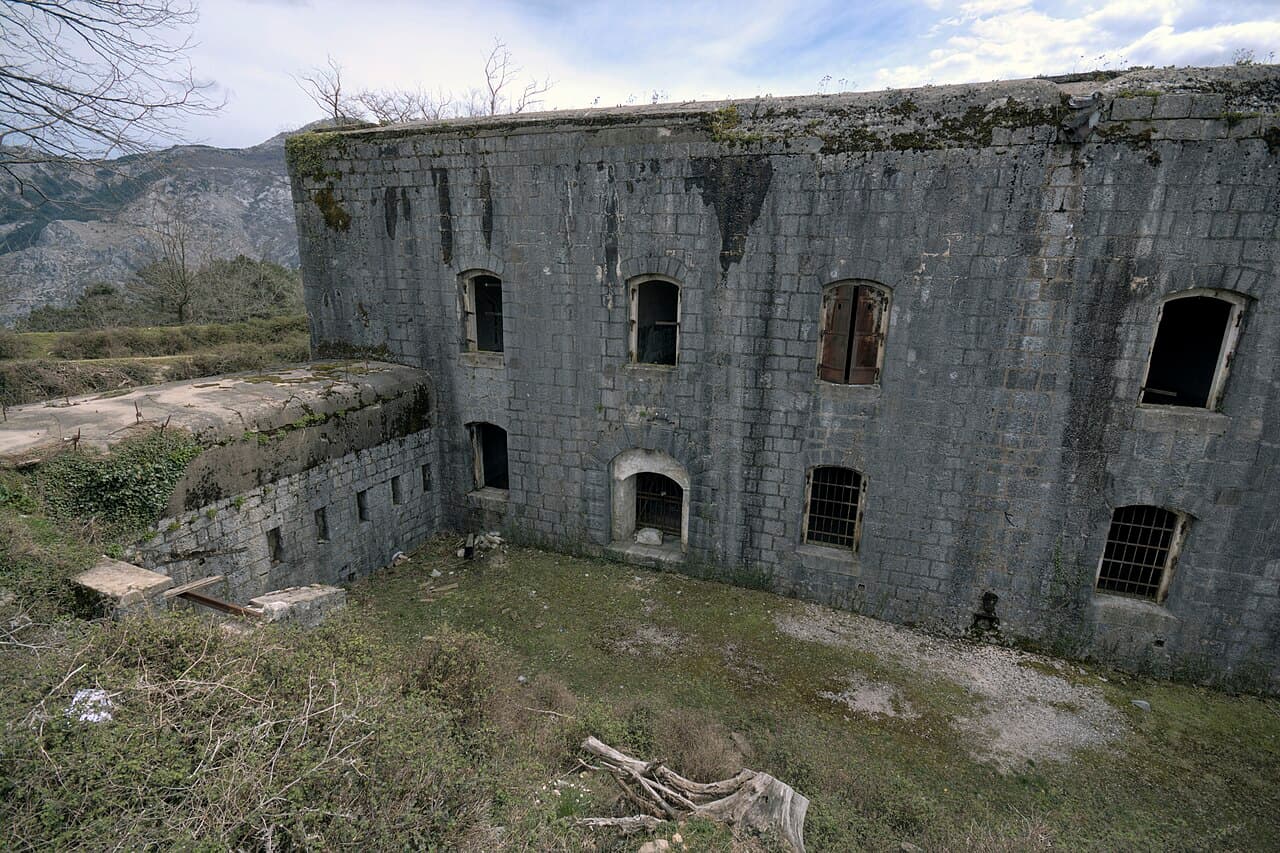
The fort is designed in the style characteristic of the so-called "Vogl period" fortresses found in South Tyrol, featuring an irregular pentagonal shape constructed on two levels. Its layout is optimized for defense, incorporating a ditch surrounding the main structure and protected by three caponiers—defensive structures projecting into the ditch to cover it with gunfire and prevent enemy approach.
The fort's walls are a combination of heavily reinforced stone and concrete, reflecting late 19th-century advances in military architecture. The roof consists of a 1.5-meter thick concrete slab installed between 1906 and 1907, a response to improvements in Montenegrin artillery that necessitated enhanced protection against bombardment.
The main entrance is located on the north side, accessed from the ditch and guarded by a caponier, ensuring a strong defensive choke point. The fort's barracks are situated on the ground and first floors on the north side, providing accommodation for the garrison. The other sides of the fort house armoured casemates which contained the main artillery pieces. These casemates were designed to protect the guns while allowing them to fire on approaching enemies.
Armament and defensive features
The fort was equipped with a variety of artillery, including main guns housed in armoured casemates and howitzers placed in steel cupolas manufactured by the renowned Škoda Works in Pilsen. These cupolas served both as observation posts and protected firing positions, enhancing the fort's ability to monitor and engage enemy forces at a distance.
Ammunition was stored in a separate magazine building located a short distance to the north of the main fort, reducing the risk of catastrophic explosions within the main defensive structure.
Historical significance and military use
Fort Vrmac played an active role during the First World War. It came under heavy bombardment from Montenegrin forces, who recognized its strategic importance in controlling the Bay of Kotor and surrounding areas. Despite the damage inflicted, the fort was repaired and disarmed before the war's end, reflecting the shifting military situation and the eventual dissolution of the Austro-Hungarian Empire.
Following the war, the fort was occupied for a period by Yugoslav troops before being abandoned. Its abandonment marked the end of its military use, but its robust construction has allowed it to survive in a relatively well-preserved state compared to other fortifications in the region.
Preservation and current status
Today, Fort Vrmac is recognized as one of the best-preserved Austro-Hungarian fortifications in the Bay of Kotor area. Its state of preservation offers valuable insights into late 19th and early 20th-century military architecture and Austro-Hungarian defensive strategies.
The fort's stone and concrete structure, caponiers, and armoured casemates remain largely intact, allowing visitors to appreciate the complexity and strength of its design. The site attracts historians, military enthusiasts, and tourists interested in the region's military heritage and architectural history.
Architectural details and influences
The design of Fort Vrmac reflects the influence of Austro-Hungarian military engineers who adapted fortification principles to the specific terrain and threats of the Adriatic coast. The use of reinforced concrete was innovative for its time and demonstrated a transition from traditional masonry fortifications to modern, resilient structures capable of withstanding artillery bombardment.
The irregular pentagonal layout allowed for overlapping fields of fire, minimizing blind spots and maximizing defensive coverage. The positioning of the barracks and casemates also reflects careful planning to ensure the fort could sustain a prolonged defense while maintaining operational efficiency.
Visiting Fort Vrmac
The fort is accessible to visitors interested in exploring military history and architecture. Its location near Tivat makes it a convenient destination for those touring the Bay of Kotor region. While the fort is not fully restored as a museum, its preserved state offers a tangible connection to the Austro-Hungarian era and the complex history of Montenegro's coastal defenses.
Visitors can explore the exterior fortifications, including the ditch and caponiers, and view the robust construction of the walls and roof. The surrounding landscape provides panoramic views of the bay and the nearby town of Kotor, enhancing the site's appeal.
Frequently asked questions (FAQ)
- How do I get to Fort Vrmac?
- Fort Vrmac is located near Tivat, Montenegro, and can be accessed by car or on foot. If you're driving, the fort is situated along the scenic road that connects Tivat and Kotor, offering stunning views of the Bay of Kotor. Public transportation options are also available from Tivat to nearby areas.
- What is the historical significance of Fort Vrmac?
- Fort Vrmac was constructed in the 19th century by the Austro-Hungarian Empire as part of a coastal defense system. It played a crucial role during various military conflicts in the region, reflecting the strategic importance of the Bay of Kotor. Today, it stands as a testament to the architectural and military history of Montenegro.
- When was Fort Vrmac built?
- Construction of Fort Vrmac began in 1860 and was completed in 1864. It was designed to protect the bay from naval attacks and served as a military outpost. The fort's architectural style is representative of the military engineering techniques used during that era.
- Can I visit Fort Vrmac year-round?
- Yes, Fort Vrmac is open to visitors year-round, although the best time to visit is during the spring and early autumn when the weather is mild. However, it's advisable to check local weather conditions and any seasonal restrictions before planning your visit. Guided tours may be available during peak tourist season.
- Why is Fort Vrmac popular among tourists?
- Fort Vrmac is popular for its breathtaking views of the Bay of Kotor and the surrounding mountains. Its historical significance and unique architecture attract history enthusiasts and photographers alike. Additionally, the fort offers a peaceful escape from the busier tourist areas, making it a favorite spot for those seeking tranquility.
- Is it possible to explore the interiors of Fort Vrmac?
- Yes, visitors can explore the interiors of Fort Vrmac, including its tunnels and various structures. There are no guided tours regularly available, so guests are encouraged to wander and take in the historical atmosphere at their own pace. However, it's important to exercise caution as some areas may be less maintained.
- What are the opening hours for Fort Vrmac?
- Fort Vrmac does not have fixed opening hours, as it is generally accessible at all times. However, it is recommended to visit during daylight hours for safety and to fully appreciate the views. Always check local resources for any updates regarding access or maintenance work.
- Are there any nearby attractions to visit after Fort Vrmac?
- Yes, after visiting Fort Vrmac, you can explore the charming town of Tivat, which offers beautiful waterfront promenades, shops, and restaurants. The nearby town of Kotor, a UNESCO World Heritage site, is also worth a visit for its stunning old town and historical sites. Additionally, consider visiting the luxurious Porto Montenegro marina for a taste of modern elegance.
- What are the ticket prices for visiting Fort Vrmac?
- Visiting Fort Vrmac is typically free of charge, which makes it an attractive option for travelers on a budget. However, donations for maintenance and preservation are often appreciated. Always check for any special events or guided tours that may have associated costs.
Photo gallery

Information
Loading map...
Visitor reviews
No reviews yet. Been here? Write the first review and help other travelers!
Write the first reviewVisited this castle? Share your experience
Your review helps other travelers and adds first-hand knowledge to our encyclopedia.